By Brian · September 16, 2026
Outdoor Christmas Decorating Ideas That Read From the Street
How to compose the outside of your house for Christmas as one picture instead of a pile of parts: the three layers that matter, the one color decision that makes or breaks it, ideas sorted by what your house actually gives you to work with, and the daytime layer almost everyone skips.
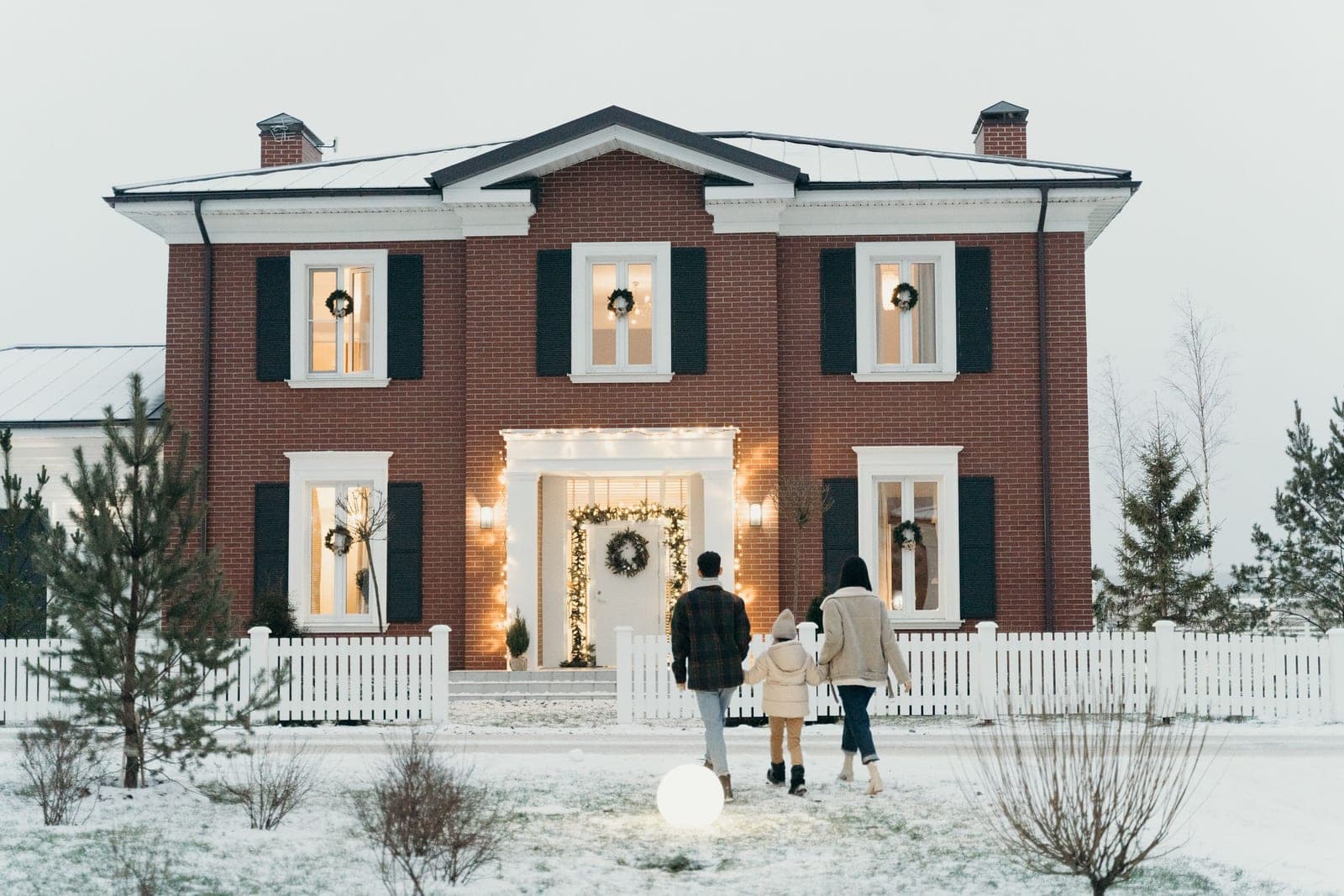
Drive any American neighborhood in December and the houses sort themselves into three groups almost instantly. A few are genuinely beautiful. Most are fine. And a surprising number have clearly spent a lot of money and a lot of Saturday to end up looking cluttered.
The difference is almost never budget. It is that the beautiful houses were composed as a single picture and the cluttered ones were assembled one purchase at a time.
The outside of your house has a frame, and the frame is the curb. Everything you do out there is going to be seen from about sixty feet away, at an angle, usually from a moving car, and usually in the dark. That is a completely different design problem from a mantel, and it rewards completely different instincts.
Rule zero: go stand in the street
Before you buy anything, before you open a bin, walk to the end of your driveway at night and turn around.
That view is the entire brief. From there you will notice things you never see from inside: which windows actually face the street, that the porch is in shadow, that the neighbor's floodlight washes out your left side, that a mature maple blocks half the roofline, that the house sits so far back that anything smaller than a doorway disappears.
Take a photo from that spot. It is the before image, it is the composition you are working on, and if you want to try schemes against it without buying anything, drop it into our Christmas decor visualizer and see the options on your own house.
The three layers, in order
Every good exterior scheme is built in three horizontal bands. Do them in order, and finish one before you start the next.
Layer one: the architecture line. This is the roofline, the eaves, the porch columns, the window frames, and the door surround. It is the skeleton, it is what tells a passerby the shape of your house in the dark, and it is where the first dollar should go. A single clean run of lights along the primary roofline does more for a house than everything else on this list combined.
Layer two: the middle ground. Shrubs, small trees, urns, planters, railings, and whatever focal point sits on the lawn. This is where depth comes from. A house with only layer one looks like a drawing of a house. Add two or three lit shrubs and it becomes three-dimensional.
Layer three: the ground plane. The walkway, the steps, the driveway edge. This is the smallest layer and the one that makes a scheme feel finished, because it draws the eye from the street to the door.
The reason the order matters is money. Most people run out of budget or patience partway through, and running out after layer one leaves you with a clean, architectural, genuinely handsome house. Running out after buying a scatter of lawn pieces leaves you with a yard sale.
The one decision that makes or breaks it
Pick a color temperature and commit to it across every layer.
Warm white, somewhere around 2700K, is the most forgiving choice and the most flattering on brick, stone, cedar, and anything with a warm undertone. It photographs beautifully and it looks expensive.
Cool white is crisper, suits modern and contemporary architecture, and looks genuinely spectacular against snow and white trim. It looks cold and slightly clinical on warm brick.
Multicolor is not the lesser option. Done wholeheartedly, across the whole house, with matched bulbs, it is joyful and nostalgic and better than a timid warm-white display. What kills multicolor is using it on one layer and white on another.
The actual mistake, and it is everywhere, is mixing two whites. Warm-white LEDs from this year next to warm-white LEDs from four years ago are usually a few hundred kelvin apart, and from the street that difference does not read as variety. It looks like a section you forgot to replace. Buy your strands in one purchase, from one product line, and buy extra. Our LED versus incandescent breakdown covers why the color consistency of cheap LEDs varies so much between production runs, and the best Christmas lights buying guide covers what holds its color across seasons.
Ideas sorted by what your house actually gives you
Generic outdoor decorating lists assume everyone has the same house. Here is the version that starts from what you are working with.
If you have a strong, simple roofline. Light it and stop. Ranches, mid-century homes, and modern builds all live or die on a single clean horizontal line, and adding a second element usually competes with it. Our Christmas light ideas for ranch-style homes goes deeper on making a low, wide house look intentional rather than sparse.
If you have two stories and a lot of vertical wall. Vertical is your asset, so use windows. A lit wreath in every upper window, hung at a consistent height, turns a big blank facade into a composition. This is the single highest-impact move on a colonial, and we broke down the geometry in Christmas light ideas for two-story colonial homes.
If the house sits far back from the street. Scale up ruthlessly. From 100 feet, a 24-inch wreath disappears. Go to 36 or 48 inches, use C9 bulbs rather than mini lights on the roofline, and put your money into the driveway approach rather than the door details nobody can see.
If you have mature trees. Wrap trunks rather than trying to reach the canopy. A trunk wrapped tightly from the ground to the first branch, on the two or three trees closest to the street, produces more visual depth per dollar than anything else outdoors. Loose spiral wraps look sloppy from a distance, so keep the spacing tight and even.
If you have a small front yard or a townhouse. Everything concentrates at the entry. One oversized wreath, a pair of filled urns, a lit garland on the railing, and warm-white lights in the two shrubs nearest the walkway. That is a complete scheme, and it will beat a thin scatter across a bigger property.
If your street is genuinely dark. You have an advantage most people do not. Low light levels mean modest displays land hard. Resist the urge to compensate with brightness and lean into warmth instead: lanterns on the steps, candles in windows, uplights on the facade.
If your street is bright. Streetlights and neighbors flatten everything. Go for silhouette and contrast rather than glow, which means bolder shapes, denser bulbs, and darker greenery.
If you live somewhere warm. Almost none of the winter imagery applies and pretending otherwise is why so many Florida and Arizona houses look off. Outdoor Christmas decorations that work in warm climates covers palms, citrus, heat-rated strands, and what to do instead of pretending it snows.
Not sure what you are working with architecturally? Our house style identifier will tell you, and the answer usually resolves a lot of decorating arguments at once.
The daytime layer everybody forgets
Here is an uncomfortable fact about outdoor Christmas lights. In December, most of the country gets somewhere between nine and ten hours of daylight and the display is only on for a fraction of the dark. For the majority of the hours your neighbors see your house, your lights are gray wire on a gutter.
That is what the daytime layer is for, and it is entirely separate from lighting.
Greenery is the backbone. Real or high-quality faux garland on the porch railing, around the door, and along the portico. Real cedar and fir hold up beautifully in cold weather and cost far less than people assume, especially bought as bulk roping from a garden center. Our garland calculator works out linear footage from your measurements, and the wreaths and garland buying guide covers what survives outside.
Urns and planters do the heavy lifting. A matched pair flanking the front door, filled with fir, magnolia, birch branches, and red twig dogwood, is the most consistently elegant outdoor Christmas move there is. It works on every house style, it reads perfectly in daylight, and it lasts all winter.
Ribbon has to be outdoor ribbon. Velvet turns to a wet rag in the first rain. Weather-resistant wired ribbon holds its shape through a season, and the difference is visible from the street by mid-December.
Oversized shatterproof ornaments hung from bare branches or clustered in a planter are cheap, read from a distance, and do their entire job at noon.
Window wreaths in daylight are structural, not decorative. Small identical wreaths, hung at a consistent height, give a flat facade rhythm. Consistency matters far more than size here.
For the porch specifically, Christmas front porch decorating ideas by house style gets into scale, layering heights, and framing the door instead of burying it.
The practical constraints nobody mentions until it is too late
Measure before you buy. Every year, a spectacular number of people buy a random number of light boxes and discover on a ladder that they are eleven feet short. Measure your roofline, your railings, and your walkway, then use the Christmas light calculator and add about 15 percent for slack and corners. Our guide to how many Christmas lights you actually need covers the per-foot and per-shrub math.
Everything outdoors goes on a GFCI circuit, with outdoor-rated extension cords, and connections kept off the ground and out of standing water. This is the part of the project where cheaping out has a genuinely bad failure mode.
Respect the run limits. LED strands can typically be chained far longer end to end than incandescents, which is a design constraint as much as a cost one. Check the tag rather than guessing.
Put everything on a timer. A cheap outdoor timer or a smart plug means the display is on when people are actually driving by, which is roughly 5pm to 10pm, and off when it is doing nothing but running the meter.
Install in decent weather and light it later. Hanging lights in November when it is 55 degrees and dry is a pleasant hour. Doing it the week before Christmas at 28 degrees is how people fall off roofs. How to hang Christmas lights covers gutters, brick, and rooflines, and when to put up Christmas decorations makes the full case for separating the install date from the switch-on date.
Know when to hand it over. Steep pitches, three stories, and slate or tile roofs are not DIY projects. Our DIY versus professional cost breakdown has honest numbers, and our guide to hiring a Christmas light installer covers how to vet one.
What to skip
More than one focal point. A lit reindeer, an inflatable snowman, and a nativity on the same lawn cancel each other out. Pick one, place it where it relates to the house rather than floating in the middle of the grass, and let it be the thing.
Inflatables on formal architecture. Nothing against them, and they are wonderful on the right house. On a symmetrical brick colonial they read as a costume.
Projection lights aimed anywhere near the street or a neighbor's windows. They are cheap, they are easy, and they are the most complained-about outdoor decoration in America.
Stakes and spotlights pointed straight up at nothing. Uplighting works when it grazes a textured surface like brick, stone, or bark. Aimed at flat siding it just makes a bright blob.
Anything that requires you to be home to turn it on. If it is not on a timer, it will be dark on half the nights that mattered.
Three budgets, three complete schemes
Around $150. Two 36-inch wreaths, one on the door and one centered above the garage. A pair of urns filled with cut greenery from a garden center. Warm-white minis on the two shrubs closest to the walkway. Done, and it will look considered.
Around $400. Everything above, plus a C9 run along the primary roofline, garland on the porch railing, and small matched wreaths in the street-facing windows. This is the sweet spot where a house starts to look professionally decorated.
Around $1,000 and up. Add wrapped tree trunks, a lit walkway, a single well-chosen lawn focal point, and permanent-mount clips so next year takes two hours instead of six. At this tier the smarter money often goes into installation rather than more product. For honest ranges by house size, what it costs to decorate a house for Christmas has the breakdown, and the best time to buy Christmas decorations explains why October is when the good outdoor stock is still on the shelf.
The one-paragraph version
Stand in the street and take a photo. Light the architecture line first and finish it before you touch anything else. Pick one color temperature and buy every strand at once. Build depth with two or three wrapped shrubs or trunks rather than a wide scatter. Give the entry a daytime scheme of greenery, urns, and ribbon so the house works at noon as well as at night. Measure before you buy, put it on a timer, hang it in November while the weather is kind, and turn it on the day after Thanksgiving. If you want to see how other people are solving the same problem, our city-by-city Christmas lights guide maps the best displays in forty American cities, and the good ones all follow these rules whether they know it or not.
And when it is up, Rate My Christmas Lights will score a photo of the finished thing out of 100 against exactly the criteria above, which is a faster way to find the weak layer than staring at it from the sidewalk.
Share this guide
Frequently asked questions
How do I decorate the outside of my house for Christmas?
What color Christmas lights look best on a house?
How many outdoor Christmas lights do I need?
How can I decorate outside for Christmas cheaply?
What do outdoor Christmas decorations look like during the day?
Are outdoor Christmas lights expensive to run?
Keep reading
The Best Outdoor Christmas Decorations to Buy (by Where They Go)
What outdoor Christmas decorations are actually worth buying, organized by where they go in your yard: the front lawn, pathways, trees and shrubs, the roofline, and the porch. Inflatables, lit figures, projectors, and the practical gear that makes it all work.
Christmas Front Porch Decorating Ideas (by House Style)
How to decorate your Christmas front porch by the architectural style of your home. Six styles (ranch, colonial, Cape Cod, Craftsman, Victorian, modern farmhouse), the five universal rules, common mistakes, and a starter shopping list.
Christmas Light Ideas for Ranch-Style Homes: The Complete Guide
How to light a ranch home for Christmas: the layering system, the right bulb types, the exact color temperature, and the five-layer plan that flatters the horizontal silhouette instead of fighting it.
Prefer pen & paper?
The Christmas Planner
A 25-page printable kit covering budget, gifts, hosting, and decor, built on the same planning logic as this tool. Print it once, keep it in a binder, and reuse it every year.
Or grab 3 pages free first.
Decor that suits the home you have.
Seasonal decorating tips and the occasional new tool, straight to your inbox. One list, no spam.