By Brian · May 19, 2026
Christmas Light Ideas for Ranch-Style Homes: The Complete Guide
How to light a ranch home for Christmas: the layering system, the right bulb types, the exact color temperature, and the five-layer plan that flatters the horizontal silhouette instead of fighting it.
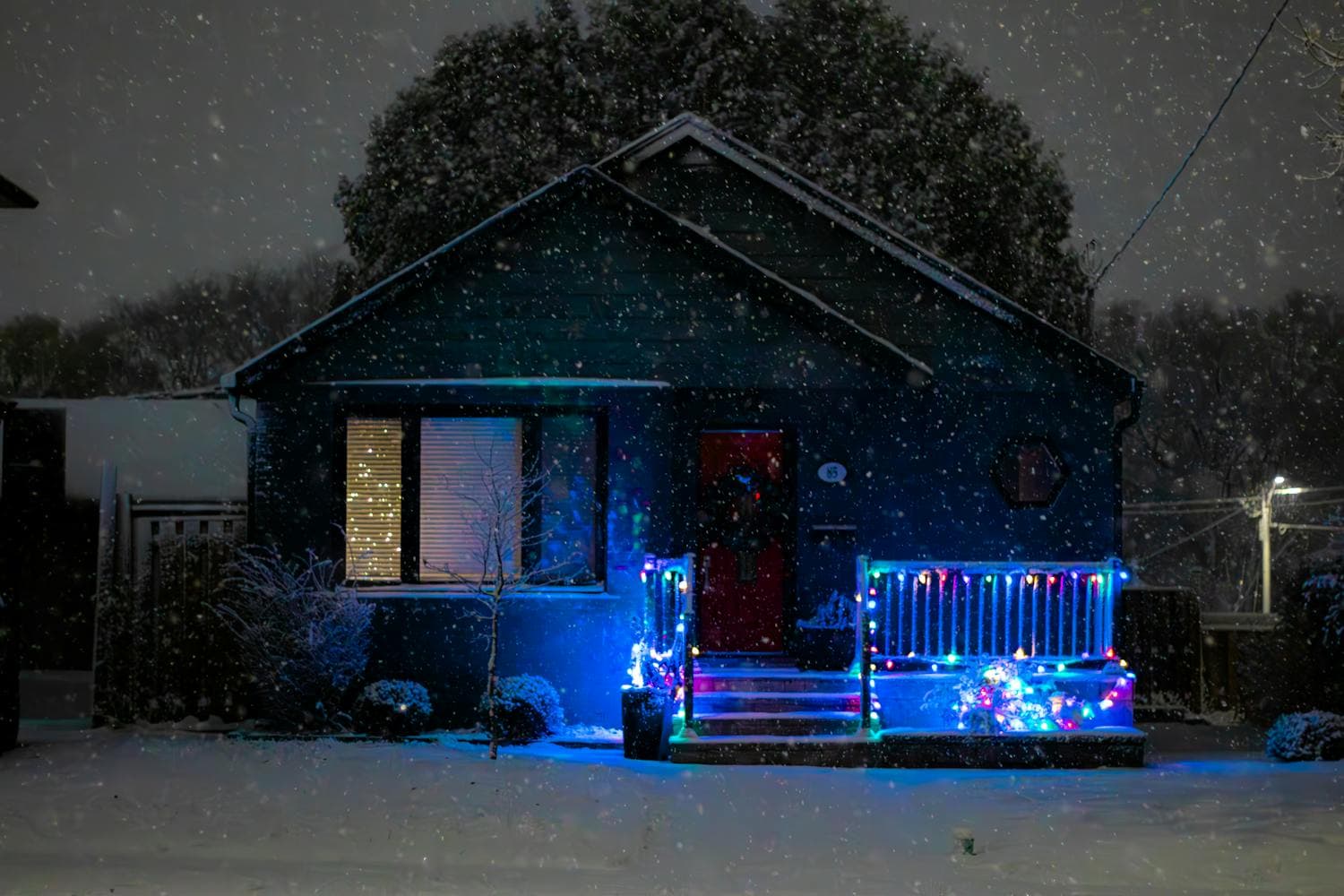
Ranch homes are the most-built house style in America and the most overlooked in Christmas-decorating advice. Every Pinterest board fills up with two-story colonials wrapped in lights and Victorian houses dripping with garland. Ranch homeowners scroll past wondering how any of it translates.
The thing is, ranch homes are arguably the easiest house style in America to light beautifully for Christmas. The single-story silhouette is forgiving. The long roofline is one uninterrupted canvas. The yard is the show because there's no second story to compete with it. Done right, a ranch home glowing at night is one of the most photogenic Christmas displays you can build, and it doesn't require a ladder taller than ten feet.
The catch: most ranch homeowners decorate them like smaller two-story homes. Vertical moves, multi-color bulbs, top-heavy swags. That fights the architecture. This guide covers the five-layer lighting system built specifically for ranch homes, the bulb types and color temperatures that actually flatter the style, and the upgrade path if you want this to be a one-time install.
Before you buy anything, plug your home's dimensions into the free Christmas Light Calculator. It tells you exactly how many bulbs you need for the roofline, shrubs, and yard trees. No more buying 30% more than you need or running out mid-decorating.
Why ranch homes light differently
A few architectural realities shape what works:
- The roofline is low and continuous. Most ranches have a single uninterrupted front roofline. That's a gift. A single line of lights from one corner to the other comes across cleaner and more deliberate than the broken rooflines of more complex architecture.
- The garage is part of the same line. Attached garages on ranches sit right next to the main house, sharing the same eave height. Treat them as one continuous facade. Skipping the garage is the most common ranch lighting mistake.
- The entry is at human level. No towering portico, no second-story landing. The front door is right there at eye level, which means a single great wreath does heavy visual work.
- Window banks tend to be horizontal. Many ranches feature long stretches of front-facing windows, which respond beautifully to repeated decoration. A candle in every window creates rhythm in a way it can't on a vertical facade.
- The yard is part of the show. Without a second story drawing the eye upward, what happens at ground level matters more. Yard decorations, pathway lighting, and front-facing trees do most of the work.
Those five realities are why the lighting plan below is layered in the order it is.
Bulb types: what to use where
Ranch lighting works best when you commit to a small vocabulary of bulb types and use them strategically. Five types cover everything:
C9 bulbs (the foundation)
Best for: Roofline. The most important light type on a ranch, full stop.
C9s are the larger 1.25-inch dome bulbs you see along commercial storefronts. Spaced one bulb per foot, they read cleanly from the street at any distance. Modern commercial-grade C9 LEDs (Wintergreen Lighting, Christmas Designers, Yard Envy) use 0.9-1.5 watts per bulb instead of the 7 watts of old incandescent C9s, so a 150-bulb roofline draws under 200 watts total.
Wire color matters: green wire if your roofline / siding is dark, white wire if your home is white or cream. The wire is visible during daytime; matching it to your facade is the single cheapest way to make the daytime view look professional.
Mini lights (the workhorse)
Best for: Foundation shrubs, garland wraps, tree-trunk wrapping, porch column wraps.
Mini lights are the small string lights with bulbs every 2.5-4 inches. They're meant for closer viewing distances where C9 bulbs would look too sparse. Standard density is 100 bulbs per strand, 50 feet long.
For shrub wrapping, plan ~100 mini lights per medium shrub (3-4 ft tall). For tree-trunk wrapping, ~100 lights per foot of trunk and main branches you wrap.
Net lights (the time-saver)
Best for: Shrubs and bushes when you want fast coverage.
Net lights are pre-formed grids of mini lights you drape over a shrub like a blanket. Much faster than hand-wrapping with mini lights, a 4×6 ft net covers a medium shrub in under a minute. The trade-off: nets look slightly less precise than hand-wrapping at close range, but at street viewing distance the difference is invisible.
Pathway / yard stakes (the accent)
Best for: Walkways, garden edges, around yard trees.
Solar pathway stakes are the easiest install (no wiring), but light output is modest and battery life is iffy in cold climates. Plug-in low-voltage path lights (Malibu, Hampton Bay) are brighter and more reliable. Use one stake every 4-5 feet along walkway edges.
Battery-operated window candles (the secret weapon)
Best for: Every front-facing window, regardless of season.
Modern battery-operated window candles with built-in dusk-to-dawn timers ($30-60 for an 8-pack) turn on automatically at dusk and run six hours every night, all season, on a single set of D batteries. The colonial-style window-candle look is one of the strongest ranch moves because the long horizontal window banks of a ranch create rhythm in a way two-story homes can't match.
Color temperature: the warm-white-only rule
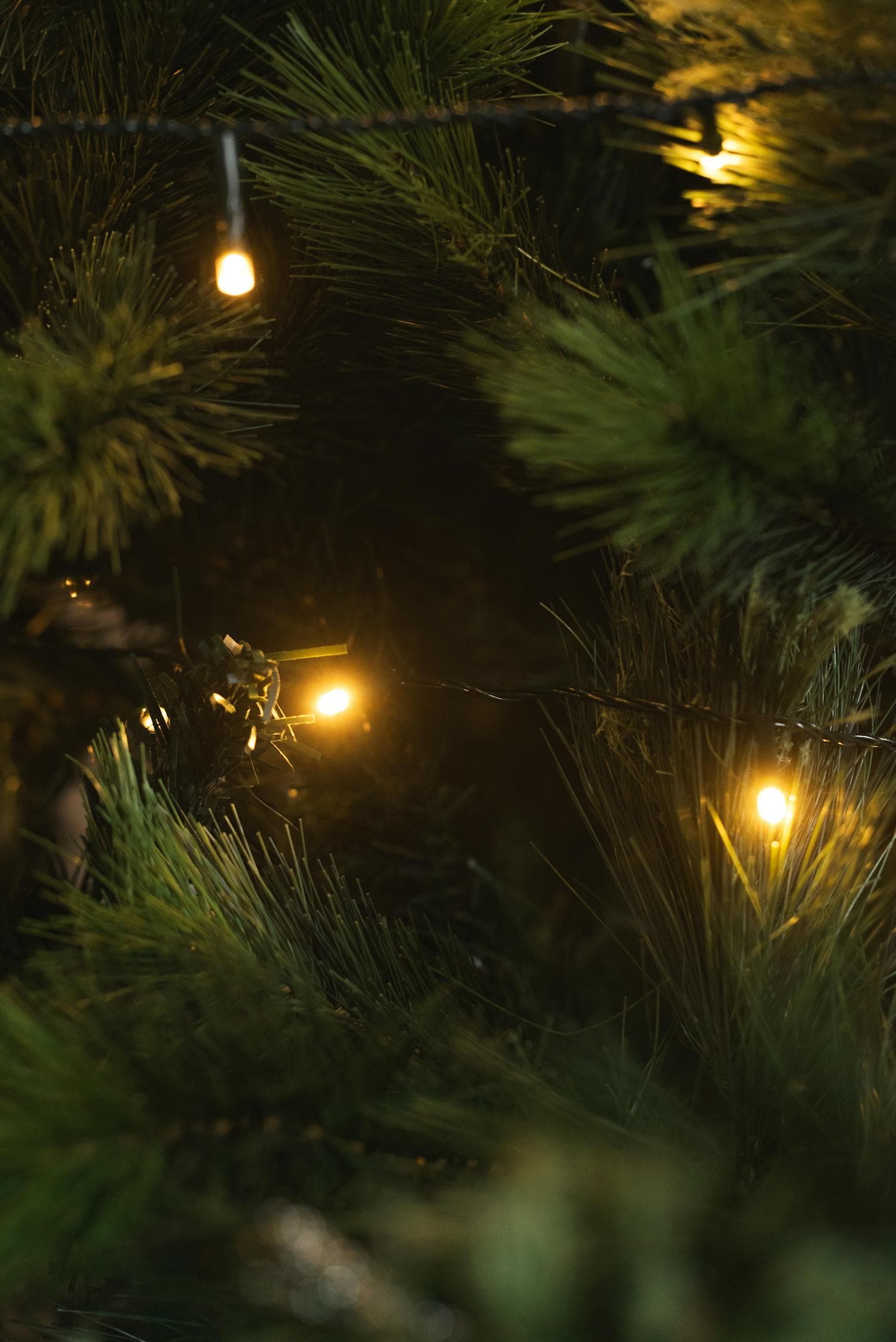
If you take away one thing from this guide, it's this: warm white only, 2700K-3000K.
Ranch homes have warm interior wood tones (most have at least some natural wood or warm flooring visible through windows at night) and earthy or neutral exterior palettes. Warm-white lights pair with those palettes. Cool white (4000K-5000K) looks harsh and clinical against warm materials. Multi-color displays fight the entire clean ranch aesthetic.
The one exception: pure-white modern ranches (the contemporary all-white kitchen-and-bath flip remodels) can sometimes pull off cool-white successfully because the architecture has no warm tones to fight. But this is rare. If you're unsure, default to warm white.
Stay within ONE color temperature across the whole property. The most expensive-looking ranch displays at night use exactly one color temperature for every bulb, roofline, shrubs, trees, walkway. Mixing warm and cool whites in the same display is the visual equivalent of mixing two slightly different shades of white paint on a wall.
The five-layer ranch lighting system
A great ranch Christmas display layers five distinct lighting zones. Each one alone is fine; all five together is what creates the memorable display people drive past at 5 PM in December.
Layer 1: The roofline (the foundation)
This is non-negotiable. A continuous unbroken line of warm-white C9 bulbs running the entire front roofline (including over the attached garage) does more than every other layer combined. The continuity is the point. Any break in the line draws the eye for the wrong reason.
Plan on 100-150 feet of C9 for a typical ranch (1,800-2,500 sq ft). That includes the main house frontage + the garage line. Use the Christmas Light Calculator for an exact number based on your home's specific dimensions.
Installation specifics:
- Use plastic shingle clips (gutter clips on most ranches don't work because the soffit overhang blocks them). One clip per foot, yes, every bulb gets a clip.
- Start at one corner of the house and run the entire line in one direction before turning the corner.
- Test the strand fully unwrapped on the ground before climbing the ladder. About 1 in 20 strands has at least one bad bulb out of the box.
- If you have to splice two strands together at the garage transition, do it where the line bends around the corner so the splice is hidden.
Layer 2: Window candles in every front-facing window
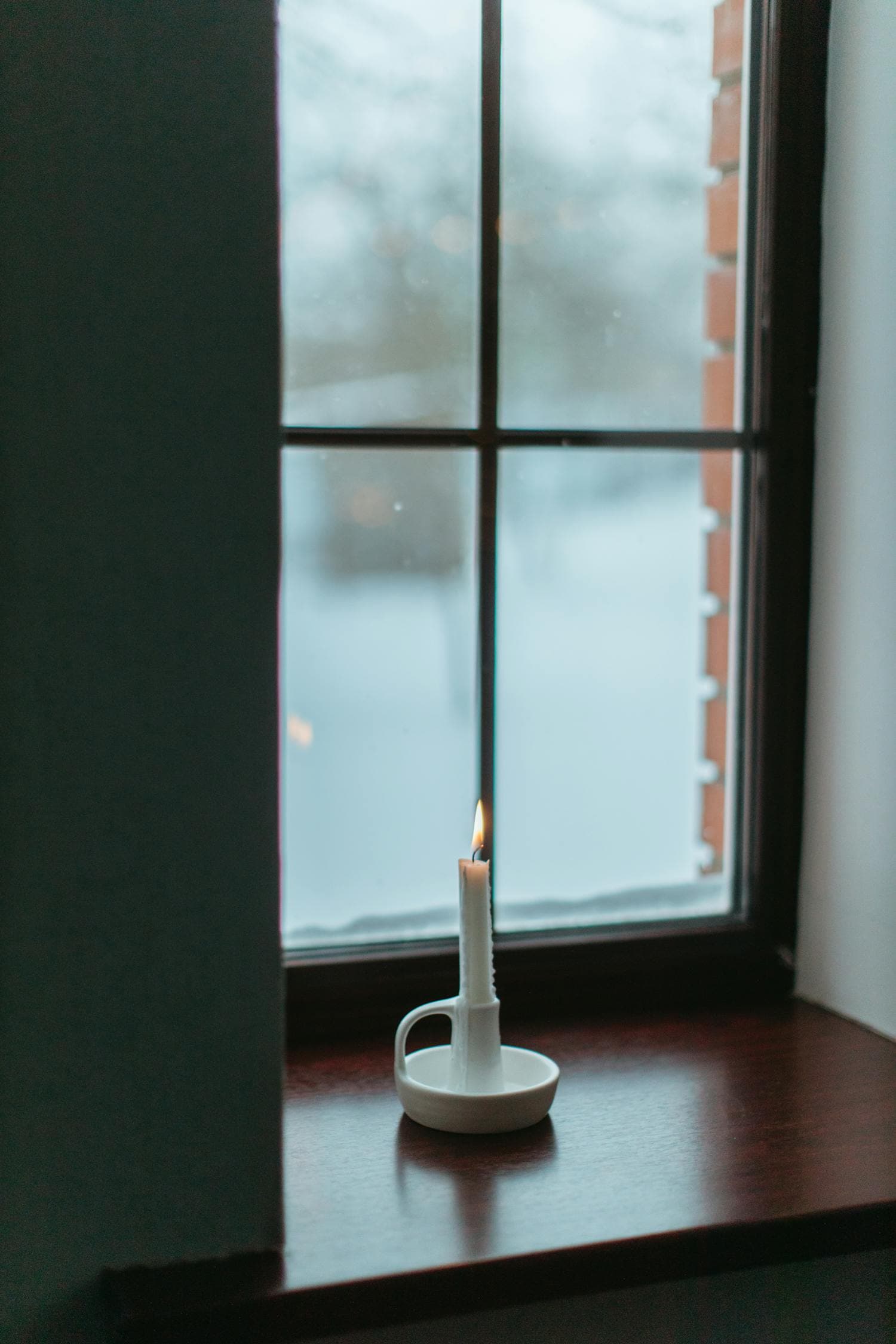
This is the second-most-important layer and the most underused on ranches. Most ranch facades have 4-8 front-facing windows. Put a battery-operated warm-white candle in every single one of them, centered on the lower pane.
Why this works so well on ranches: the long horizontal window bank repeats the visual rhythm of the roofline lights above. Two parallel lines of warm light running the length of the home, with the dark facade between them, is one of the most photogenic light patterns you can build.
The rule: every window gets one. Skipping windows breaks the rhythm. The cost is trivial ($30-60 for an 8-pack of battery-operated candles with built-in timers), so there's no reason not to commit fully.
Our pick
Window candles with dusk-to-dawn timer (4 pack)
Layer 3: Landscape lighting (the often-skipped layer)
This is where most ranches lose the plot. Homeowners light the house but leave the front yard plantings dark. The result is a glowing house surrounded by a black void, which makes the house itself look smaller and floating.
Three sub-layers to get right:
Foundation shrubs. Wrap or net-light every front-facing foundation shrub. Net lights are faster; hand-wrapping with mini lights looks slightly more deliberate. Either way: every shrub. Skipping even one breaks the visual continuity.
Yard trees. Wrap the trunks and main branches up to about 8 feet for any front-yard trees. You don't need to wrap the whole tree, wrapping just the lower trunk and main limbs creates the impression of a fully lit tree from the street.
Mailbox. A small swag of pre-lit garland on the mailbox post (or a wired-in mini-light wrap) tells passersby the whole property is decorated, not just the front door. Tiny touch, disproportionately rewarding.
Layer 4: Pathway lighting
A ranch home looks inviting when the walkway is a series of warm points of light leading toward the entry. Three options that layer well:
- Solar pathway stakes in warm white, easy install, no wiring, but light output is modest
- Plug-in low-voltage path lights, brighter and more reliable
- Battery-powered luminaries (real candle-in-paper-bag style, or the modern LED equivalents), best for special nights, not necessarily the whole season
For a long ranch facade, plan on one stake every 4-5 feet along both sides of the walkway. Closer than that looks busy; farther apart and the path goes dark in stretches.
Layer 5: A yard tableau (the focal point)
This is where ranch homes have an unfair advantage. Without a second story competing for attention, the yard becomes the focal point. One well-staged scene reads dramatically better from the street than a row of disconnected inflatables.
Pick exactly one direction:
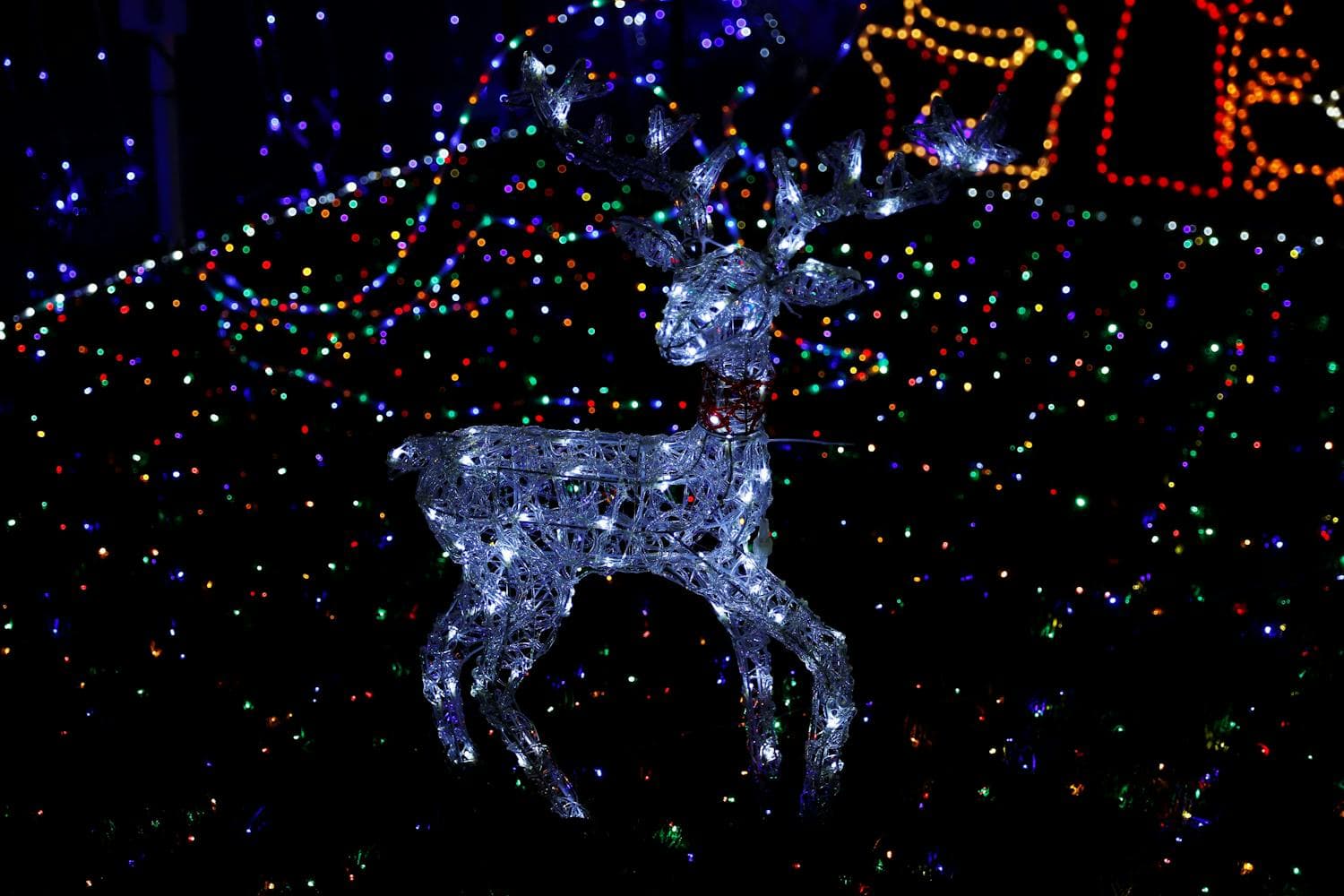
- A trio of lit deer in graduated sizes (large doe, medium buck, small fawn)
- A nativity scene lit with a single warm spotlight
- A grouping of three lit trees in a triangular arrangement, varying in height
The rule across all three: odd numbers, varied heights, single light temperature. Mixing warm-white deer with cool-white trees in one tableau makes everything feel cheap. The yard tableau wants to feel curated, not yard-saled.
Permanent eave lights: the one-time-install upgrade
If you've been putting up the same C9 lights for 3+ years and the climbing-the-ladder ritual has lost its charm, permanent eave lights are the upgrade play.
Permanent eave lights (Govee Outdoor Pro, Twinkly Pro, Trimlight, Jellyfish, Oelo) install once on a track under the soffit and stay there year-round. They're controlled from a phone app. For Christmas, they display as warm-white C9-style bulbs. The rest of the year, they stay off (or do subtle accent lighting for Halloween orange, Fourth of July, summer evenings).
The economics:
- Upfront cost: $1,500-$3,500 for professional install on a typical ranch (DIY kits start around $700)
- No annual setup time (vs ~3-5 hours per year of installing temporary lights)
- No annual ladder risk
- Per-year cost over 7 years: ~$215-500
- Per-year cost of new commercial-grade strands every 5 years: ~$60-80
So permanent isn't strictly cheaper. But the time saved (15-25 hours over 5 years) and the risk eliminated (no ladder climbs at 50+) often justifies the price for ranch homeowners specifically, single-story homes are the easiest install for permanent systems because there's no second-story track to run.
Brand notes (none of these are affiliated yet, just informational):
- Govee Outdoor Pro ($600-1000 DIY): cheapest entry point, app-controlled, decent for the price
- Twinkly Pro ($2000-3500 installed): app-controlled with animation programming, premium feel
- Jellyfish ($3000-5000 installed): the "Lexus", best track concealment, longest warranty (8 years), highest install quality. Local franchise model
- Trimlight ($2500-4500 installed): similar to Jellyfish, larger franchise network
If you go this direction, get three quotes, ask to see the installer's actual work in your neighborhood, and verify the warranty covers both bulb failures AND track damage.
Common ranch lighting mistakes
After enough drives through ranch neighborhoods, the same five mistakes show up everywhere:
-
Mixing warm and cool whites. The single most common mistake. One section gets cool-white from one strand brand; another section is warm-white from a different brand. The mix is jarring even when both are technically "white." Commit to one color temperature across every layer.
-
Skipping the garage roofline. The attached garage is part of the same horizontal line as the main house. Run roofline lights all the way across. A house lit but the garage dark is the most common ranch lighting mistake by far.
-
Vertical decor that doesn't fit. Tall light-up trees, top-heavy door arches, second-story icicle imitations, these were designed for two-story homes and look out of scale on a ranch. Stick to horizontal moves.
-
Multi-color C9 bulbs. Multi-color feels chaotic at ground level on a ranch. Warm white only.
-
Glowing house, dark yard. Lighting the house but leaving the yard plantings dark creates a glowing house surrounded by a void. Light the shrubs and front-yard trees too. Even minimal landscape lighting is a 10x improvement over zero.
The complete ranch lighting shopping list
For a typical 2,000 sq ft ranch with 50 ft of front roofline + a garage, 6 front-facing windows, 4 foundation shrubs, 2 yard trees, and a 30-ft walkway, here's the realistic starter spend:
| Category | Specifics | Cost |
|---|---|---|
| Roofline C9 lights | 150 ft warm-white commercial-grade LED C9, green wire (or white per siding), 1-bulb-per-ft spacing | $180-250 |
| C9 shingle clips | 200 clips (1 per bulb + spares) | $25 |
| Window candles | 8-pack battery-operated with dusk-to-dawn timers + batteries | $50 |
| Foundation shrubs | 4× net lights, 150-bulb each, warm white | $60-80 |
| Yard trees | 2× 100-bulb mini-light strands, 50 ft each, warm white | $40 |
| Pathway stakes | 12-pack solar warm-white pathway lights | $50-80 |
| Yard tableau | One lit-deer trio (large/medium/small) | $120-180 |
| Mailbox | Pre-lit garland swag with red bow | $25-40 |
| Extension cords + outdoor timer | 100ft outdoor cord + heavy-duty timer | $40-60 |
| TOTAL | $590-805 |
That's a one-time investment that lasts 5+ years on commercial-grade gear. Per-season amortized cost: ~$120-170 for a ranch that goes from dark to fully decorated.
The honest answer for most ranch homes
If you're starting fresh and want maximum visual impact for minimum effort, do these three things and skip everything else for year one:
- 150 feet of warm-white C9 lights along the full roofline including the garage. This alone is 70% of the visual impact.
- Window candles in every front-facing window. This is 20% more visual impact for $50 total.
- One yard tableau (lit deer trio is the simplest). This is 10% more impact and the focal point that completes the photo.
Skip the foundation shrubs and pathway lights in year one if you're decision-overwhelmed. Add those in year two. The first three layers carry the display.
The architecture is already telling you what to do. Long, low, horizontal, warm. Listen to it, and the house takes care of itself.
Related guides:
- How to Decorate a Ranch House for Christmas: the full ranch decorating playbook, interior, exterior, wreaths, and yard staging beyond just lighting
- Christmas Light Calculator: plug in your exact dimensions, get the bulb count and cost estimate before you buy
- How Much Does It Cost to Decorate Your House for Christmas?: full budget breakdown across all categories
- Christmas Light Ideas for Two-Story Colonial Homes: the lighting playbook for the opposite house style, vertical, symmetric, formal
- Best Christmas Lights Near You: city-by-city guides to the displays worth driving to, including the free neighborhoods
Share this guide
Frequently asked questions
What color Christmas lights look best on a ranch home?
How many feet of Christmas lights do I need for a ranch house?
Should I use C9 or mini lights on a ranch house?
How long do commercial-grade Christmas lights last vs consumer-grade?
What's the single biggest Christmas lighting mistake on a ranch home?
Are permanent eave lights worth it for a ranch home?
Keep reading
The Best Christmas Lights to Buy (by What You're Lighting)
How to choose Christmas lights and what's actually worth buying, by use case: roofline, trees, shrubs, the indoor tree, garland, and pathways. LED vs incandescent, bulb types, and color temperature explained.
How to Decorate a Ranch House for Christmas: 15 Ideas That Actually Work
Ranch homes have a low, horizontal silhouette that calls for specific Christmas decorating moves. Here are 15 ideas (exterior, interior, and lighting) designed to flatter the ranch style instead of fighting it.
Christmas Lights Not Working? Find the Fault in Ten Minutes
The four ways a Christmas light string fails, how to tell them apart in about a minute, and the fixes that actually work. Includes the fuse door most people never open, why half a string goes dark, and the point where a strand is not worth saving.
Prefer pen & paper?
The Christmas Planner
A 25-page printable kit covering budget, gifts, hosting, and decor, built on the same planning logic as this tool. Print it once, keep it in a binder, and reuse it every year.
Or grab 3 pages free first.
Decor that suits the home you have.
Seasonal decorating tips and the occasional new tool, straight to your inbox. One list, no spam.