By Brian · May 25, 2026
Christmas Front Porch Decorating Ideas (by House Style)
How to decorate your Christmas front porch by the architectural style of your home. Six styles (ranch, colonial, Cape Cod, Craftsman, Victorian, modern farmhouse), the five universal rules, common mistakes, and a starter shopping list.
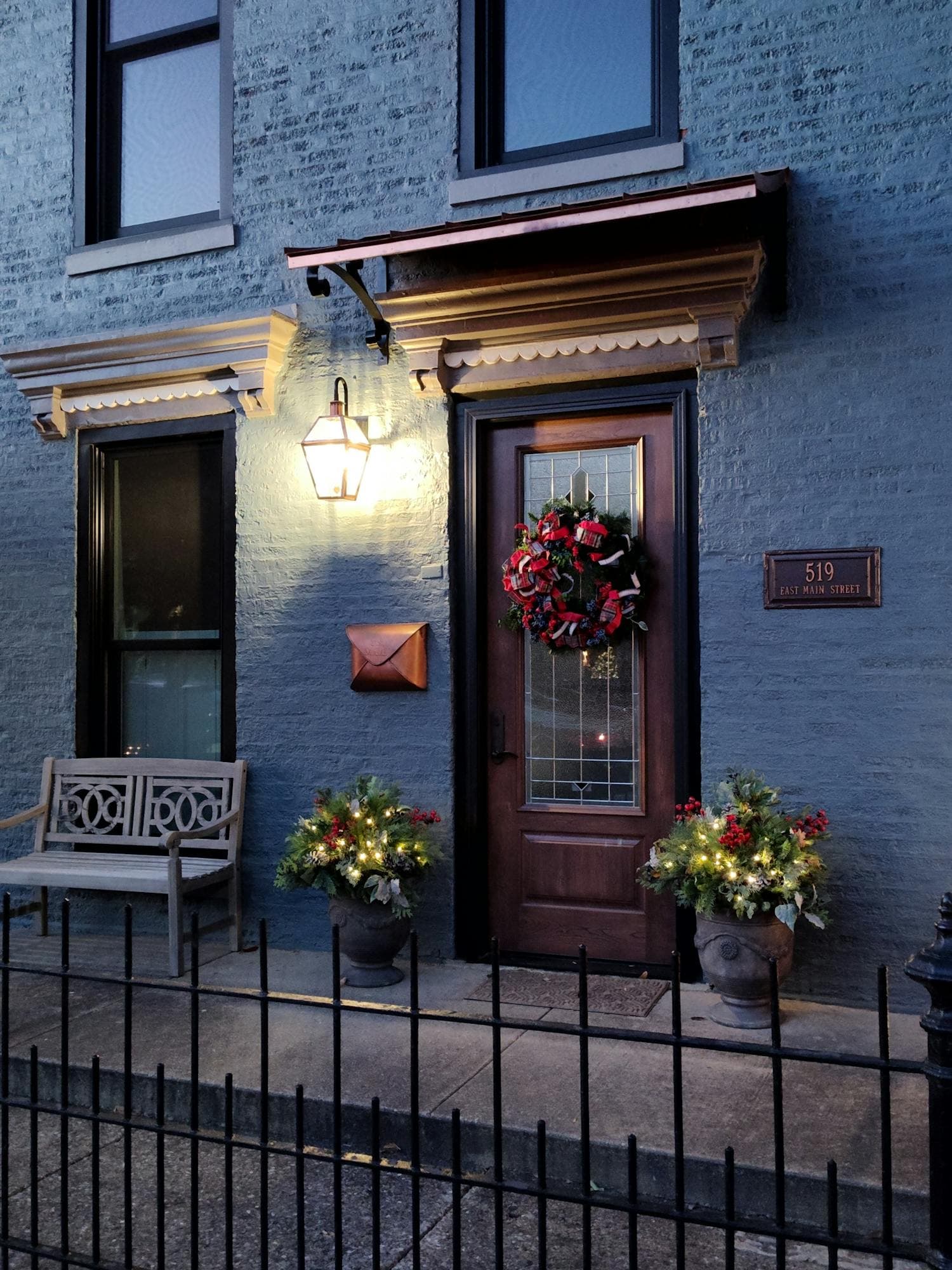
The front porch is the only Christmas decorating canvas most people share with their entire neighborhood. The roofline lights are seen by passing drivers. The interior tree is seen by family and guests. The porch is seen by every neighbor walking the block, every delivery driver, every kid on the sidewalk. It's also the slowest-viewed surface. People pause at your steps, glance at the door, take it in. It rewards attention to detail more than any other part of your Christmas display.
The trouble is that most Christmas porch advice treats every porch as if it were the same. A "20 Christmas porch ideas" Pinterest roundup will show you a wreath on a Craftsman bungalow, a wreath on a Victorian, a wreath on a Cape Cod, never noting that the right wreath for one is wildly wrong on the other. Scale, abundance, palette, and material all change based on the porch's architecture. A Cape Cod stoop wants restraint. A Victorian wraparound wants abundance. A Craftsman porch wants natural materials. Treating them all the same is why so many porches end up looking generic and slightly off, no matter how much money was spent.
This guide covers the five universal rules that apply to every porch, then porch decorating ideas for the six house styles most readers actually live in: ranch, two-story colonial, Cape Cod, Craftsman bungalow, Victorian, and modern farmhouse. Plus the most common mistakes and a realistic starter shopping list.
Not sure what style of porch you have? Take the free house style identifier quiz. Eight questions, 60 seconds, then jump to the section of this guide written for your style.
The 5 universal porch decorating rules
These apply regardless of house style. Get these right and the by-style decisions become easier; get them wrong and no amount of "good wreaths" will save the display.
Rule 1: Scale to the porch, not the door
Wrong-scale decor is the biggest visual failure on Christmas porches. A 12-inch wreath on a standard 36-inch door looks like an afterthought. A 30-inch wreath on a Cape Cod cottage door looks comical. A pair of 4-foot topiaries on a stoop dwarfs the entry.
The default rule: wreath at roughly three-quarters of door width. A standard 36-inch entry door wants a 26-30 inch wreath. A 42-inch door (common on modern farmhouses) wants a 30-32 inch wreath. Cape Cod and cottage doors that are 30 inches or narrower want 20-24 inch wreaths. Two styles run bigger on purpose: ranch doors sit close to the viewer and Victorian doors absorb scale, so both carry 30-36 inches comfortably.
Planters scale to the porch depth, not the door. A 4-foot covered porch wants planters no taller than 36 inches and no wider than 14 inches. A 10-foot wraparound porch can take 48-inch topiaries without flinching. Measure your porch first, then buy.
Rule 2: Layer at three heights
Successful porch displays work at three viewing heights:
- Eye level (50-65 inches): the door wreath, garland on the door frame, sconce-mounted decor.
- Mid level (24-48 inches): matched planters, lanterns, urns, side tables.
- Ground level (0-12 inches): doormat, pathway lights leading to the steps, small ground-level planters or a small basket of pinecones.
Skip any of these and the porch comes across as incomplete. The most common skip is ground level. People decorate the door and the planters but leave the porch floor and stair treads bare, so the bottom half of the display feels like it never got finished.
Rule 3: Light it well
A dark porch is the number one visual failure in Christmas decorating. Roofline lights are great but they don't reach the porch ceiling, and the porch is where guests pause to ring the doorbell. Three lighting moves:
- Porch ceiling light on a timer. Pendant or sconce, kept on from dusk through 10 PM. If your porch ceiling has no fixture, a battery-powered LED puck mounted overhead passes for a real fixture from the sidewalk.
- Garland and wreath in warm white only. Never colored lights on the porch unless your entire exterior is committed to multi-color. The mixing is what looks cheap.
- Pathway lights leading to the steps. Solar or low-voltage stake lights, three to five per side, spaced about 18 inches apart. This is the move that turns a normal porch into a Christmas-card scene.
For exact light counts based on your porch dimensions, plug your numbers into the Christmas Light Calculator.
Rule 4: One palette, not three
Pick two or three colors and repeat them at every layer of the porch. A traditional red-green-gold porch works. A neutral cream-and-cedar porch works. A burgundy-and-forest porch works. What doesn't work is a red wreath, a green garland, a gold ribbon, a navy doormat, and a silver lantern all on the same porch, five colors with no relationship.
The simplest test: stand at the curb and squint at your porch. If you see more than three distinct color groups, simplify. For palette inspiration that complements your home's existing exterior, the color palette finder reads the colors in an uploaded photo and suggests a Christmas palette that matches.
Rule 5: Frame the door, don't bury it
The point of the wreath and the garland is to draw the eye TO the door, not to obscure it. Aim for about 30% of the door visible behind the decor. The knocker, the trim, the kick plate should all read clearly. When wreaths get too big or garland gets too dense, the door disappears, and with it the entire focal point of the porch.
If your wreath is so full it touches the doorframe on both sides, scale down. If your garland on the door frame is so heavy you can't see the trim, lighten it. Christmas porch decor should compose around the door, not consume it.
Porch decorating by house style
Below: the porch type, the signature decorating move, the most common mistake, the right palette and lighting for each of the six most common American house styles.
Ranch homes
The porch: Low single-story with a shallow stoop or a small covered front entry. Ranch porches typically have 4-8 foot depth, a single concrete step or a 3-step rise, and either a small flat overhang or a wraparound roof extension.
The signature move: Horizontal everything. Match the home's long horizontal silhouette by decorating in horizontal lines: a wide, low wreath on the door (or a horizontal door swag instead), planters in a long row beside the entry rather than two flanking pairs, and a single horizontal garland across the porch roofline that ties into the home's main roofline lights.
Palette: Warm white lights only, single accent color. Ranches photograph best with a clean palette: warm white string lights, cedar greenery, and one accent (cranberry red ribbon or terracotta planter pots). Skip the multi-color.
Common mistake: Decorating a ranch porch vertically. Tall topiaries, multi-tier pots, vertical light columns: all fight the home's horizontal soul. If you have a porch column, wrap it loosely with garland but don't crown it with anything tall.
For the full ranch Christmas treatment beyond just the porch, see How to Decorate a Ranch House for Christmas and Christmas Light Ideas for Ranch-Style Homes.
Two-story colonial homes
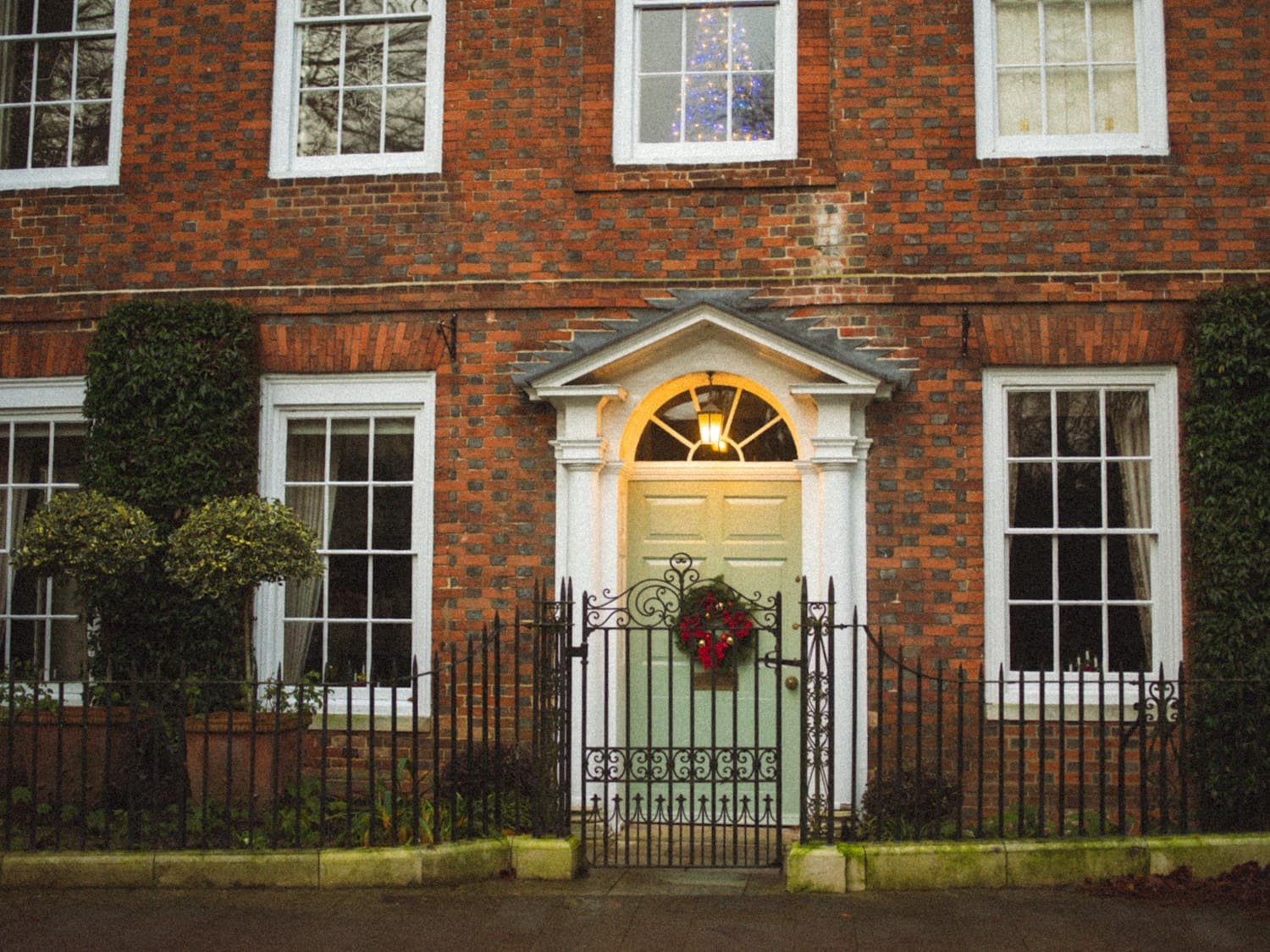
The porch: Formal symmetric portico or columned entry, typically centered on the facade with a small pediment or flat roof above. Colonial porches are made for symmetry, so everything on one side should mirror the other side.
The signature move: Matched pairs of everything. Two identical urns or topiary planters left and right of the door. Garland-wrapped columns if you have them. A single large wreath dead-center on the door. Window candles in every front-facing window (the colonial signature; see the colonial light guide below). The whole porch should compose as a perfect mirror image around the central door axis.
Palette: Traditional. Red, evergreen, and gold is the canonical colonial Christmas palette. Burgundy and cream works for more formal colonials. Whatever you pick, commit to symmetry. If there's a red ribbon on the left urn, there's an identical red ribbon on the right urn.
Common mistake: Asymmetry. Colonials punish asymmetric porch decor more than any other style. One planter on the left and a different one on the right registers as wrong, not eclectic. Either commit to symmetry or pick a different style.
For the full colonial Christmas lighting treatment, see Christmas Light Ideas for Two-Story Colonial Homes.
Cape Cod homes
The porch: Usually a small stoop or concrete step-up entry rather than a full covered porch. Cape Cod entries are typically modest: a single granite slab step, a small overhang, maybe a pair of side-light windows flanking the door.
The signature move: Restraint. Single large wreath on the door, one pair of planters with fresh boxwood or cedar, white lights only. That's the entire porch. The Cape Cod aesthetic is built on understatement, and porch decor that fights that lands wrong.
Palette: Coastal-traditional. Cream, navy, evergreen, with red as the single accent. Or all-white with cedar greenery for the most editorial cape-style look. No multi-color, no glitter, no inflatables.
Common mistake: Treating a Cape Cod stoop like a covered porch. Adding garland to a doorway that doesn't have a porch ceiling to anchor it. Stacking planters in tiers. Putting up a 30-inch wreath on a 30-inch door. The principle is "less, done well," and the most common failure is doing too much.
For the full Cape Cod Christmas treatment, see Christmas Decorating Ideas for Cape Cod Style Homes.
Craftsman bungalows
The porch: Deep covered porch (6-12 feet deep) with tapered columns on stone or brick bases, exposed rafter tails, often a brick or stone half-wall. Craftsman porches are the single best canvas for Christmas decoration in American residential architecture. They have ceiling, columns, depth, and a built-in handcrafted aesthetic.
The signature move: Garland-wrapped tapered columns. This is the Craftsman Christmas signature move: wrap the columns with fresh cedar or pine garland from base to capital, anchored with warm-white mini lights. The wrapped columns frame the entry porch as a single composed scene from the street. Hang oil-rubbed bronze, copper, or brass lanterns from the porch beams. Add a single oversized wreath on the door, made from magnolia or mixed natural greens.
Palette: Earth tones, exclusively. Cedar green, magnolia bronze, kraft brown, terracotta, copper. Skip primary red and silver, since both fight the Arts & Crafts ethos of the architecture. If you want red, use a deep oxblood or wine, never a fire-engine red.
Common mistake: Glitz. Craftsman bungalows were designed in deliberate reaction to Victorian ornamental excess. Glittery, metallic, plastic, or multi-color decor amounts to a violation of the architecture. Stick to matte finishes, natural materials, and warm-white lighting only.
For the full Craftsman Christmas treatment, see How to Decorate a Craftsman Bungalow for Christmas.
Victorian homes
The porch: Wraparound porch with ornate trim, spindle work, gingerbread brackets, and often a turret or bay at one corner. Victorian porches are the most ornamentally complex residential porches in America. They were designed to be looked at.
The signature move: Layered abundance. Victorian porches reward the maximalist treatment that fails on every other house style. Multiple wreaths (one on each visible door and window facing the porch), garland along every railing, ribbon down every column, candles in every porch-facing window, swags above each window. The principle is "every architectural feature gets dressed."
Palette: Burgundy, forest green, and cream is the canonical Victorian Christmas palette. It's sophisticated, period-correct, and ages beautifully. Skip primary red here too; it suggests a 1970s revival rather than a true Victorian palette. Add brass or aged-bronze accents (lanterns, ribbon hardware, ornament finishes) for the period-appropriate metallic notes.
Common mistake: Restraint. Nothing hurts a Victorian Christmas more than decorating it like a Cape Cod: one wreath, one set of pots, white lights, done. The architecture demands abundance. Victorian Christmas porches that look "perfect" are doing four times what a Cape Cod would do, and the architecture absorbs it without flinching.
For the full Victorian Christmas treatment, see How to Decorate a Victorian House for Christmas.
Modern farmhouse homes
The porch: Covered porch with simple square or X-pattern posts, usually a metal roof, often a wide enough porch for rocking chairs flanking the door. The modern farmhouse porch sits between traditional farmhouse (rustic) and modern (minimal), and Christmas decor has to walk that same line.
The signature move: Simple materials, deliberately deployed. Galvanized metal planters with fresh cedar or boxwood. A single plain cedar wreath, no ribbon, on the door. A simple cedar garland along the porch railing or the door frame (one, not multiple). Warm-white string lights along the porch eaves. The aesthetic is "clean handmade," where every piece looks intentional and a little spare.
Palette: Cream, sage green, evergreen, and one accent (a deep cranberry ribbon, or a matte black ironwork detail). Galvanized metal counts as a "color" in this palette, so let it show. Skip glitter, skip glossy plastic, skip primary red.
Common mistake: Over-styling. The modern farmhouse look fails when porches get too busy. Joanna Gaines didn't put four wreaths on every doorway. The look works when there's intentional empty space between the styled pieces. Let the porch breathe.
For the full modern farmhouse Christmas treatment, see How to Decorate a Modern Farmhouse for Christmas.
Common Christmas porch decorating mistakes
A short list of the most frequent failures, regardless of house style:
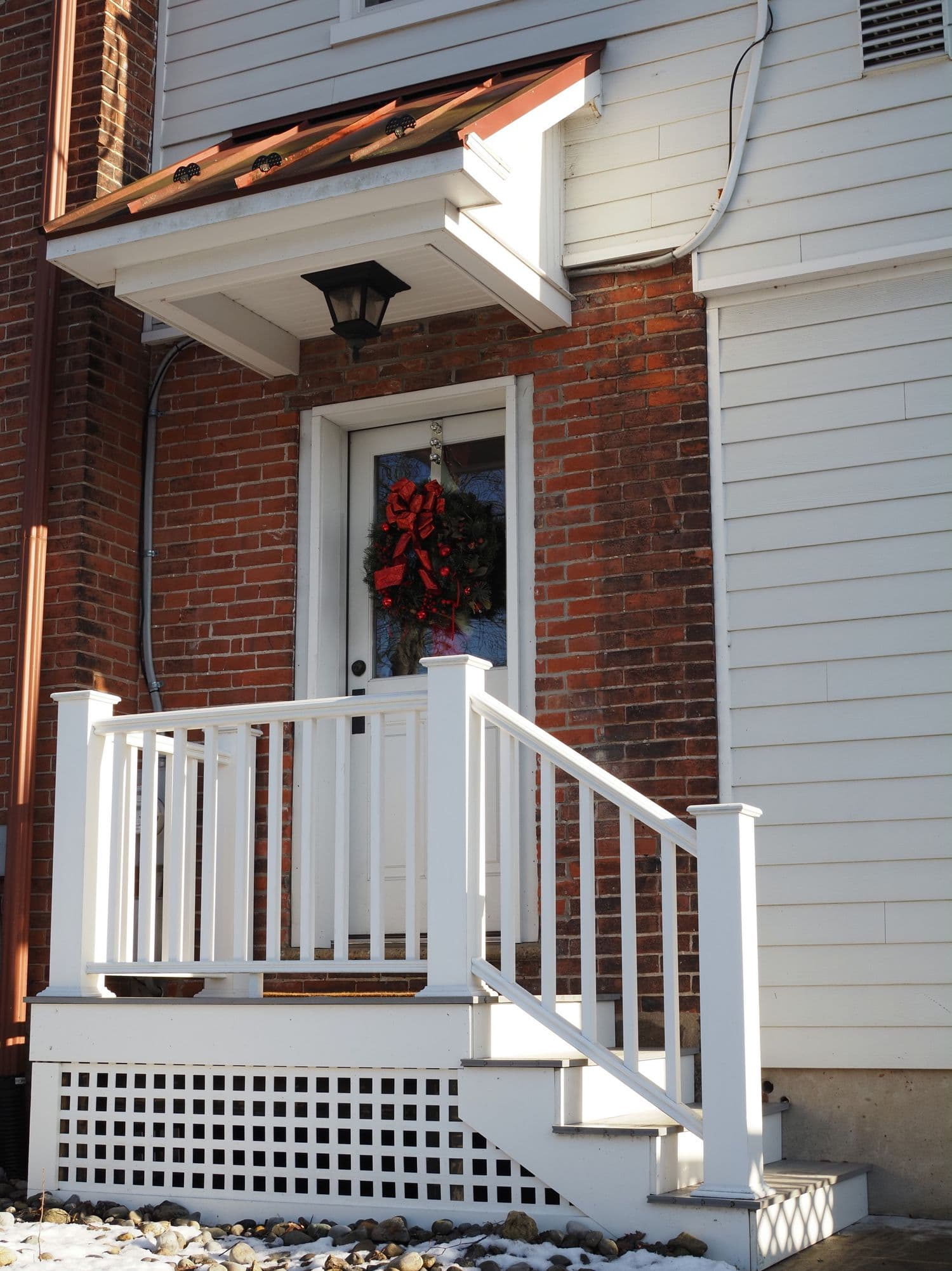
- Wrong-scale wreath. Either too small (looks lost) or too big (buries the door). Measure first, then buy. The three-quarters-of-door-width rule is the safe default.
- Too many garlands at competing heights. A garland on the door frame plus a garland on the railing plus a garland on the porch ceiling, three lines of greenery competing for attention. Pick one, maybe two if the porch is large enough.
- Multi-color lights mixed with warm-white. Pick one color temperature for the entire exterior and commit. Mixed temperatures look accidental, never intentional.
- Forgetting the floor. No doormat, no pathway lights, no ground-level decor, so the bottom of the porch sits bare while the top is over-styled. The third viewing height matters.
- Inflatables on small porches. A 6-foot snowman in a 4-foot porch eats the entire entry. Inflatables (if you must) belong in the yard, not on the porch.
- Synthetic everything. Plastic wreath, plastic garland, plastic pathway lights, plastic everything. At least one real material (fresh greenery, real candlelight, brass or copper or actual wood) anchors the whole composition. Without it, the porch feels cheap regardless of how much was spent.
- Skipping the porch ceiling. A dark overhead kills the whole display once the sun sets. Turn on the porch ceiling light (or install one) and put it on a timer.
How to light your porch for Christmas
Porch lighting is a system, not a single decision. Four layers, applied in this order:
Layer 1: The porch ceiling. Existing pendant or sconce, on a timer from dusk to 10 PM. If your porch ceiling is bare, a battery-powered LED ceiling puck or a plug-in pendant on a smart plug solves it for under $50.
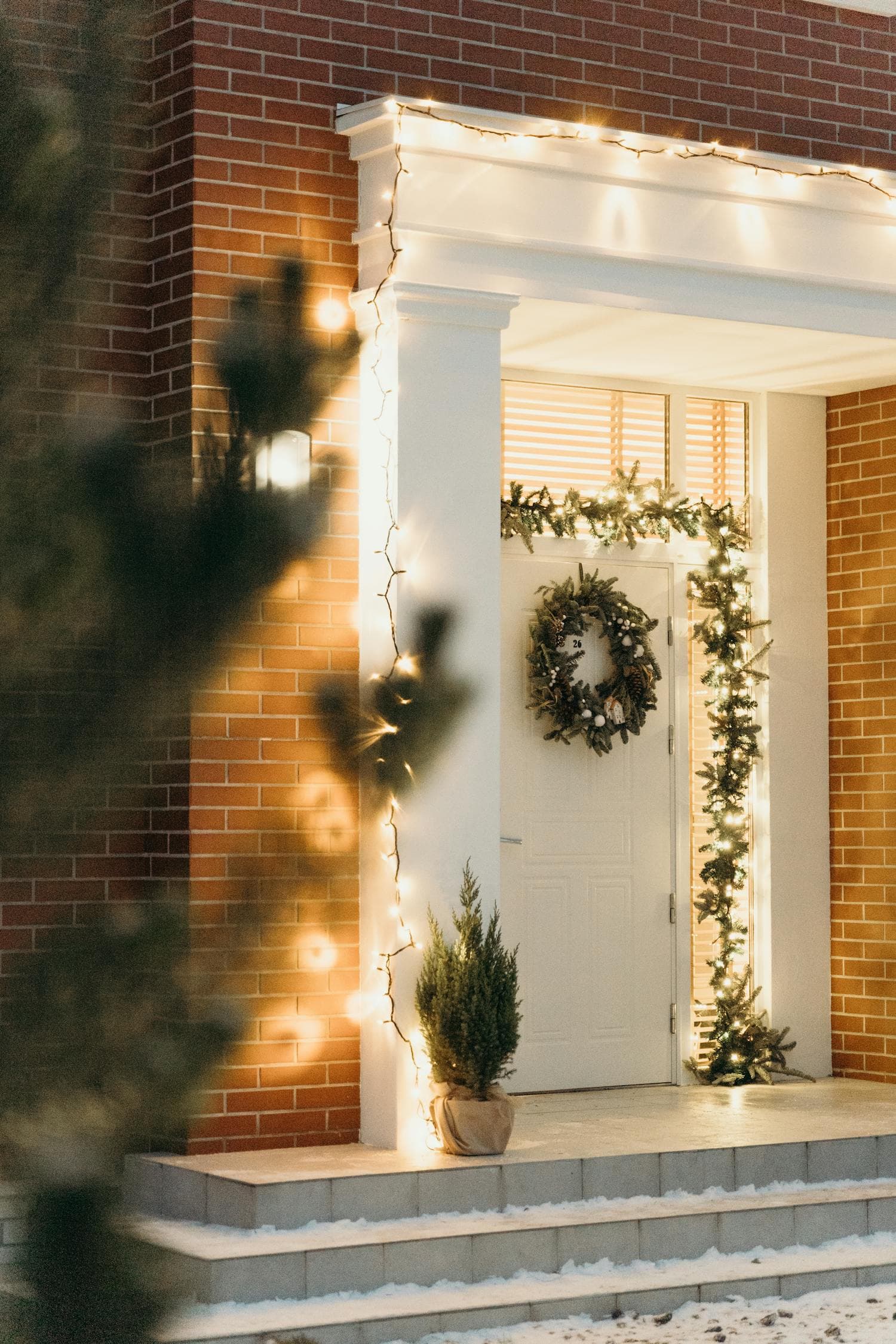
Layer 2: The garland. Warm-white mini lights. Pre-lit garland typically comes with 50-100 lights per 9-foot section, which is plenty for most porches and by far the easiest path. If you want the dense, professionally wrapped look, wrap unlit garland yourself at roughly 33 mini lights per foot (about 100 lights per 3 feet), so a typical front-door garland (10-12 feet) takes 330-400 lights, three or four standard 100-light strands.
Layer 3: The wreath. A pre-lit warm-white wreath with 25-50 lights or a battery-operated micro-light insert added to a standard wreath. Battery packs go on timers too.
Layer 4: The path. Three to five solar or low-voltage stake lights per side of the walkway, spaced about 18 inches apart, leading from the sidewalk or driveway to the bottom step. This is the move that turns a normal porch into a Christmas-card scene: small light cost, massive visual impact.
For exact bulb counts and the right type to buy for each layer based on your porch's specific dimensions, use the Christmas Light Calculator. It handles the math and outputs a shopping list.
A realistic starter porch shopping list
If this is your first year decorating the porch from scratch, here's a realistic budget breakdown. Costs are mid-range estimates for 2026 retail prices; you can spend less by going faux or DIY and more by going designer or installed.
| Item | Cost range |
|---|---|
| 26-30 inch wreath (pre-lit) | $50-100 |
| 2 matching porch planters with fresh greenery | $60-120 for the pair (or $30 DIY) |
| 1 garland for door frame or railing (real cedar, 9-12 ft) | $30-80 |
| Pre-lit warm-white string lights (per calculator output) | $40-100 |
| 1-2 large lanterns or candle holders | $40-80 |
| Christmas doormat | $25-40 |
| Solar pathway lights (set of 6-8) | $30-60 |
| Starter total | ~$275-580 |
This buys you a complete, well-composed porch that lasts 4-6 weeks outdoors and looks intentional from the curb. You can build on this kit year over year: add a second planter pair next December, upgrade to pre-lit garland the year after, swap the pathway lights for in-ground LEDs when you're ready.
For a fuller view of what Christmas decorating costs across categories (porch is one of several), see How Much Does It Cost to Decorate Your House for Christmas?.
Let the porch pick the decor
The right Christmas porch decor depends on the porch's architecture more than on Pinterest trends, your budget, or the year's color of the season. A 4-foot Cape Cod stoop wants a single oversized wreath and a pair of small planters; a 12-foot Victorian wraparound wants four wreaths, two garlands, and ribbon down every column. The same decor on the wrong porch looks off, no matter how nice the individual pieces are.
Pick your house style. Follow its signature move. Commit to one palette. Light all four layers. Don't forget the floor.
If you're not sure which style you're working with, the house style identifier quiz takes 60 seconds and routes you to the full Christmas decorating guide written for it. From there, your porch becomes the easiest part of the display to get right.
Related guides:
- Christmas Mantel Ideas (by House Style): the interior companion piece, same five-rules-plus-six-styles structure applied to the mantel, the highest-visibility surface inside the home
- How to Decorate a Ranch House for Christmas: the full ranch decorating guide, beyond just the porch
- Christmas Light Ideas for Two-Story Colonial Homes: the full colonial lighting playbook
- Christmas Decorating Ideas for Cape Cod Style Homes: coastal-traditional Christmas done right
- How to Decorate a Craftsman Bungalow for Christmas: natural materials and earth tones for the Arts & Crafts era home
- How to Decorate a Victorian House for Christmas: layered abundance for ornate architecture
- How to Decorate a Modern Farmhouse for Christmas: simple materials, deliberate restraint
- Outdoor Christmas Decorations That Work in Warm Climates: for Florida, Arizona, and other porches that never see snow
- Christmas Light Calculator: exact bulb counts for every layer of the porch
- House Style Identifier: 60 seconds to identify your home's architectural style
- Christmas Color Palette Finder: upload a room photo and get a Christmas palette that complements your home
Share this guide
Frequently asked questions
What's the best wreath size for a front door?
How many Christmas lights do I need for my front porch?
Should I match my porch lights to my roofline lights?
What's the most common porch decorating mistake?
When should I put up Christmas porch decorations?
Keep reading
Outdoor Christmas Decorating Ideas That Read From the Street
How to compose the outside of your house for Christmas as one picture instead of a pile of parts: the three layers that matter, the one color decision that makes or breaks it, ideas sorted by what your house actually gives you to work with, and the daytime layer almost everyone skips.
Christmas Mantel Ideas (by House Style): The Complete Guide
How to decorate your Christmas mantel by the architectural style of your home. Six styles (ranch, colonial, Cape Cod, Craftsman, Victorian, modern farmhouse), the five universal mantel rules, common mistakes, and a starter shopping list.
10 Christmas Decorating Mistakes That Make a Home Look Cluttered
Most Christmas decor problems are not about owning the wrong things. They are placement and restraint problems, and every one of them has a cheap fix. The ten mistakes we see most, and what to do instead.
Prefer pen & paper?
The Christmas Planner
A 25-page printable kit covering budget, gifts, hosting, and decor, built on the same planning logic as this tool. Print it once, keep it in a binder, and reuse it every year.
Or grab 3 pages free first.
Decor that suits the home you have.
Seasonal decorating tips and the occasional new tool, straight to your inbox. One list, no spam.