Christmas / Ideas / Buying Guides
By Brian · June 17, 2026
The Best Outdoor Christmas Decorations to Buy (by Where They Go)
What outdoor Christmas decorations are actually worth buying, organized by where they go in your yard: the front lawn, pathways, trees and shrubs, the roofline, and the porch. Inflatables, lit figures, projectors, and the practical gear that makes it all work.
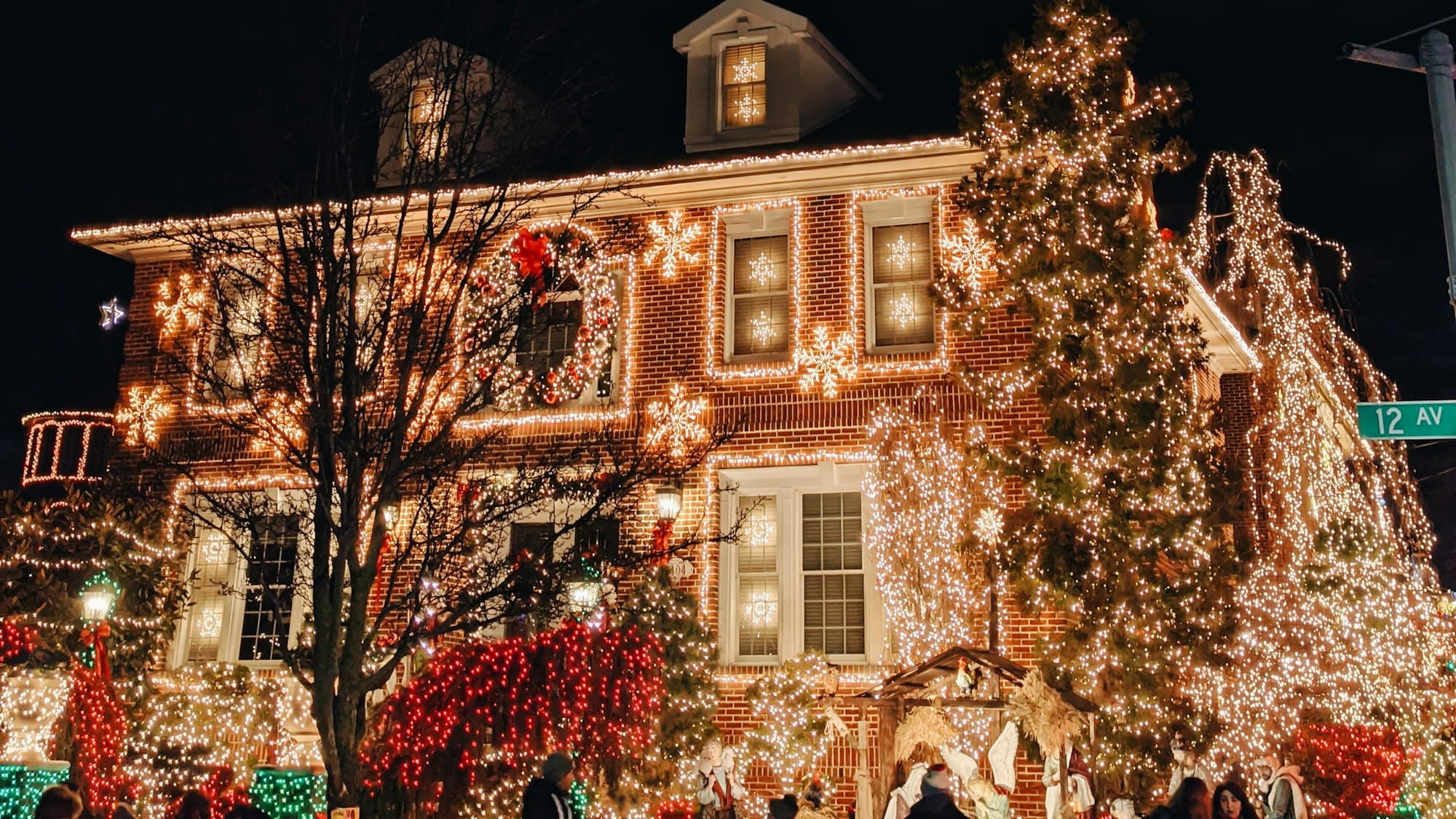
A great outdoor Christmas display isn't about owning the most stuff. It's about lighting the yard in layers (the house, the trees, the ground, and one or two focal points) so the whole property looks composed rather than cluttered. The houses that stop you on an evening drive almost always do less than you'd think, just with better pieces placed deliberately.
This guide is organized the way you'll actually shop: by where each thing goes, from the roofline to the trees and shrubs, the front lawn, the pathway, and the porch. For each zone, here's what's worth buying, what to skip, and the specs that separate a piece that lasts a decade from one that sags after one season.
One principle to carry through all of it: commit to one warm-white color temperature across every lit element, and let your showpieces be the only color. A unified light tone is the biggest difference between a display that looks designed and one that looks like a clearance bin.
Start with the roofline (the biggest payoff)
Nothing transforms a house's exterior like a clean line of light along the eaves and peaks. It's the foundation every other piece builds on, and it's where your first dollar should go.
For the full breakdown of bulb types, counts, and what to buy (C9 vs. mini, LED specs, how many strands per run), see the dedicated Christmas lights buying guide, and use the free Christmas Light Calculator to get the exact bulb count for your roofline before you order. The short version: buy all-LED, warm white, on heavy-gauge wire, and get all-weather light clips so you're not stapling into your fascia.
Our pick
outdoor light clips / gutter clips
The catch is that the roofline is also the hardest, highest, most weather-exposed run to hang yourself. A two-story gutter line in late November is exactly where DIY displays go sideways.
Wrap the trees and shrubs (this adds the depth)
If roofline lights are the outline, lit trees and shrubs are what give a yard dimension, the difference between a flat facade and a display with foreground and background.
- Tree-trunk wraps. Spiral-wrapping a trunk and a few major branches with mini lights is the highest-impact move in the whole yard. Budget roughly 100 mini lights per vertical foot of trunk you wrap; tighter spacing on the trunk, looser as you climb. Use LED string lights rated for outdoor use.
Our pick
outdoor LED mini string lights, warm white
- Net lights for shrubs. Draping a net light over a boxwood or hydrangea takes thirty seconds and looks even and full, far better than trying to weave a string through a bush. One 150-bulb net per medium shrub.
Our pick
LED net lights, warm white
- Pre-lit yard trees. A lit twig tree or birch-style tree on the lawn or flanking the door is a clean, modern showpiece that stores compactly.
Choose your front-lawn focal point
This is where personality comes in, and where restraint matters most. Pick one or two showpieces, not eight.
- Lit figures (deer, sculptural shapes). A lit wireframe or sculptural deer (ideally a buck-and-doe pair, with the buck head-up and the doe grazing) is the timeless, never-tacky choice. Look for welded frames and commercial-grade LED rather than flimsy bent-wire kits that sag.
- Inflatables. Genuinely fun, especially with kids, if you buy one good one and place it deliberately. Get a larger, name-brand model with a strong fan, built-in LEDs, and serious stakes plus tie-downs, because wind will flatten and fray a cheap one. Keep in mind the fan runs continuously, so an inflatable draws more power than several light strands combined, and the Christmas Lights Electricity Cost Calculator shows exactly what yours will add to the bill.
Our pick
large Christmas inflatable, name-brand
- Nativity and large statement figures. A simple outdoor nativity or a single oversized ornament/figure can anchor a lawn elegantly.
A quick rule for the lawn: odd numbers and breathing room. One figure, or a group of three with space between them, almost always looks more intentional than a row of evenly spaced pieces.
Consider smart, app-controlled lights
The biggest recent shift in outdoor lighting is app control. Smart permanent-install systems (Govee and Twinkly both make outdoor lines) mount once under the eaves and stay up year-round, then change color and pattern from your phone: warm white all December, red and white for Valentine's, pastels in spring, off the rest of the year. The upfront cost is higher than a box of C9s, but you climb the ladder exactly once.
Our pick
smart outdoor permanent lights (Govee / Twinkly)
Prefer the effect without the permanent mount? App-controlled smart string lights give you the same phone control and music-sync scenes on a seasonal strand you still take down in January. Either way, the restraint rule holds: just because you can run a rainbow chase pattern doesn't mean the house looks better for it. A steady warm white, with color saved for one accent, almost always wins.
Our pick
app-controlled smart string lights, outdoor
Whichever route you take, an outdoor display adds up quickly, so it's worth setting a number before you start. The free Christmas budget planner helps you plan the whole thing by category.
Light the path and the approach
The walkway is the most overlooked zone, and the one guests actually move through. A lit approach makes the whole property feel finished.
- Pathway stake lights. Lit candy canes, mini lamp-posts, or modern stake markers line a walk or driveway and add a warm guiding glow.
Our pick
Christmas pathway stake lights, C9 string, 25 ft
- Pathway projectors and laser lights. A staked laser or LED projector throws snowflakes or points of light across the facade or a blank wall with zero ladder time, a great low-effort supplement for surfaces you can't string. Treat it as an accent, not a substitute for hung lights.
Our pick
outdoor christmas light projector, weatherproof
Finish at the door and porch
The front door is the close-up moment, the part visitors see from three feet away, so it rewards quality over quantity.
A lit or unlit wreath, garland framing the doorway, and a pair of porch planters or pre-lit topiaries is the complete formula. For exactly what to buy here (fresh vs. artificial, lit vs. unlit, and sizing) see the Christmas wreaths and garland buying guide. To work out how much garland the doorway, posts, and railings actually need, the free Christmas Garland Calculator does the math (with the drape built in).
Don't forget the gear that makes it all work
The unglamorous category that separates a display that runs all season from one that trips a breaker on December 2nd:
- Outdoor-rated extension cords. Never use indoor cords outside.
Our pick
outdoor extension cords, 3-prong outdoor-rated
- A weatherproof outdoor timer or smart plug. Run the display dusk-to-late-evening to save both bulb life and money.
Our pick
outdoor christmas light timer / smart plug
- Ground stakes, gutter clips, and a weatherproof cord connection cover so nothing is stapled, sagging, or sitting in a puddle.
Our pick
Weatherproof cord connection box
The stakes and clips have their own pick above; this is the box that keeps the plug joins dry.
Plug everything into a GFCI-protected outlet, keep connections elevated and dry, and check your total draw before you flip the switch. A standard 15-amp circuit safely carries about 1,440 watts, plenty for thousands of LEDs, but easy to overshoot with old incandescent strings plus inflatable fans. The free electricity cost calculator estimates both your running cost and your load.
Common mistakes to skip
The fastest way to make a display look cheap has nothing to do with budget:
- Mixing color temperatures. A warm-white roofline beside a cool-white tree beside a multicolor inflatable is visual chaos. Pick one white and commit.
- Cramming the lawn. Two pieces placed with space around them beat eight fighting for attention. Restraint looks expensive.
- Buying the cheap version of anything with a motor. Bargain inflatables and animated figures are the first things to fail. Spend up here, or skip them.
- Using indoor lights or cords outside. That's a genuine fire and shock risk, not just a durability problem. Outdoor-rated only, into a GFCI outlet.
- Skipping the timer. Running everything all night burns out bulbs and money. A cheap timer pays for itself in a season.
- Waiting until December to hang. Frozen ground and icy ladders are how the job goes wrong. Install in mild November weather and switch on whenever you like.
The bottom line
Build the display in layers, in this order, and you'll never overspend on the wrong thing:
- Roofline lights, the foundation and the biggest payoff.
- Wrapped trees and net-lit shrubs for depth and dimension.
- One or two lawn showpieces, such as a lit deer, a pre-lit yard tree, or one good inflatable.
- Pathway lighting to make the approach feel finished.
- Door and porch, the close-up moment.
- The right power gear, so all of it runs safely, all season.
Keep the light tone consistent, leave breathing room between pieces, and add one new showpiece each year. A yard built that way looks better every December, and costs less than cramming it all in at once.
Share this guide
Frequently asked questions
What are the best outdoor Christmas decorations to buy first?
Are Christmas inflatables tacky, or worth it?
How do outdoor Christmas light projectors work, and are they any good?
What should outdoor Christmas decorations be made of to last?
How do you power outdoor Christmas decorations safely?
When should you put up and take down outdoor Christmas decorations?
Keep reading
The Best Christmas Lights to Buy (by What You're Lighting)
How to choose Christmas lights and what's actually worth buying, by use case: roofline, trees, shrubs, the indoor tree, garland, and pathways. LED vs incandescent, bulb types, and color temperature explained.
The Best Christmas Movies of All Time (27 Picks, Sorted by Mood)
A curated, honest guide to the best Christmas movies: the undisputed classics, modern favorites, family picks, the funny ones, the romantic ones, and the underrated gems. Plus the eternal Die Hard question, settled.
Christmas Light Ideas for Ranch-Style Homes: The Complete Guide
How to light a ranch home for Christmas: the layering system, the right bulb types, the exact color temperature, and the five-layer plan that flatters the horizontal silhouette instead of fighting it.
Prefer pen & paper?
The Christmas Planner
A 25-page printable kit covering budget, gifts, hosting, and decor, built on the same planning logic as this tool. Print it once, keep it in a binder, and reuse it every year.
Or grab 3 pages free first.
Decor that suits the home you have.
Seasonal decorating tips and the occasional new tool, straight to your inbox. One list, no spam.