By Holiday Home Ideas Editorial Team · May 16, 2026
Scandinavian Christmas Decor: A Complete Hygge Guide
How to decorate for a Scandinavian Hygge Christmas. Fifteen specific ideas built around the principles that actually define the style: warmth, restraint, natural materials, and a lot of candles.
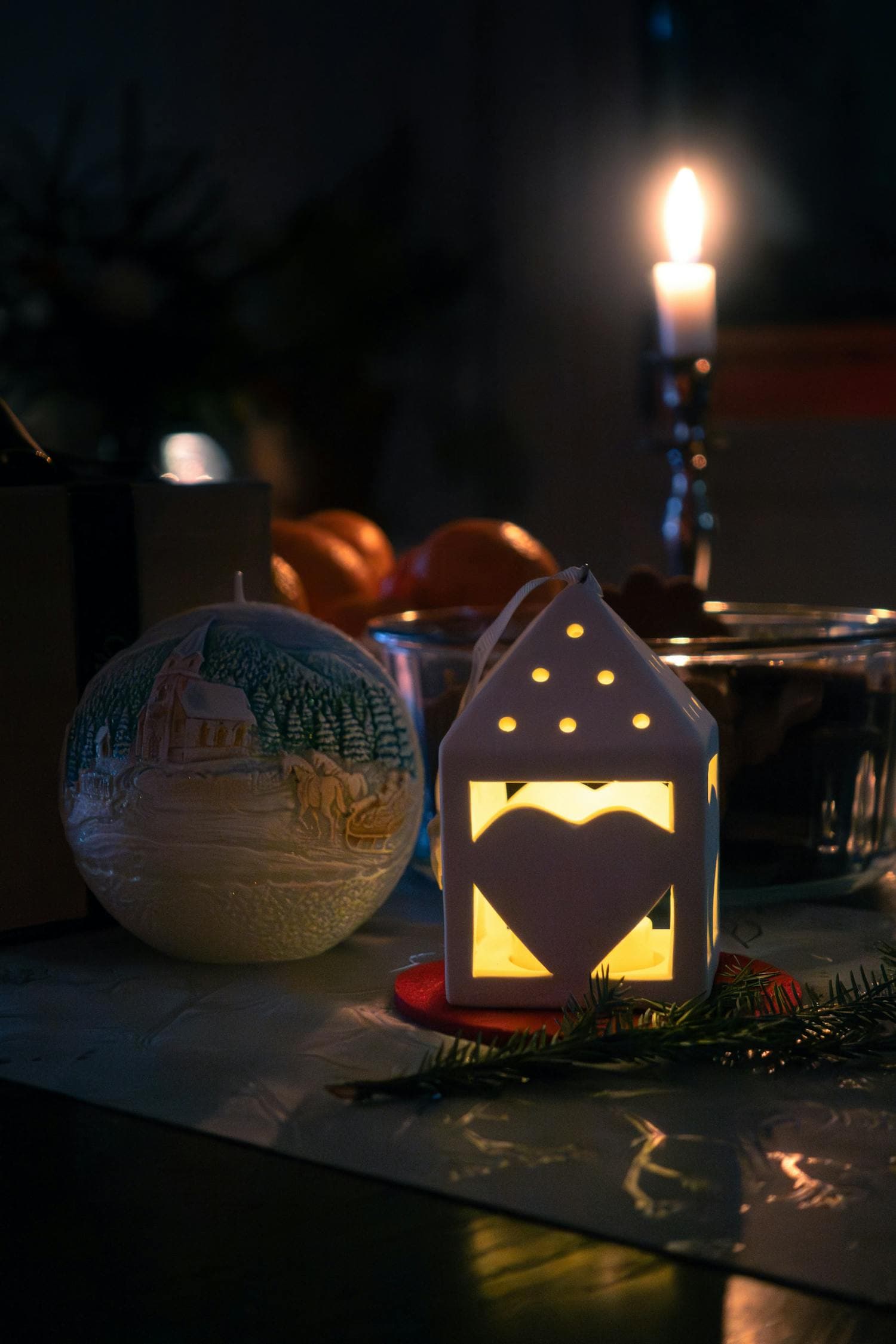
Scandinavian Christmas is the style most accounts get wrong. The Pinterest version is all-white minimalism, sparse, cold, museum-quiet. The actual Scandinavian Christmas, the one you'd see in a Copenhagen apartment or a Stockholm farmhouse, is the opposite of that. It's warm. It's layered. It's heavy on candlelight and textiles. Hygge (Danish: HOO-ga, untranslatable cozy contentment) is the underlying principle, and hygge isn't sparse. It's the warmest holiday aesthetic in the world.
The misreading comes from confusing Scandinavian with Modern Minimalist. They share the restrained palette and the rejection of glitter, but Scandinavian Christmas is built around atmosphere, not austerity. The Modern Minimalist mantel says composed. The Scandinavian mantel says cozy. Same brand of restraint, very different emotional register.
This guide covers 15 ideas designed for a real Scandinavian Christmas, the kind that honors the cultural origin, not the Instagram simplification. Whether you're decorating a small apartment or a full home, the principles are the same: warmth, restraint, natural materials, and candlelight.
Not sure if Scandinavian is your style? The free Christmas Decor Style Quiz takes 8 questions and matches you to one of six styles, with the actual differences between them spelled out. Scandinavian Hygge is one of the six possible results.
Why Scandinavian Christmas works the way it does
Geography is destiny in this case. Christmas in Denmark, Sweden, Norway, Finland, and Iceland happens during the darkest, coldest, most interior season of the year. Sun comes up at 9 AM, sets at 3 PM, sometimes never rises at all in the far north. There's no outdoor Christmas show, no neighborhood-light-tour culture, no front-yard inflatables. The decor is built around the inside of the home because the inside is where everyone lives for the next three months.
That cultural fact shapes the entire aesthetic:
- Candlelight isn't an accent. It's the lighting. Scandinavians burn more candles per capita than any other region in the world. Christmas is the peak season. The warm flickering light against neutral walls is what creates the hygge mood. Overhead lighting is dimmed or turned off entirely in favor of taper candles, tea lights, and fireplace glow.
- Natural materials read as honest, not rustic. Wood, linen, wool, paper, straw. Plastic and glitter signal mass production, which fights the whole intentional-craft origin of the style.
- The palette is consciously desaturated. Bright primary red is American. Bright kelly green is American. Scandinavian uses cranberry, terra cotta, muted sage, colors that have been mixed down. Plus a lot of cream, white, and natural wood as the base.
- Texture does the work color usually does. Knit throws, linen runners, woven straw stars, fur (real or faux) on chairs. The eye finds richness without saturation.
- Restraint is the design, but it's a warm restraint. Not the empty modernist restraint of "less is more." More like "fewer, but better, and arranged with care."
Hold those five things in mind and the ideas below feel like a system rather than a checklist.
The Scandinavian Christmas elements
1. Candles, Candles, More Candles
If you only do one thing, do this. Replace overhead lighting (or supplement it heavily) with candles throughout the main living spaces. The standard Scandinavian setup:
- Cream or white pillar candles on the mantel, dining table, and coffee table
- Taper candles in brass or pewter holders on the dining table
- Tea lights in glass votives scattered on side tables, bookshelves, window sills
- Battery-operated candles in every front-facing window (Scandinavian Christmas tradition that translates beautifully)
For a typical living room + dining room, plan on 15-25 lit candles burning at once during a Christmas evening. That sounds like a lot until you've seen it.
2. Lit Paper or Straw Stars in Every Window
The signature Scandinavian Christmas window treatment: a lit Moravian-style paper star (the geometric pointed star with a bulb inside) hung in every front-facing window. From inside, the warm glow is intimate. From outside, the dark winter facade is dotted with constellation-like lights, magical without being Christmas-y in the multi-color-bulb sense.
Sizes: 18 to 24 inches for living room windows, 12 to 14 inches for smaller windows. White or cream paper is most traditional; warm yellow is the more old-world variant.
Straw stars are the rustic version. Flat, woven, hung from a single piece of twine. Both work; pick one direction and stay consistent through the house.
3. A Restrained Christmas Tree With Real Candles (or LED Candles)
The most traditional Scandinavian Christmas trees are decorated with real lit beeswax candles, yes, actual flames on the tree. Beautiful and unmistakably Scandinavian. Modern fire codes and most American insurance policies make this impractical, so the realistic substitute is warm-white LED candle clips that mimic the flickering candle look without the fire risk.
The tree itself: a real Fraser or Noble fir, decorated with:
- Wood bead garland
- Straw or paper ornaments (woven straw stars, paper hearts, wood mushrooms)
- A few brass or pewter ornaments for shine
- One single small accent color (cranberry red bows, or maybe black silhouette ornaments)
- A straw star or paper star topper instead of an angel
No tinsel. No glitter. No multi-color baubles. The restraint is the design.
If you're not sure what tree size fits your space, the free Christmas Tree Size Calculator recommends a height and shape based on your ceiling and floor space.
4. Fresh Evergreen Everywhere
Real garland (pine, cedar, juniper) on the mantel, the staircase, the dining table runner. Fresh wreaths on every door. Sprigs of evergreen tucked into glasses, picture frames, drawer pulls.
The scent matters as much as the look. A Scandinavian Christmas home smells like fresh pine, beeswax candle, and (if you're really committed) cinnamon and orange from the kitchen. Faux greenery loses the entire olfactory dimension.
If you can't keep fresh greenery alive for the full season, swap it out every 2-3 weeks. The cost ($40-60 per refresh) buys back the authentic feel.
5. Wool and Linen Layered Everywhere
The textile layer is what separates a sparse Scandinavian Christmas from a cozy one. Drape and stack:
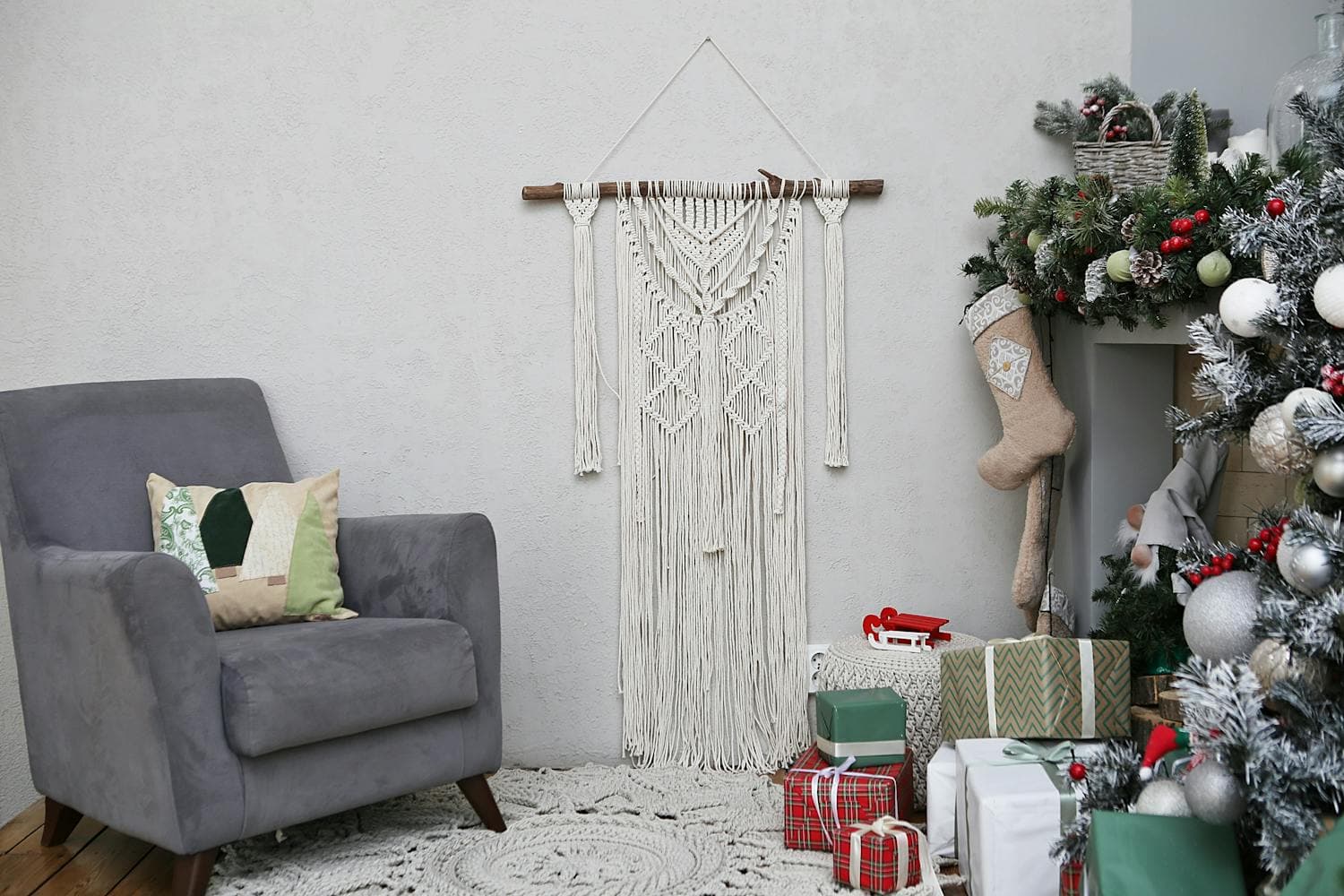
- Cream or oatmeal wool throws on every sofa and armchair
- Linen runners down the dining table (raw-edge or white)
- Linen tea towels as napkins, draped casually rather than folded sharply
- Felted wool hearts or stars as ornaments and garlands
The textiles aren't decorative tchotchkes. They're functional, meant to be wrapped around shoulders during evening reading, draped across laps during dinner. Scandinavian Christmas isn't a museum installation; it's an active, lived-in atmosphere.
6. Heart-Shaped Woven Decorations (Julehjerter)
A Danish Christmas signature. Julehjerter (yule-HEER-ter) are small heart-shaped baskets woven from interlocking strips of colored paper, traditionally red and white. Hung on the tree, used to hold candies, gifted between neighbors. Genuinely Scandinavian in a way few American Christmas decorations are.
You can buy them imported from Danish brands, or weave them yourself in an afternoon, there are templates online, the technique is straightforward. A handful on the tree adds heritage detail in a way no other ornament does.
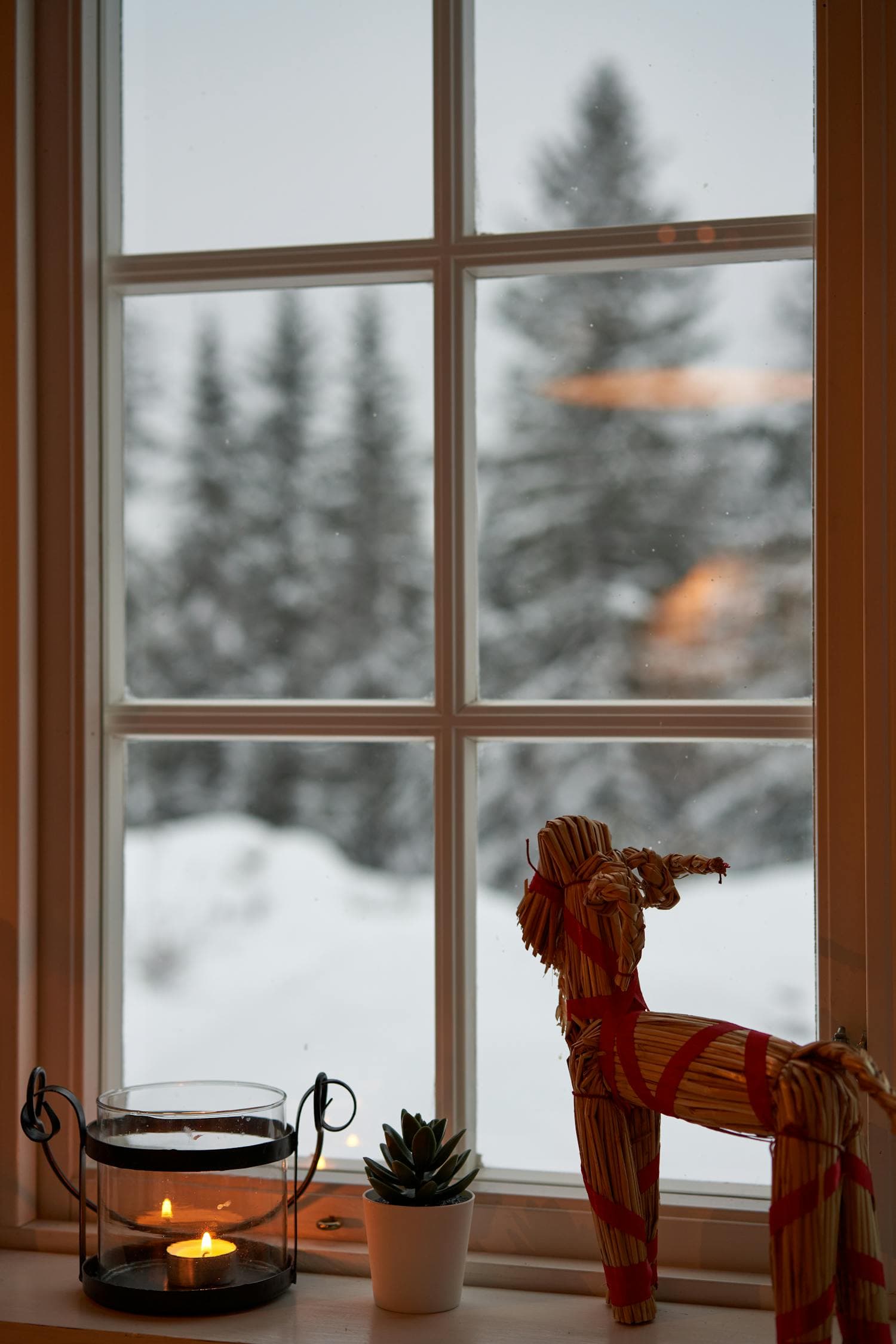
7. A Yule Goat (Julbock) Somewhere Visible
The Swedish Yule goat is woven from straw, banded with red ribbon, ranging from 3 inches to 4 feet tall. Originally a pre-Christian symbol that survived into modern Christmas, now a beloved Swedish Christmas decoration. The town of Gävle erects a giant straw goat every year, and it's been burned by mischief-makers more than 30 times since 1966.
A small straw goat on the mantel, side table, or under the tree adds heritage. A large floor-standing one (24+ inches) makes an unmistakable statement. Either way, it should be visible from the doorway.
8. Hyacinths, Amaryllis, and Paperwhites in Brass
Forced bulbs are the Scandinavian Christmas flower. Plant them in brass pots or simple glass cylinders in mid-November; they bloom right in time for the holiday season. Hyacinths (purple or white) for fragrance, amaryllis (cranberry red) for drama, paperwhites for simple Northern winter beauty.
The brass pot matters, it ties the flowers to the broader brass-and-natural-wood material palette of the room. Skip ceramic or plastic planters.
9. Gingerbread (Pepparkakor) as Ornaments
Hung from the tree, strung as garlands, scattered on tables. Pepparkakor (Swedish gingerbread, thinner and crisper than American) is both decoration and snack. The smell during baking is its own contribution to the hygge atmosphere.
If you're not going to bake, the next best is a few high-quality pre-made gingerbread cookies hung from the tree with red twine. Real beats faux here, gingerbread "ornaments" made of resin are immediately recognizable as wrong.
10. Glögg Setup as Decor
Glögg (Swedish mulled wine) doubles as a decorating element. Set up a permanent station on a console or kitchen counter:
- A pewter or copper pot
- A row of small heat-resistant glasses
- A bowl of blanched almonds and raisins (the traditional add-ins)
- Cinnamon sticks in a small vase
- A handwritten card with the recipe
Lit and used in the evenings throughout the season, with friends and family. The setup itself is Scandinavian Christmas in physical form.
11. Cozy Reading Corners (The Jolabokaflod Setup)
Icelandic Christmas tradition: Jólabókaflóð, the "Christmas book flood." Books are exchanged on Christmas Eve and the family spends the night reading by candlelight. The Scandinavian Christmas home creates space for this whether or not you formally observe the tradition.
- A reading chair pulled close to the fireplace or window
- A stack of unread books in an accessible spot
- A throw and a small side table for a mug
- A single candle or small lamp within reach
Even if no one ends up reading there, the setup signals the atmosphere the whole style is built around.
For a full library of Christmas book recommendations by age, see The Best Christmas Books for Kids. The wrapped-books-advent tradition pairs perfectly with this aesthetic.
12. Dried Orange Slices and Cinnamon Sticks
Threaded onto twine as garland, hung from tree branches, placed in bowls. The smell of dried orange + cinnamon is one of the strongest Scandinavian Christmas scent memories. Making them is easy, slice oranges thin, dry in a 200°F oven for 3 hours, thread on twine.
A 6-foot garland of orange slices and cinnamon sticks on the mantel or above the dining table costs about $4 in oranges and a couple hours of passive baking time. Lasts the whole season.
13. Real Birch Logs in Decorative Stacks
If you have a fireplace, real birch logs stacked beside it (peeled bark, white surfaces facing out) make a striking, understated statement. If you don't have a fireplace, a wooden basket holding birch logs in a corner of the living room substitutes well.
Birch (rather than oak or maple) matters because of the white bark, which fits the Scandinavian palette. Painted-white logs are a common substitute but read as less authentic up close.
14. Christmas Pyramid (Weihnachtspyramide) if You Want Drama
Technically German rather than Scandinavian (a Weihnachtspyramide), but the candle-powered carousel that spins nativity figures or Christmas vignettes has been adopted into Scandinavian Christmas widely. A 3-tier wooden pyramid powered by the heat of small candles is unmistakable holiday craft, and pleasantly old-fashioned in its low-tech mechanics.
Quality matters. Cheap mass-produced versions are flimsy; an Erzgebirge-made German pyramid is heirloom-quality and lasts generations.
15. One Red Accent, Used Sparingly
The single permitted bright color in a Scandinavian Christmas palette is cranberry red, traditional, restrained, used as punctuation rather than a foundation:
- Red ribbon tying packages
- Red wool tomte (small gnome) figurines
- Red velvet stockings (only if otherwise minimal)
- Red Julehjerter on the tree
- Red berries on the wreath
The rule: pick TWO of those, maximum. If you use red ribbon on packages AND red tomte AND red Julehjerter AND red stockings AND red berries, you've crossed into American Traditional Christmas territory. Restraint is the design.
The Scandinavian Christmas palette
| Element | Yes | No |
|---|---|---|
| Base colors | Cream, white, oatmeal, natural wood | Pure black, navy, bright primary |
| Accent | Cranberry red (sparingly), or skip the accent entirely | Kelly green, gold metallic, multi-color |
| Metals | Brass, pewter, copper, unpolished | Chrome, silver, mirror finishes |
| Greenery | Real pine, fir, cedar, eucalyptus | Plastic, glitter-coated, neon |
| Textiles | Wool, linen, felt, fur (real or faux) | Polyester, sequins, satin |
| Lighting | Warm white (2700K), candles, candle-look LEDs | Cool white, multi-color, color-changing |
| Decor materials | Wood, paper, straw, glass, ceramic | Plastic, resin, foam |
Common Scandinavian Christmas mistakes
After enough hygge-attempting living rooms, the same patterns show up:
-
Treating it as Minimalism. Strip away too much and the warmth disappears. Scandinavian is restrained, not empty. The textile layer (throws, runners, fur) is what makes it cozy rather than cold.
-
Skipping candles to "stay safe." The number-one mistake. Plug-in lamps don't substitute. The flickering live flame is the entire mood. Use LED candle alternatives if real flames aren't practical, but don't skip the candle volume.
-
Mixing color palettes. Bright primary red plus cranberry plus cream looks like indecision. Pick cranberry-and-natural OR cream-only OR cream-with-black. Don't mix.
-
Plastic everything. Plastic Yule goat. Plastic gingerbread. Plastic Julehjerter. Even one cheap plastic element in a real-material room ruins the whole illusion. Either commit to real materials or don't bother.
-
Modern farmhouse drift. Buffalo plaid, black metal fixtures, galvanized metal, these are American Modern Farmhouse signals. They feel similar to Scandinavian but cross a brand line. Scandinavian skips plaid, uses brass instead of black metal, and goes natural-paint over galvanized.
A first-year Scandinavian Christmas setup
If you're starting fresh and want a complete look without overbuying:
Lighting:
- 12-piece set of cream pillar candles ($45)
- 6 brass taper candle holders + 12 taper candles ($60)
- 24 tea lights in glass votives ($30)
- 8 battery-operated window candles with dusk-to-dawn timers ($60)
- 4 large lit paper Moravian stars for front-facing windows ($120)
Greenery:
- One 7-foot real Christmas tree ($90)
- 18 feet of fresh garland (mantel + staircase + dining table) ($75)
- One large fresh wreath for the front door ($65)
- Two small fresh wreaths for kitchen windows ($30)
Textiles:
- Two cream cable-knit wool throws ($90)
- One linen table runner ($35)
- Six linen napkins ($30)
- One fur (or faux fur) throw for a reading chair ($60)
Heritage details:
- Small Swedish straw Yule goat ($25)
- Dozen Julehjerter (woven hearts) ($30)
- Garland of dried oranges + cinnamon sticks (make at home, $5)
- Set of 20 wood/paper/straw ornaments ($45)
Total: approximately $895 for a full Scandinavian Christmas. Skip the imported pyramid + add a few amaryllis bulbs and you can get the whole thing under $1,000.
For year-over-year planning (when to buy what, the most-overspent categories), see How Much Does It Cost to Decorate Your House for Christmas?.
Which homes Scandinavian works on
The style is more architecturally flexible than most. It works on:
- Small apartments and studios. Restraint looks deliberate in compact spaces. The textile and candle layer adds warmth that other styles can't deliver at this scale. See Christmas Decor Ideas for Small Apartments for apartment-specific moves.
- Modern Scandinavian or Nordic-style homes. Obviously. The architecture and the decor speak the same language.
- Modern homes with neutral palettes. Mid-century modern, contemporary, modern farmhouse-leaning. The shared restraint-and-natural-material vocabulary translates.
- Cottages and bungalows. The warmth of hygge fits the intimate scale of smaller traditional homes well.
It works less naturally on:
- Victorian and ornate traditional. The architecture wants abundance; Scandinavian's restraint comes off as understyled. (See Victorian Christmas Decorating Ideas for the abundance-first alternative.)
- Mediterranean and Spanish Revival. The warm-stucco palette fights with the cool-cream Scandinavian base.
- Federal-era and grand colonial. Formal symmetry expects formal decor; hygge's casual coziness looks under-dressed.
The honest answer for most homes
If you're paralyzed by the choices: buy more candles. The candle volume is what separates a "Scandinavian-inspired" attempt from a real Scandinavian Christmas. Everything else is supporting cast.
Beyond that: pick natural materials over synthetic, pick texture over pattern, pick fewer-but-real over many-but-faux. Add one cranberry accent only after the rest is set, not as a starting point.
The aesthetic was built by people living through 18-hour Nordic winter nights. It rewards going slower, having less, and lighting more candles than feels reasonable. Do that, and the room takes care of itself.
Related guides:
- Modern Minimalist Christmas Mantel Ideas: the closest neighbor style, also restrained but more austere
- Christmas Decor Style Quiz: 8 questions to confirm Scandinavian is the right match for your home
- Christmas Tree Size Calculator: pick the right tree height for your space
- Christmas Decor Ideas for Small Apartments: the small-space sibling style guide
- Christmas in Iceland: the full deep-dive into the thirteen Yule Lads, the Christmas Book Flood (jólabókaflóð), hangikjöt, and why an Icelandic Christmas Eve is the most beautiful reading night of the year
- Christmas in Sweden: the full deep-dive into St. Lucia processions, the julbord buffet, the country-wide 3:00 PM Donald Duck broadcast, and Jultomte
- Christmas in Denmark, Christmas in Norway, and Christmas in Finland: the three other Nordic Christmas traditions that share the visual and culinary language
Share this guide
Frequently asked questions
What is a Scandinavian (Hygge) Christmas?
What colors define Scandinavian Christmas decor?
How is Scandinavian Christmas different from Modern Farmhouse?
What's the most important element of a Scandinavian Christmas?
Do you need real evergreen for a Scandinavian Christmas?
What's the Scandinavian tradition of paper stars in windows?
Keep reading
Christmas Decor Under $50 That Looks Expensive
Expensive-looking Christmas decor is a materials trick, not a budget trick. Velvet, brass, real-feel greenery, and warm light read as rich at any price. Seven under-$50 pieces that prove it, and the cheap tells to avoid.
The Best Outdoor Christmas Decorations to Buy (by Where They Go)
What outdoor Christmas decorations are actually worth buying, organized by where they go in your yard: the front lawn, pathways, trees and shrubs, the roofline, and the porch. Inflatables, lit figures, projectors, and the practical gear that makes it all work.
The Best Christmas Color Schemes for Traditional Homes
Traditional Christmas colors aren't just red and green, there's significant range within the classic palette. Six color schemes that work for traditional homes, with the layering rules behind each.
Prefer pen & paper?
The Christmas Planner
A 25-page printable kit covering budget, gifts, hosting, and decor, built on the same planning logic as this tool. Print it once, keep it in a binder, and reuse it every year.
Or grab 3 pages free first.
Decor that suits the home you have.
Seasonal decorating tips and the occasional new tool, straight to your inbox. One list, no spam.