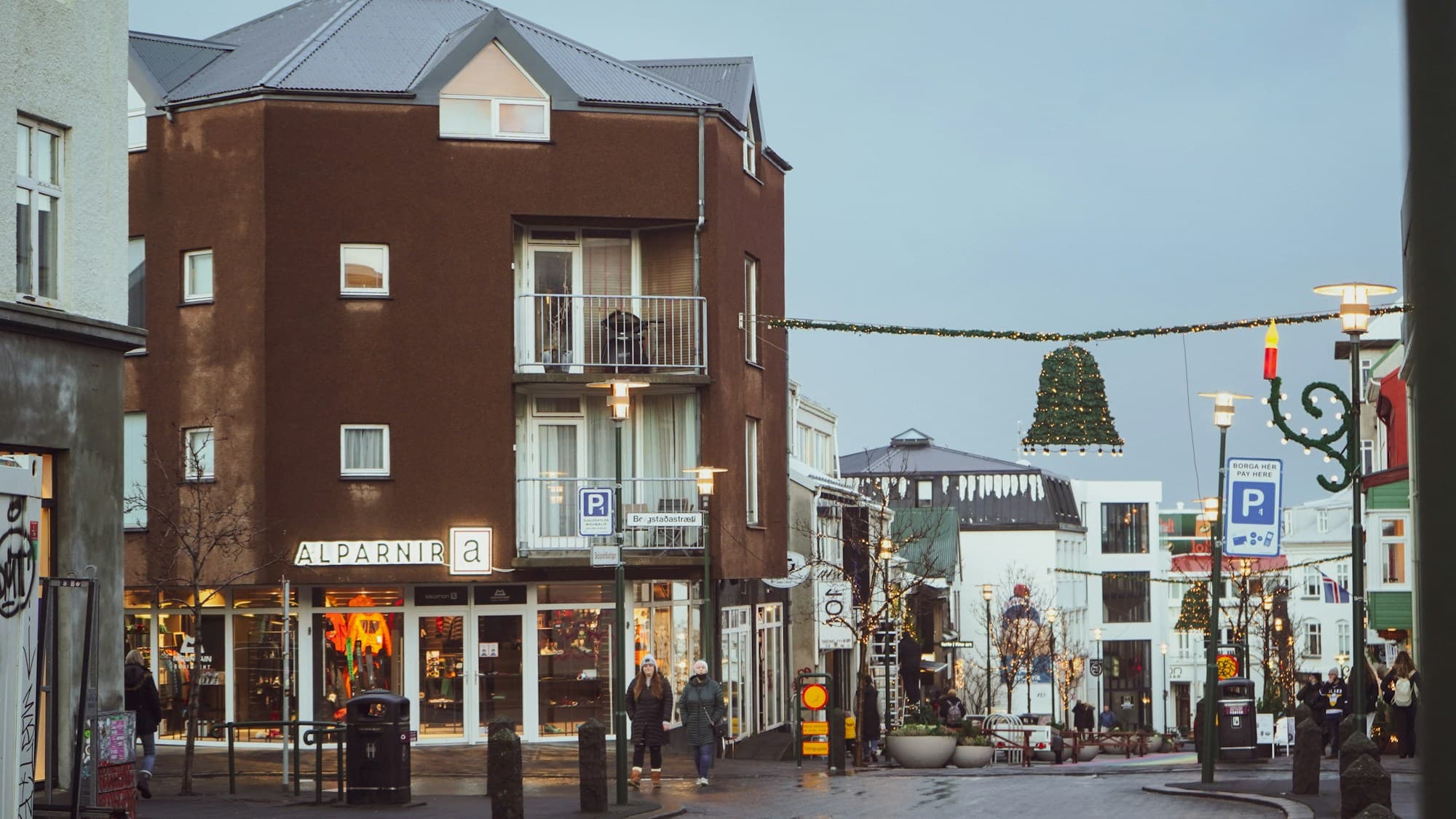
Christmas in
Iceland
Celebrated: December 12 through January 6 (the 13 days of the Yule Lads)
Signature traditions
- 1.The 13 Yule Lads (Jólasveinar), mischievous trolls who visit one by one in the 13 nights leading up to Christmas
- 2.Children leaving a shoe in the window each night, good kids get small gifts, bad kids get a rotten potato
- 3.The Yule Cat (Jólakötturinn), a giant cat that eats anyone who didn't receive new clothes for Christmas
- 4.Jólabókaflóð, the 'Christmas book flood,' where Icelanders give books on Christmas Eve and spend the night reading
- 5.Hot chocolate and lit candles around midnight on Christmas Eve
What's on the table
Hangikjöt and laufabrauð
Hangikjöt is smoked lamb served with potatoes in white sauce. Laufabrauð (leaf bread) is paper-thin, deep-fried bread cut into intricate patterns, families gather to cut the designs together.
The iconic decoration
Candles and books
Iceland's dark winter shapes the aesthetic: every window has candles, and books are stacked everywhere as gifts and decorations.
How gifts are given
The 13 Yule Lads each leave a small gift in children's shoes on the 13 nights before Christmas. Larger family gifts are exchanged on Christmas Eve.
But who delivers yours?
Iceland's gift-giver is The Yule Lads. But there are eight cultural Christmas gift-givers worldwide — Santa, La Befana, the Yule Lads, Ded Moroz, Sinterklaas, the Three Kings, Christkind, and Joulupukki. Take the 6-question quiz to find your match.
Take the gift-giver quizDid you know?
The Yule Lads have wonderfully specific personalities and names (Pot-Scraper, Door-Slammer, Sausage-Swiper, Window-Peeper, and Spoon-Licker among them), each visiting a different night and named after the mischief they cause.
The shape of the season
Christmas in Iceland is a thirteen-day affair, and that's not a metaphor. The season officially opens on December 12, when the first of the thirteen Yule Lads comes down from the mountains, and runs through January 6, the day the last of them goes home. In between, you get one of the most distinctive Christmas cultures in the world: a blend of medieval Norse folklore, deep Lutheran tradition, and a uniquely Icelandic obsession with books and chocolate.
The high point is Christmas Eve, aðfangadagur, when the radio broadcasts the church bells of Reykjavík's cathedral at exactly 6:00 PM and the country effectively pauses. Stores close. Families sit down to dinner. Gifts are opened that evening, not Christmas morning. Then the new books arrive, which is a sentence that requires its own explanation.
The Yule Lads
The Yule Lads (jólasveinar) are thirteen brothers, the sons of an ogress named Grýla who lives in the mountains and eats naughty children. Each of the brothers has a specific name, a specific personality, and a specific bad habit. They come down from the mountains one by one in the thirteen nights leading up to Christmas, and one by one they go home in the thirteen nights after.
The thirteen, in order of arrival:
- Stekkjarstaur: Sheep-Cote Clod, harasses sheep
- Giljagaur: Gully Gawk, hides in ravines and steals milk
- Stúfur: Stubby, short and steals from frying pans
- Þvörusleikir: Spoon-Licker, licks wooden spoons
- Pottaskefill: Pot-Scraper, steals leftovers from pots
- Askasleikir: Bowl-Licker, hides under beds waiting for a bowl
- Hurðaskellir: Door-Slammer, slams doors at night
- Skyrgámur: Skyr-Gobbler, eats all the skyr
- Bjúgnakrækir: Sausage-Swiper, hides in rafters and steals sausages
- Gluggagægir: Window-Peeper, peers in windows looking for things to steal
- Gáttaþefur: Doorway-Sniffer, has an enormous nose and a love for baked goods
- Ketkrókur: Meat-Hook, uses a hook to steal meat
- Kertasníkir: Candle-Stealer, follows children to steal their candles
Each night beginning December 12, a Lad arrives and Icelandic children put a shoe in their bedroom window. If they've been good, the Lad leaves a small gift, usually candy or a small toy. If they've been bad, they get a rotten potato. The next night, the next Lad arrives. By Christmas Eve all thirteen are in town. Then they begin leaving, one by one, until þrettándinn (the thirteenth day, January 6) when Kertasníkir goes home and Christmas is over.
The Yule Lads were softened considerably in the twentieth century. The medieval versions were genuine bogeymen, the kind parents threatened their children with, and Grýla was used in earnest as a fearsome figure. In 1746 the Danish king (Iceland was then a Danish colony) actually banned parents from frightening children with the Yule Lads. They've since evolved into something closer to the American Santa: still mischievous, but charming rather than terrifying. A Reykjavík kid in 2026 thinks of them as funny old men in folk costumes, not as actual home-invading thieves.
The Christmas Book Flood
Iceland's defining Christmas tradition is jólabókaflóð, the Christmas Book Flood. Most of Iceland's annual book sales happen in the weeks leading up to Christmas. Books are the default Christmas gift, given to nearly everyone, opened on Christmas Eve, and read late into the night accompanied by hot chocolate and the kind of focused quiet that only exists in a country with 350,000 people and a deep winter.
The tradition's origin is straightforward. During World War II, paper was one of the few imports Iceland could still get reliably while other goods were rationed. Books became one of the few things you could actually give as a gift. The Icelandic publishing industry built itself around this season. Most new titles still drop in October and November, and most authors release their work specifically for the Christmas market. A free book catalogue called Bókatíðindi is mailed to every household each November, listing every new title published that year. People mark up their copy, plan their gift-giving, and order accordingly.
The end-result: on Christmas Eve, after the meal, an Icelandic family typically gathers in the living room and unwraps a stack of books each. Then everyone reads in silence for the rest of the night. It is genuinely the most beautiful Christmas tradition in the world, and it produces a country where 50% of adults still read at least eight books a year, one of the highest rates anywhere.
At the table
Christmas Eve dinner is the meal of the year. The main course varies by family but the two most traditional choices are:
- Hangikjöt: smoked lamb, served sliced with white sauce, peas, and red cabbage. The lamb is cured for weeks in smoke from birch wood or dried sheep dung (yes, really; the latter is the traditional method, though birch is now more common in urban kitchens). It comes out intensely flavored and salty, with a smokiness that's distinctively Icelandic.
- Hamborgarhryggur: Danish-style smoked pork loin, glazed, served with potatoes and red cabbage. More recent in popularity but now nearly as common as hangikjöt in younger households.
The starters and sides go deep. Laufabrauð, "leaf bread," is a paper-thin fried flatbread, intricately cut with patterns before frying. Families gather in early December to cut and fry the year's batch together. It's both a food and a craft. Síld (pickled herring) in multiple variations. Möndlugrautur, almond rice pudding, with a single whole almond hidden in the pot; whoever gets it in their portion wins a small prize.
The drink is jólabland, a non-alcoholic mix of malt soda (Malt) and orange soda (Appelsín) in equal parts. It tastes like a cross between root beer and Fanta, and almost no one drinks it any other time of year. Ölgerðin Egill Skallagrímsson, Iceland's historic brewery and the maker of both Malt and Appelsín, releases a pre-mixed Christmas edition each November and it sells through immediately.
For Christmas Day itself, the meal is leftovers, and that's the point. Christmas Eve was the work; Christmas Day is rest.
Inside the home
Icelandic homes lean restrained and Scandi-minimal, not maximalist. The tree is usually real, either Norwegian spruce or a Danish-imported variety, and decorated with simple white lights, straw stars, wooden ornaments, and small Icelandic flags strung as garland, a flag-on-the-tree habit Iceland shares with its Nordic neighbors. Jólasveinar figurines from the Yule Lads tradition appear on shelves and in window displays, with the specific Lad on duty that night sometimes given a place of honor.
Candles are everywhere. The advent calendar in many homes is a wooden one with four candles, lit one per week through Advent. The Icelandic version of this tradition was imported from Germany but has fully naturalized. Aðventukrans candles burn on dining tables. Window candles are common (LED, mostly, these days) and are left lit all night through the dark winter weeks.
How gifts are given
The Yule Lads handle the small daily gifts in the shoe (December 12 through Christmas Eve, one per night). The main gift exchange happens on Christmas Eve after dinner, around the tree, and is purely a family affair. The gifts themselves tend to be modest by American standards. Icelanders are slightly embarrassed by lavish gift-giving, and the cultural ideal is something thoughtful rather than something expensive. Books, hand-knitted lopapeysur (the iconic Icelandic wool sweater), and chocolate are the safe defaults.
Children write letters to the Yule Lads, which in modern Iceland are routed to the postal service's Christmas address and answered with a thank-you note from whichever specific Lad's turn it is to visit that night.
If you wanted to borrow this tradition
Start with jólabókaflóð. Nothing about it depends on Iceland, and it improves any holiday it touches. The whole recipe: buy books for everyone in the family, exchange them on Christmas Eve, and then read together. No spending pressure, no Pinterest staging, no clutter. The closest American analog is hygge, but books-as-gifts gives the evening a structure and a destination that hygge alone doesn't have.
The Yule Lads are harder to borrow without context, but the shoe-in-the-window mechanic adapts well. Small daily gifts in the run-up to Christmas, spaced across multiple nights, make for a much more interesting rhythm than a single Christmas-morning avalanche. American families with young kids could easily adopt the format using just one or two stand-in characters.
The food traditions don't really export, since hangikjöt is hard to make without weeks of curing, but pickled herring, almond rice pudding, and a single hidden almond in the dessert all travel surprisingly well to American tables.
Did you know
- Iceland's capital, Reykjavík, sees only about four hours of daylight on Christmas Eve. The candles, the Christmas market lights, and the home decorations are functional, not just decorative. They're how Icelanders see in December.
- The Yule Cat (jólakötturinn) is a giant black cat that, per the old folklore, eats anyone who hasn't received new clothes by Christmas. This is partly why knitted sweaters are such a common gift. Historically, parents made sure each child received at least one new wool item before Christmas Eve specifically to protect them from the cat. The tradition persists even though no one really believes in the cat anymore.
- Iceland publishes more books per capita than almost any country on earth. The Christmas Book Flood is a major reason; the publishing economics work because Q4 sales are so concentrated.
More from Europe



Bring a little of it home
Borrowing one tradition from somewhere else is how most of the traditions on this page started.
Free AI tool
See your own home decorated
Upload one photo and watch your room or house transform, before you buy anything.
Interactive map
All 41 countries
Gift-givers, feast tables, and the surprising customs most articles skip.
City guides
Lights worth the drive
The best displays in 40 US cities, including the free neighborhoods.
More Christmas traditions across Europe
Christmas ideas for your own home.
Seasonal decorating tips and the occasional new tool, straight to your inbox. One list, no spam.