Christmas in
Germany
Celebrated: December 24 (Heiligabend) through December 26
Signature traditions
- 1.Christmas markets (Weihnachtsmärkte) that fill town squares from late November through Christmas Eve
- 2.Advent calendars with 24 numbered doors, opened one per day in December
- 3.Lighting one Advent wreath candle per Sunday for the four Sundays before Christmas
- 4.St. Nicholas Day on December 6, children leave shoes out for small gifts and treats
- 5.Christmas Eve gift exchange (German children open presents on the 24th, not the 25th)
What's on the table
Stollen, lebkuchen, and Christmas goose
Stollen (a dense bread with marzipan, dried fruit, and powdered sugar) and lebkuchen (gingerbread) are baked weeks ahead. Christmas dinner is often roast goose with red cabbage and dumplings.
The iconic decoration
The Christmas pyramid and glass ornaments
The Weihnachtspyramide is a wooden carousel powered by candle heat that spins nativity figures. Hand-blown glass ornaments from the Erzgebirge region became the global standard.
How gifts are given
Christkind (Christ Child) brings gifts on Christmas Eve in southern Germany; Weihnachtsmann (Father Christmas) handles delivery in the north. Either way, gifts appear under the tree on the 24th.
But who delivers yours?
Germany's gift-giver is Christkind. But there are eight cultural Christmas gift-givers worldwide — Santa, La Befana, the Yule Lads, Ded Moroz, Sinterklaas, the Three Kings, Christkind, and Joulupukki. Take the 6-question quiz to find your match.
Take the gift-giver quizDid you know?
Germany invented the modern Christmas tree tradition. The first decorated trees appeared in the 16th century in Strasbourg, and the custom spread globally after Queen Victoria's German-born husband Prince Albert popularized it in England.
The shape of the season
If you trace most of modern Christmas back to its source, you arrive in Germany. The Christmas tree, Advent calendars, the gingerbread house, stollen, the Christmas market. All of them are German inventions or German-elaborated traditions that the rest of the West later adopted. Germans take this lineage seriously. Christmas in Germany feels like a more carefully kept version of the holiday Americans think they're celebrating, with sharper edges, deeper rituals, and a much earlier start.
The season runs from late November through January 6 (Epiphany), but the real cultural beats are: Advent (the four Sundays leading up to Christmas), December 6 (St. Nicholas Day), December 24 (Christmas Eve, Heiligabend, the main gift-giving night), and December 25-26 (two full holiday days, both with their own meal traditions).
The opening signal is the lighting of the first Advent candle, four Sundays before Christmas. The closing signal is Heilige Drei Könige (Three Kings Day) on January 6, when costumed children in many southern German towns walk door to door chalking blessings above doorframes. In between, every weekend is choreographed by the Christmas market, the church, and the kitchen.
The Christmas market
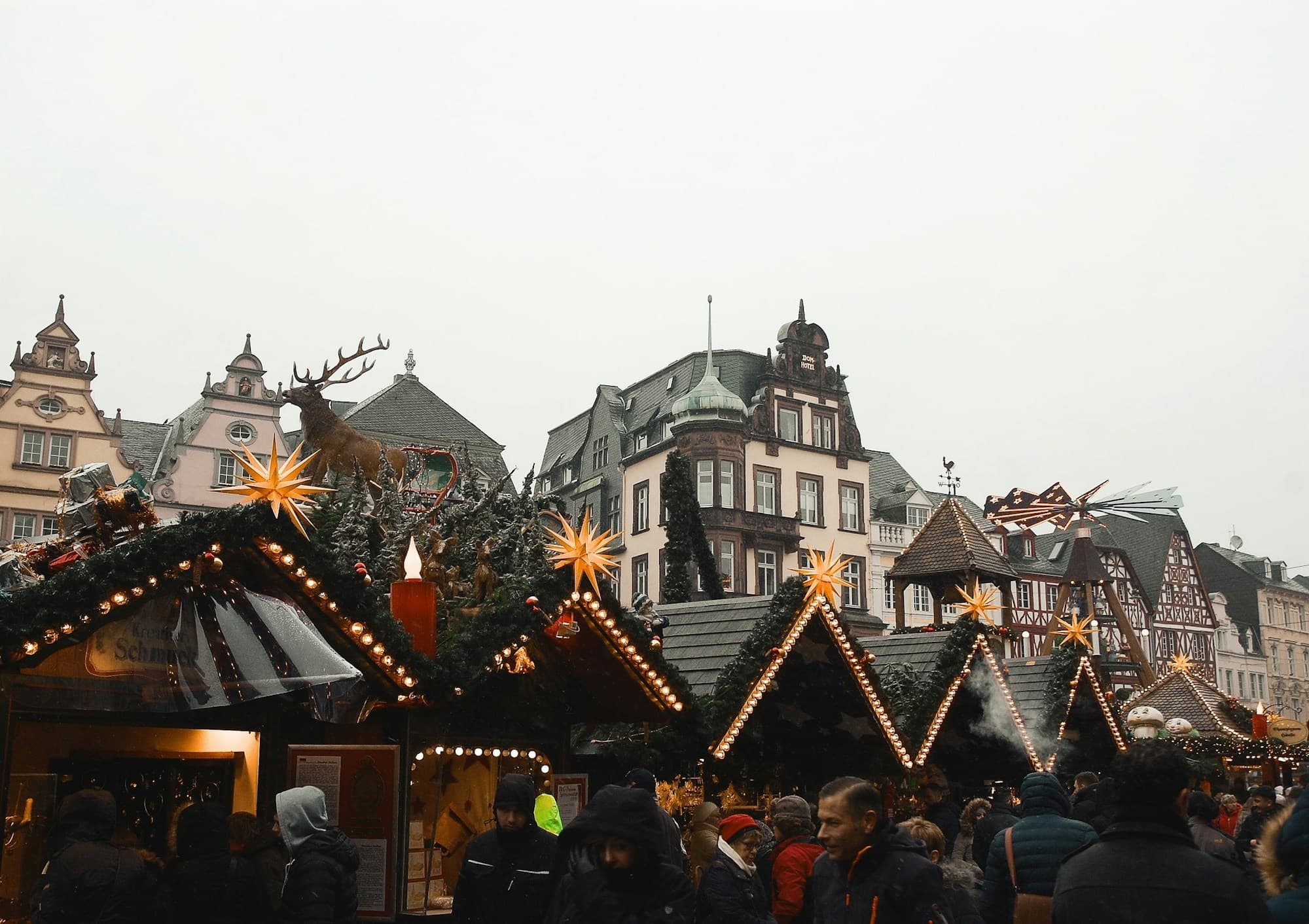
The German Weihnachtsmarkt, or Christmas market, is the most exported and most influential German Christmas tradition. Almost every German town of any size runs one. The major markets in Nuremberg, Dresden, Cologne, Munich, Stuttgart, and Frankfurt each draw millions of visitors over the season.
The format is consistent: small wooden stalls arranged in the town square or main pedestrian street, opening in late November and running through Christmas Eve. Each market has the same core categories of stalls: handcrafted ornaments, candles, wooden toys, leather goods, beeswax products, knitted items, and a heavy concentration of food and drink.
The food canon at any German Christmas market includes:
- Glühwein: hot mulled red wine, spiced with cinnamon, cloves, star anise, orange peel, and sometimes a sugar cube set on fire (Feuerzangenbowle). Served in a souvenir mug; you pay a small deposit (Pfand) for the mug and either return it or keep it as a souvenir.
- Bratwurst: grilled in a small roll with mustard, often a specifically regional sausage (Nuremberg's are short, Thuringia's are long).
- Reibekuchen or Kartoffelpuffer: fried potato pancakes, served with apple sauce.
- Flammkuchen: Alsatian/Black Forest thin crispy flatbread with crème fraîche, bacon, and onion.
- Lebkuchen: gingerbread, sold in large heart-shaped versions strung on ribbon with iced messages, or in small honey-cake versions from Nuremberg (Nürnberger Lebkuchen, a protected origin product).
- Stollen: the iconic German Christmas bread, especially Dresden's Dresdner Stollen (also protected origin).
- Gebrannte Mandeln: candied roasted almonds, made fresh in copper kettles you can watch.
The atmosphere is engineered. Live brass-band Christmas music. Strung overhead lights. The smell of woodsmoke, mulled wine, and frying onions. Crowds in heavy coats with red noses, leaning on standing tables. Children riding the small carousel at the market's edge.
The Nuremberg market (Nürnberger Christkindlesmarkt) is the most famous. It dates to the mid-16th century and opens each year with an address by the Christkind, traditionally a teenage girl in a gold dress and curls who is selected through a city-wide competition.
Advent
Advent is taken extremely seriously in German Christmas culture, far more than in American practice. Four candles in an evergreen wreath (Adventskranz) on a central table; one is lit each Sunday at family gathering. The first Sunday of Advent is the cultural opening of Christmas. Stollen is broken into for the first time. Christmas markets open the following week. The tree, however, is not put up until much later, December 23 or December 24 itself, in most traditional households.
The German Adventskalender, or Advent calendar, is the most exported Christmas tradition after the Christmas market. The classic German version is a printed cardboard scene with 24 numbered windows, each opening to reveal an illustration of a Christmas object or scene. The chocolate-filled commercial version is a 20th-century derivation. Many German families still make their own: a homemade calendar with 24 small wrapped packages or envelopes hung on a string or pinned to a wall.
A particularly beautiful German Advent tradition is the Schwibbogen: illuminated wooden arches placed in windows, typically with carved scenes of miners' processions, Christmas village scenes, or nativity tableaux. Originating in the Erzgebirge mining region of Saxony, they're now ubiquitous across Germany and are one of the most distinctive visual markers of a German Christmas window.
St. Nicholas and Krampus
December 6, Nikolaustag, is one of the most-loved days of the German Christmas season, especially for children. The night before, children leave a polished shoe outside their bedroom door (or by the front door). In the morning, the shoe is filled with small gifts, sweets, oranges and nuts, left by St. Nicholas (Sankt Nikolaus), a separate figure from the Christmas Eve gift-giver.
St. Nicholas is the traditional German Christmas figure. He wears the red bishop's robes and miter (not the Coca-Cola Santa suit), carries a staff, and travels with a companion who plays the bad cop. In southern Germany and Austria, that companion is Krampus, a horned, fur-covered, chain-rattling demon-figure who punishes bad children by carrying them off in a basket. In some regions Krampus has been replaced by the gentler Knecht Ruprecht (a sooty man with a rod) or simply not represented.
Krampus remains a major Alpine Christmas event. The night of December 5 sees Krampuslauf (Krampus runs) in towns across Bavaria, Austria, and Slovenia, where adults in elaborate hand-carved wooden Krampus masks and full goat-skin costumes parade through town squares scaring children (in a sanctioned, performative way). The masks are extraordinary folk art objects, often passed down through families and worn only on this one night per year.
Christmas Eve and Christmas Day
In Germany, Christmas Eve is the main event, not Christmas Day. Heiligabend, December 24, is when the tree is lit for the first time (in many traditional families, children don't see it until the parents reveal it that evening), gifts are exchanged, and the family attends Christmette (midnight Mass) or a candlelit Christmas Eve service.
The Christmas Eve meal varies by family, but the most common choice across Germany is strikingly simple: potato salad with sausages (Würstchen), or a fish dish. Some families go more elaborate, with Karpfen (carp) or fondue. The simplicity of the Christmas Eve dinner is intentional; the big feast is saved for Christmas Day lunch.
Christmas Day (erster Weihnachtstag) is the day of the major meal. The canonical dish is Weihnachtsgans (Christmas goose), served with red cabbage, dumplings (Knödel or Klöße), and a rich pan gravy. In southern Germany and Bavaria, the alternative is Sauerbraten (marinated pot roast) or roast pork. The meal extends across the afternoon and is followed by Weihnachtsbäckerei, the Christmas cookie spread, featuring vanilla crescents (Vanillekipferl), Spritzgebäck, cinnamon stars (Zimtsterne), and gingerbread of every form.
December 26 (zweiter Weihnachtstag) is a second Christmas Day, another full holiday traditionally for visiting extended family or friends with whom you didn't spend Christmas Day. The German Christmas season takes two full holidays, neither of which is the day Americans treat as the main one.
Inside the home
The German Christmas tree is real, deeply traditional, and lit with real candles in the most conservative households. (LED candles are now nearly universal among younger families, with electric candle-shaped lights threaded through the tree.) The decorations lean heavy and ornate: hand-blown glass ornaments (the Thuringian town of Lauscha is the birthplace of the blown-glass Christmas ornament), straw stars, wooden figurines, and a star or angel topper.
Below the tree sits the Krippe, the nativity scene, often a multi-generational object, sometimes hand-carved from limewood in Oberammergau (a Bavarian town famous for its woodcarving workshops) or Bavaria's Berchtesgadener Land. Many German families have a Krippe that has been added to over decades, with each generation contributing a new figure or two.
The home smells of beeswax candles, fresh evergreen, Lebkuchen, Glühwein simmering on the stove, and roast goose. The combination is so consistent across German homes that it's effectively the country's olfactory signature for December.
How gifts are given
Three gift-giving moments in the German Christmas season:
- December 6 (St. Nicholas Day): Small gifts and sweets in the polished shoe overnight from December 5-6. Universal across Germany.
- December 24 (Christmas Eve): The main gift-giving moment, in the evening, around the tree. In Catholic southern Germany, gifts are brought by the Christkind (the "Christ child," depicted as a winged angel-like figure with curly blonde hair). In Protestant northern Germany, gifts are brought by the Weihnachtsmann (the Christmas man, more similar to Santa Claus). Both deliver to good children only.
- January 6 (Three Kings Day): Small additional gifts in some traditions, often candy or oranges. Less universal than the other two dates.
The Christkind/Weihnachtsmann split is one of the more interesting cultural details. In any given German town, the local convention is one or the other, and Germans from different regions will gently argue about which is the "correct" Christmas gift-giver.
If you wanted to borrow this tradition
The German Christmas market works at smaller scale in American backyards, neighborhood streets, and church basements. The required elements are short and clear: a string of stalls (or just folding tables) with handcrafted goods, mulled wine and hot cider in souvenir mugs, bratwurst grilled outdoors, and live music. The format works for any community gathering and produces an instantly recognizable Christmas-market atmosphere with relatively little setup.
The Advent calendar is the most exportable single tradition. Americans already use them but rarely treat them with the German cultural weight. A hand-made fabric or wooden calendar with 24 small daily packages (a poem, a small toy, a square of chocolate, a single sentence about a Christmas memory) becomes a genuine December ritual in a way that the chocolate-only commercial version doesn't.
The St. Nicholas Day shoe is one of the easiest borrowable Christmas traditions. The night of December 5, kids polish a shoe and leave it by the door. The next morning, a small gift (an orange, a piece of chocolate, a small toy) appears in it. It costs almost nothing, takes five minutes, and adds a quiet pre-Christmas anticipation moment that pairs beautifully with the larger December 25 gift exchange.
Did you know
- The Christmas tree itself is a German invention, dating to the early 1500s in the Alsace region (then part of Germany). The custom spread to England via Prince Albert's marriage to Queen Victoria in 1840 and then to the United States in the late 19th century. The whole modern Christmas-tree tradition is essentially exported German practice.
- Stille Nacht ("Silent Night") was composed in 1818 in the small village of Oberndorf bei Salzburg (in what's now Austria but was culturally German territory). It was written for guitar accompaniment because the church organ had broken. The melody has since been translated into more than 300 languages.
- The hand-carved Christmas ornaments and figurines from Erzgebirge, in Saxony, are still made in small family workshops that have been operating in some cases for 200+ years. The classic Erzgebirge nutcracker, the figure most American kids associate with The Nutcracker ballet, began in these workshops as the miners' caricature of authority figures: kings, soldiers, and gendarmes given oversized jaws to crack nuts with.
More from Europe


Bring a little of it home
Borrowing one tradition from somewhere else is how most of the traditions on this page started.
Free AI tool
See your own home decorated
Upload one photo and watch your room or house transform, before you buy anything.
Interactive map
All 41 countries
Gift-givers, feast tables, and the surprising customs most articles skip.
City guides
Lights worth the drive
The best displays in 40 US cities, including the free neighborhoods.
More Christmas traditions across Europe
Christmas ideas for your own home.
Seasonal decorating tips and the occasional new tool, straight to your inbox. One list, no spam.