By Brian · August 19, 2026
How to Plan a Christmas Party (The Order It Actually Goes In)
A complete Christmas party plan: choosing the date and format, how many people your rooms hold, the food and drink math per guest, a realistic budget per head, and an eight-week timeline that ends with the host enjoying their own party.
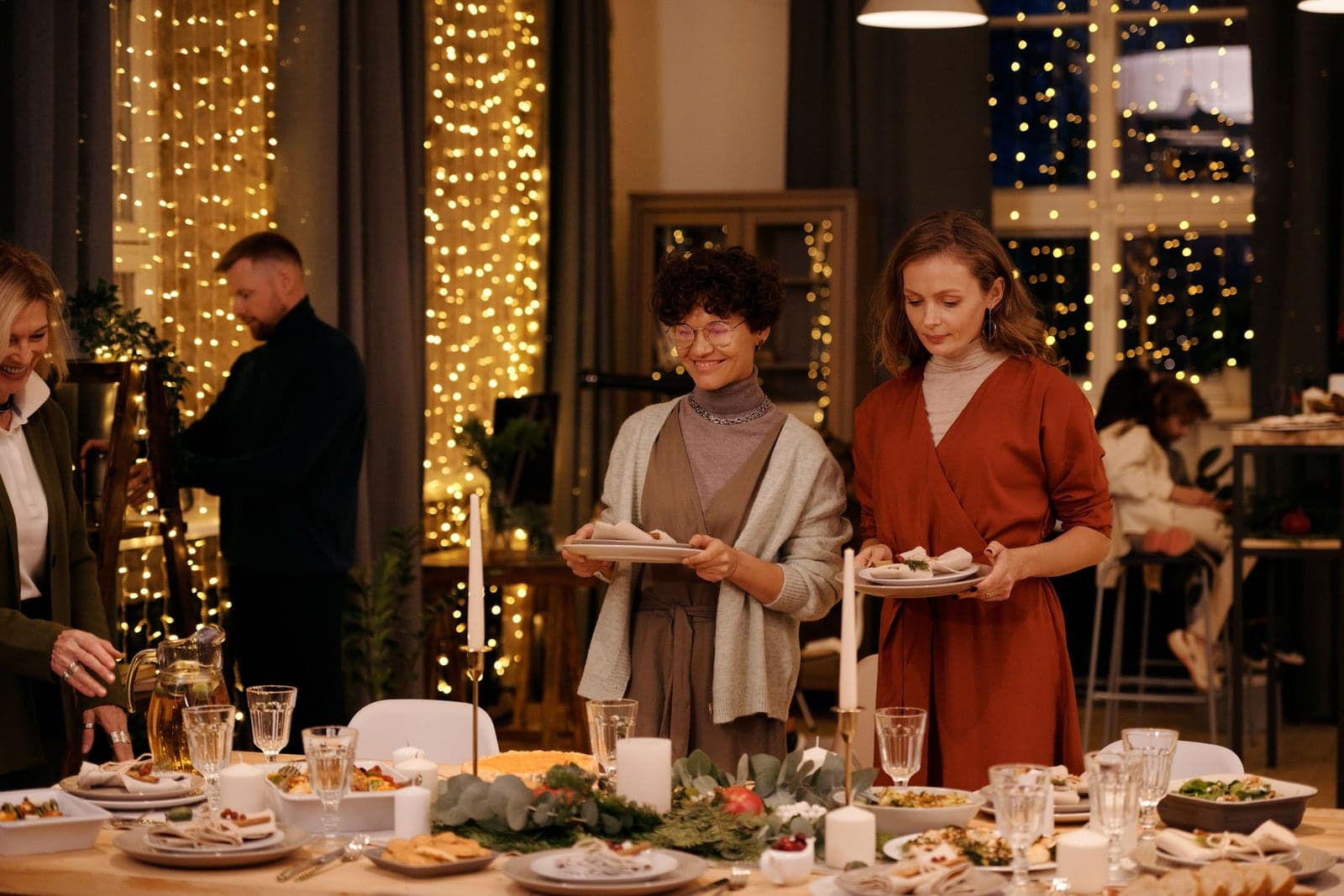
Most Christmas parties are decided long before anyone rings the doorbell. Not by the food, and definitely not by the decorations, but by three choices made weeks earlier: what night it is, what kind of party it is, and how many people are coming. Get those right and a mediocre cheese board is forgiven. Get them wrong and no amount of effort on the night rescues it.
This is the whole plan, in the order it actually happens: the three decisions, the math that keeps a house from feeling either empty or unbearable, a realistic budget, and an eight-week timeline that ends with the host holding a drink instead of a sheet pan.
Decision one: the date, and why October is not too early to pick it
December calendars fill from the outside in. Work parties, school concerts, travel, and family obligations all get locked in first, and by mid-November the good nights are gone. Whatever else you do, choose the date early and tell people early.
The realistic options, ranked by how they actually perform:
The second Saturday of December. The default, and the most contested night on the calendar. Choose it if your circle is small and coordinated, or if you know you are the party everyone plans around.
A mid-December weeknight. Thursday is the sleeper pick. Acceptance rates are noticeably higher because nobody has three competing invitations, and a 7 to 10 pm window feels generous rather than short.
Sunday afternoon, 2 to 5 pm. The best option if there are kids involved or if you want an open-house feel. Daylight parties are cheaper, easier, and shorter, and nobody is deciding whether they are okay to drive home.
The week between Christmas and New Year. December 27 to 30 is the most underrated slot of the year. Everyone is off work, nobody has plans, the pressure has lifted, and your decorations are already up. The only real cost is that a few people will be traveling.
The one to avoid: the Friday and Saturday closest to Christmas Day. You will be competing with family arrivals, travel, and exhaustion, and you will get more regrets than yeses.
Send a save-the-date in early November, and the actual invitation two to three weeks out. A text to a group thread counts. What matters is that it lands before the calendar closes.
Decision two: the format, chosen honestly
Almost every disappointing party is a mismatch between the format the host imagined and the format the guest list required. Pick one of these on purpose.
| Format | Works best for | Hours | Rough cost per head | Effort |
|---|---|---|---|---|
| Open house, drop-in | 25 to 60 people, mixed circles | 3 to 4 | $20 to $35 | Medium, front-loaded |
| Cocktail and appetizers | 15 to 30 people | 3 | $25 to $45 | Medium |
| Seated dinner | 6 to 12 people | 3 to 4 | $30 to $60 | High |
| Activity party (cookies, ornaments, games) | 8 to 20, families | 2 to 3 | $15 to $30 | Medium, cheap |
| Dessert and drinks, late | 10 to 30 people | 2 | $10 to $20 | Low |
Two things worth saying plainly. A seated dinner past about twelve people stops being a dinner party and becomes a catering job, because one table conversation breaks into three and the kitchen work scales past what one person can do. And the dessert-and-drinks party, starting at 8 pm with pie, coffee, and something stronger, is the single best effort-to-warmth ratio on that list. It is also the easiest party to add to a December weekend that already has something else in it.
Decision three: the guest count your rooms can actually hold
Space, not budget, is what determines whether a party feels good. The useful rule for a standing party is about 6 square feet of usable floor space per person, where usable means what is left after the furniture, the tree, and the food table.
So a combined living and dining area of roughly 300 usable square feet holds about 50 people at true mingle density, feels lively and comfortable at 30, and feels thin at 15. Underfilling a room is the more common mistake. A party that is half full reads as poorly attended even when everyone invited showed up, and the fix is to close off a room rather than to invite more people.
For a seated dinner, the constraint is table edge, not floor: allow 24 inches of table per person, so a 72-inch table seats six comfortably and eight only if everyone likes each other.
Two practical corrections to whatever number you land on. Expect roughly 70 to 80 percent of accepted invitations to actually appear on the night for a large drop-in party, and closer to 95 percent for a seated dinner. And remember that people cluster where the drinks are, which means the kitchen, always, no matter how nice the living room looks.
The food and drink math
This is where hosts either overspend by 40 percent or run out at 9 pm, and both are avoidable with arithmetic.
Appetizer parties. Plan on 6 pieces per guest in the first hour, then 3 to 4 per guest per hour after. Offer 4 to 5 different items for a group under 15, and 6 to 8 items for 20 or more. Variety matters more than volume: five well-chosen things in generous quantities beat ten fussy things that run out one by one.
The dinner-hour trap. If your party spans 6 to 9 pm, your guests are eating dinner at your house whether or not the invitation used the word. Either say "heavy appetizers" explicitly and back it with two substantial hot items, or move the start time to 8 pm and serve dessert.
Seated dinners. Portion planning is its own discipline, especially with a roast and a crowd. Our Christmas dinner portion calculator scales quantities to your headcount, the dinner shopping list generator turns that into a single grocery run, and the dinner timing calculator works backward from when you want to sit down so everything lands hot at once.
Drinks. Figure 2 drinks in the first hour and 1 per hour after for a typical adult crowd, then round up. A 750ml bottle of wine pours 5 glasses, a bottle of sparkling pours 6 flutes, and a 750ml bottle of spirits makes about 16 cocktails. Buy 1 to 1.5 pounds of ice per guest, which is roughly double what feels reasonable and exactly what you will use. And put out as much non-alcoholic choice as alcoholic: a good spiced cider, a citrus and rosemary spritz, or a proper mocktail is now table stakes, not a courtesy.
The one hosting rule that saves the night: make it self-serve. A drinks station on a side table, away from the food, with ice, glassware, mixers, bottles, and a printed card of one signature cocktail (give it a name; the Christmas name generator is good for exactly that), means nobody is trapped behind a bar and the traffic jam in your kitchen never forms.
The budget
For a home party, honest ranges per guest:
- Food: $15 to $30 for appetizers, $25 to $50 for a seated dinner
- Drinks: $10 to $20 if you are supplying alcohol, $3 to $5 if it is BYOB plus mixers
- Disposables, ice, and extras: $3 to $5
- Decor and flowers: whatever you decide, and the single easiest line to overspend
Three splurges that consistently earn their money: plenty of real glassware (rented or borrowed if needed, because a good glass makes a $12 bottle taste better than a $30 bottle in plastic), one genuinely impressive centerpiece dish, and enough ice. Three places to cut without anyone noticing: the alcohol tier, the number of distinct appetizer recipes, and printed anything.
Set the number before you shop. Our budget planner handles the hosting category alongside decor, and if you want to see how party spending fits into the larger holiday picture, the cost of Christmas breaks down where American holiday money actually goes.
The eight-week timeline
Eight weeks out (early October). Lock the date. Decide the format and the rough headcount. Send the save-the-date to the group thread. If you are hiring anything, a cleaner, a bartender, a caterer, book it now, because December service calendars fill earlier than anyone expects.
Six weeks out. Build the guest list properly and check the space math against it. Draft the menu. Take stock of what you own: glassware, serving platters, folding chairs, coat hangers, and whether your ice situation is a freezer tray or an actual plan. The Christmas Planner has pages for the guest list and menu so it all lives in one place instead of four notes apps.
Four weeks out. Send the real invitation with start and end times. An end time is a kindness to everyone, including you. Finalize the menu and mark which dishes are make-ahead. Order anything that ships: specialty ingredients, a case of wine, extra string lights. If there is a gift exchange, set the rules and the price cap now, and our Secret Santa generator will do the draw and email everyone their assignment without you learning who has whom.
Two weeks out. Plan the layout on paper: where the food table goes, where the drinks station goes (a different room if possible), where coats go, and what furniture is coming out of the main room. Do the deep clean of the spaces guests will use, especially the guest bathroom. Shop for everything non-perishable.
One week out. Confirm the headcount. Cook and freeze whatever freezes. Test the playlist on the actual speakers you will use, at the volume you will use. Buy the alcohol. Reply to the inevitable "what can I bring?" messages with a real answer, because "nothing" makes people feel awkward and "a bottle of red or a bag of ice" makes them feel useful.
Two days out. Grocery run for perishables. Make the sauces, dips, doughs, and anything that improves overnight. Clear the coat closet or set up the coat rack. Set out serving dishes with a sticky note on each one naming what goes in it, which sounds excessive and is the single best trick in this article. Get the ice.
The day of. Cook in the morning. Set the table and the drinks station by early afternoon. Do a walk-through from the front door as if you were a guest: where do I put my coat, where do I get a drink, where do I put this bottle I brought. Then stop cooking two hours before start time. Everything after that is arranging and lighting.
The last hour. Shower and dress before the room is finished, not after. Turn off every overhead light and switch on the lamps, the candles, and the tree. Start the music at a level where two people standing three feet apart have to lean in slightly. Pour yourself a drink before the first guest arrives, because the host's mood sets the room's mood within about ninety seconds of the first person walking in.
The room, which is mostly lighting
The difference between a house that feels festive and one that feels like a house with decorations in it is almost entirely lighting. Overhead fixtures are the enemy. Kill them all, then build the room back with lamps, candles at multiple heights, the tree, and string lights along whatever horizontal lines the room already has.
The rest of the room comes down to flow. Keep food and drinks in different zones so the two lines never collide. Leave the kitchen island clear if you can, because it becomes the party's gravitational center whether you plan for it or not. Have a real answer for coats, since a bed piled with them stops working at guest number twenty. And put a small trash and glass-collection bin somewhere visible so people can clear their own plates, which they will do if you make it easy.
If the table is the centerpiece of your night, our Christmas tablescape guide covers composition by style, and if the tree is still on the to-do list, how to decorate a Christmas tree is the professional sequence.
Something to do, without forcing it
Structure helps, especially with a mixed guest list where not everyone knows each other. It just should not feel mandatory.
The reliable options: a white elephant or Secret Santa exchange with a firm price cap, a cookie decorating station that runs itself, an ornament exchange, or a round of trivia late in the night when the room needs a second wind. For a mixed crowd, the Christmas movie character quiz is a one-minute icebreaker that starts arguments in the best way. Our roundup of the best Christmas party games sorts them by group size and energy level, and for the trivia route you can run our free Christmas trivia game straight from a phone or grab printable rounds from 40 Christmas trivia questions.
One rule: announce the activity in advance if it requires a purchase, and never spring a gift exchange on people at the door. And if hosting at all feels like too much this year, the lowest-effort holiday gathering there is remains a lights drive with friends and a thermos, which our city-by-city Christmas lights guides can plan for you in about five minutes.
The four ways a good plan still goes wrong
The host never sits down. If you are plating during your own party, the menu was wrong. Aim for three quarters of the food finished before the doorbell, and hand the last quarter to whoever offers.
Everyone stands in the kitchen. Not a failure, a fact. Plan for it. Put something in the kitchen worth crowding around and move the drinks somewhere else to pull half the crowd with them.
The party has no ending. An end time on the invitation, then a clear signal at the end: overhead lights on, music down, coffee out. It reads as gracious rather than abrupt, and everyone is quietly relieved.
Too much food, not enough ice. Every year, in every house. Cut one appetizer, buy twice the ice.
The short version
Pick the date in October and tell people. Choose one format and commit to it. Size the guest list to your square footage rather than your address book. Six pieces of food per guest in the first hour, two drinks in the first hour, a pound and a half of ice per person. Make it self-serve, kill the overhead lights, finish the cooking early, and be holding a drink when the first guest walks in. Nobody remembers the canapés. They remember that the host looked happy to see them.
Share this guide
Frequently asked questions
When should I start planning a Christmas party?
How much food do I need for a Christmas party?
How many people can I fit in my house for a party?
How much does it cost to host a Christmas party?
What is the best day to have a Christmas party?
How do I host a Christmas party without spending the whole night in the kitchen?
Keep reading
How to Plan Your Christmas Decorating (So Nothing Gets Bought Twice)
A Christmas decorating plan is five decisions made in the right order: where, what look, how much, what to buy, and when. Here is the order, the math behind the quantities, and a free tool that does the whole thing from photos of your house.
How to Plan Your Christmas Decorations: A Month-by-Month Checklist
Christmas decorating doesn't have to be a frantic rush in late November. Here's a month-by-month checklist starting in October, when to plan, when to shop, when to install, and when to pack it up.
Your First Christmas in a New Home: What to Buy, Skip, and Plan
Decorating a home for its first Christmas is a different job than decorating one you know. A realistic first-year plan: the four things worth buying well, the traps that waste a moving-year budget, and what to deliberately leave for year two.
Prefer pen & paper?
The Christmas Planner
A 25-page printable kit covering budget, gifts, hosting, and decor, built on the same planning logic as this tool. Print it once, keep it in a binder, and reuse it every year.
Or grab 3 pages free first.
Decor that suits the home you have.
Seasonal decorating tips and the occasional new tool, straight to your inbox. One list, no spam.