By Brian · September 9, 2026
How to Plan Your Christmas Decorating (So Nothing Gets Bought Twice)
A Christmas decorating plan is five decisions made in the right order: where, what look, how much, what to buy, and when. Here is the order, the math behind the quantities, and a free tool that does the whole thing from photos of your house.
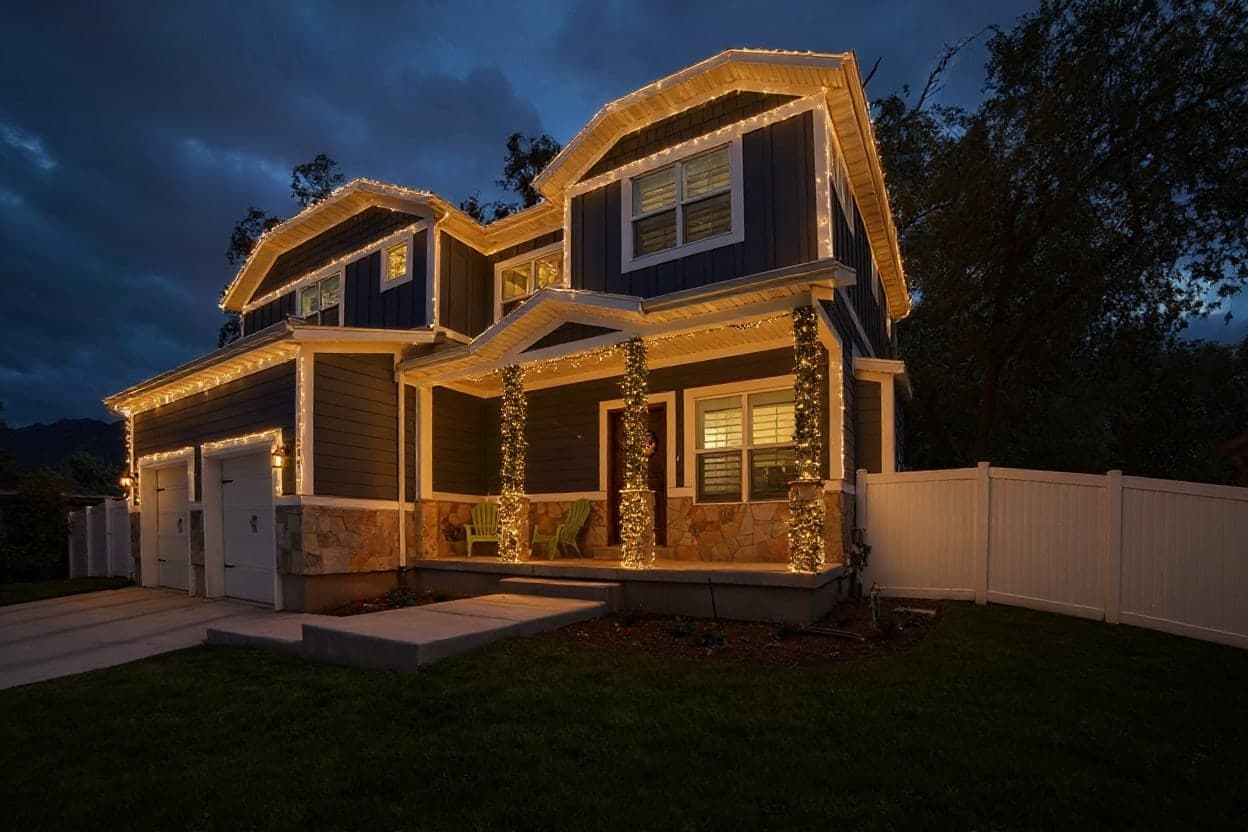
Every December there is a moment, usually in a store aisle, where you realize you have no idea whether you need two more strands or six. You buy four. Two of them end up in a bin in the garage next to the four you bought last year for the same reason.
That is what happens when decorating is a series of small decisions made in the wrong order. A plan is the same decisions made once, in the right order, before anything is bought. It takes about an hour on paper, or about five minutes with the tool at the end of this guide, and it is the difference between a house that adds up and one that never quite does.
Here is the order.
1. Decide where, before you decide what
Walk the house and pick the spaces that actually matter. For most homes that is three or four: the front of the house as seen from the street, the room where the tree goes, the mantel or the main wall people face, and the entry. Everything else is optional, and treating it as optional is what keeps a budget intact.
Two rules from this walk. First, spaces that share a sightline share a scheme, because a cranberry living room and a silver entry you can see at the same time will fight. Second, rooms behind doors are free to do their own thing, or nothing at all. Bedrooms rarely earn the effort.
Write the list down. It is the backbone of everything that follows, and it stops the "it will find a spot" purchases that our decorating mistakes guide puts at the top of the list of reasons a house looks cluttered.
2. Pick one look and hold it everywhere
A look is three decisions: a palette of two or three colors plus one metal, a light temperature, and a level of density.
The palette is taste. The light temperature is not. Warm white and cool white side by side make each other look wrong, and it is the most common reason a display feels off when everything else is right. Pick one and buy nothing in the other.
Density is the one people skip. Classic traditional wants full garlands and a well-covered tree. Natural wants texture and restraint. Minimalist wants very few things, placed exactly. Deciding this now sets your quantities later, and it is why the plan builder asks for a style before it asks for a single measurement. If you are not sure which look suits the house you already have, the decor style quiz settles it in two minutes, and the visualizer will show you a photo of your own room in each of them.
3. Put a number on it before the shopping list exists
Budget before list, not after. A list built first always grows to fill whatever number comes later.
The useful benchmarks come from our cost of decorating study: the most common annual spend is around $300 to $600 for a household with an established collection adding a few new pieces, and a first year buying everything new runs $1,800 to $3,500. The tree and the outdoor lights are the two biggest lines in either case. The budget planner will split whatever number you choose across the categories.
If the number needs saving toward rather than spending now, how to save for Christmas lays out the monthly version. The honest framing is a range with three tiers. Keep it tight means the essentials done well: a lit tree, one good garland, a wreath. A proper display adds the roofline and the stair rail. Go all in is the house people slow down for. Pick the tier, and the list in the next step gets sized to it.
4. Turn measurements into quantities
This is the step almost nobody does, and it is the whole reason for the bin in the garage. Four measurements cover most houses.
Tree height. A standard-density tree takes about 100 mini bulbs per foot, so a 7.5 foot tree wants roughly 750 bulbs, which is eight 100-bulb strands. Light density and heavy density are half and double that. Ribbon runs about 9 feet per foot of tree.
Roofline length. Walk the front of the house with a tape or pace it off. C9 bulbs go one per foot, sold in 25-bulb commercial strands, so a 90 foot roofline is 90 bulbs and four strands. If the number is 80 feet or more, most of that work is above safe ladder height, and it is worth getting a quote before committing to doing it yourself. Nearly half of holiday decorating injuries are falls.
Garland runs. Mantel, banister, and doorways. Measure each, add half again for drape, round up to 9 foot sections. A 6 foot mantel is one section. A 14 foot banister is three. A doorway framed on three sides is about 18 feet, two sections. Pre-lit garland means these lines do not also need a light line.
Shrubs. Count the ones you would light. One 150-bulb net per medium shrub.
The light calculator and the garland calculator do this arithmetic one measurement at a time. Add a product to each line with its price and you have a shopping list that cannot be bought twice, because every quantity came from your own house.
5. Put dates on it
The calendar is the part of the plan that saves the most money, because it decides what you pay and what is left to buy.
Now through late October: buy. The good warm white sets, the pre-lit garlands in the popular lengths, and mid-size trees sell through by Black Friday. Test every strand you already own first so you are only buying what you actually lack.
Early to mid November: the outside. Roofline and structural lights first, on a dry day above freezing. Wrestling clips onto gutters in December is how the job goes wrong. Then wreath, porch greenery, and pathway lights. Set the timer once and leave it.
Late November: the inside, in one pass. Tree first, in the order professionals use: fluff, then lights woven into the depth, then ribbon, then ornaments in three sizes. Mantel and stair garland next. Candles and tabletop last.
Early January: pack it away for next year. Wrap strands around something rigid. Label boxes by zone, not by contents. Write down what you wished you had. That note is worth more than anything you buy next November, because it is the start of next year's plan.
The five-minute version
Everything above can be done with a tape measure, a notebook, and an hour. It can also be done from photos.
My Christmas Plan takes up to four photos of your home, the front and the rooms that matter, plus a style, a budget tier, and the same four measurements. It returns your own spaces decorated in the style you chose, a shopping list with every quantity above already computed, the measured cost against what households actually spend, a palette, and the dated timeline. The plan lands in your inbox with a link you can forward to whoever is helping, and it is free.
The arithmetic is the same arithmetic as this guide. The difference is that you do not have to do it, and you get to see the house before you buy anything for it.
Share this guide
Frequently asked questions
When should I start planning Christmas decorating?
How do I know how many Christmas lights I need?
How much garland do I need for a mantel or staircase?
What should be on a Christmas decorating checklist?
How much does it cost to decorate a house for Christmas?
Is there a tool that plans Christmas decorating for you?
Keep reading
How to Plan Your Christmas Decorations: A Month-by-Month Checklist
Christmas decorating doesn't have to be a frantic rush in late November. Here's a month-by-month checklist starting in October, when to plan, when to shop, when to install, and when to pack it up.
When to Put Up Christmas Decorations (and When to Take Them Down)
The honest answer to the annual argument: what most American households actually do, what the traditional calendars say, why outdoor lights should go up weeks before you turn them on, and how to pick a start date that fits your house instead of somebody else's rule.
The Best Time to Buy Christmas Decorations (and What to Buy When)
The same wreath costs three different prices depending on the month you buy it. Here is the honest buying calendar: what to grab in the January clearance, what to hunt in the summer off-season, when the good stuff actually sells out, and why Black Friday is the worst day of the year for Christmas decor.
Prefer pen & paper?
The Christmas Planner
A 25-page printable kit covering budget, gifts, hosting, and decor, built on the same planning logic as this tool. Print it once, keep it in a binder, and reuse it every year.
Or grab 3 pages free first.
Decor that suits the home you have.
Seasonal decorating tips and the occasional new tool, straight to your inbox. One list, no spam.