By Brian · October 17, 2026
What Clark Griswold's 25,000 Christmas Lights Would Cost to Run Today
We ran the numbers on the Griswold house from Christmas Vacation: what 25,000 incandescent lights cost to run in 1989, what they would cost at Illinois rates today, and what Clark would pay if he switched to LED. Plus a calculator to see how Griswold your own house is.
Every December someone rewatches National Lampoon's Christmas Vacation, gets to the scene where Clark plugs in the house, and asks the same question: what would that actually cost?
We ran it properly. Clark gives us the count himself (250 strands, 100 bulbs each, 25,000 lights), the story puts the Griswolds in the Chicago area, and the Energy Information Administration publishes what Illinois households pay for electricity. The answer is less than you would think for 1989, more than you would think for today, and almost nothing if Clark had waited for LEDs.
The short answer
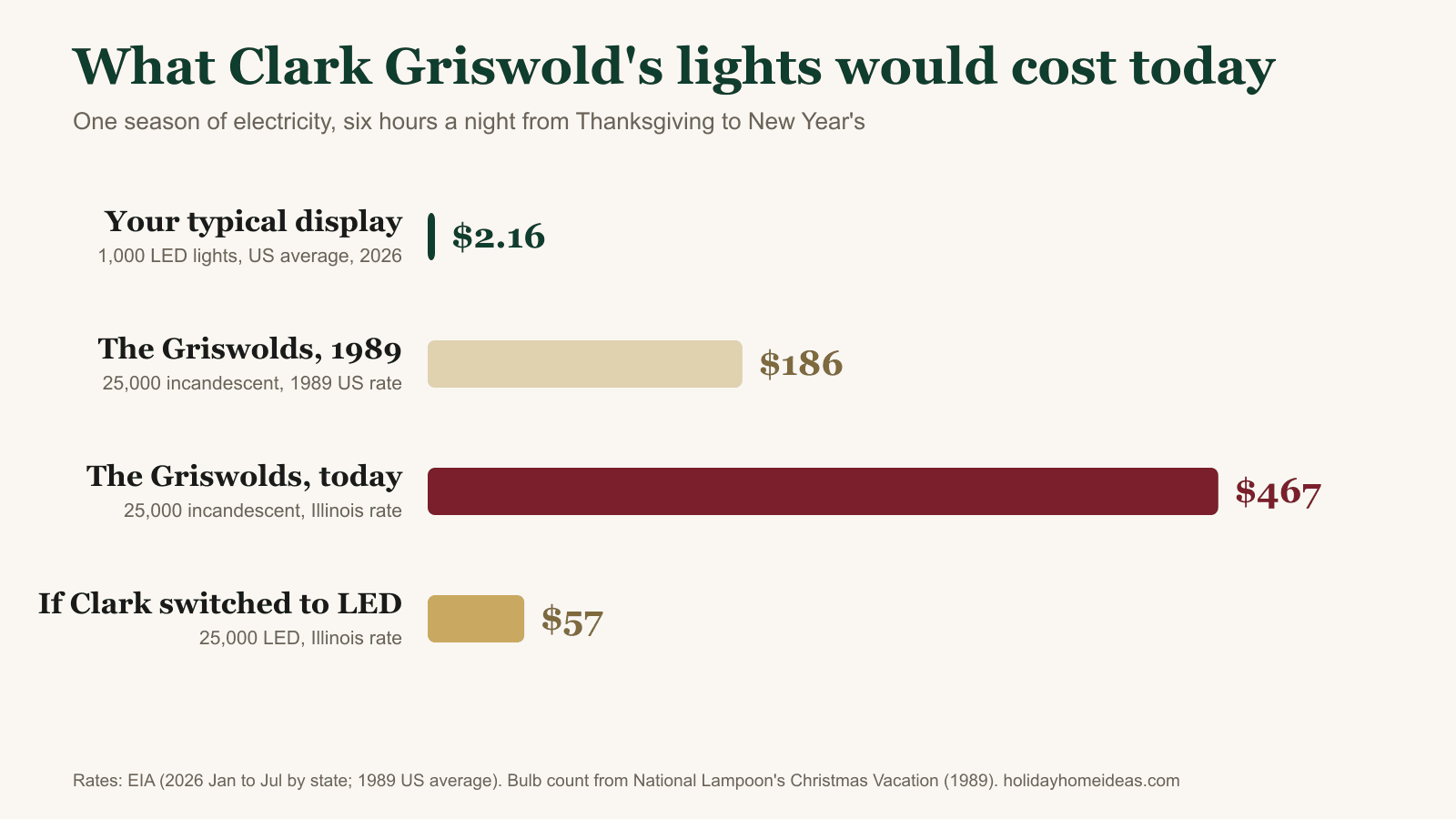
For one season, six hours a night from Thanksgiving to New Year's:
- In 1989, at that year's US average residential rate of 7.65 cents per kWh: about $186.
- Today, at Illinois rates (19.22 cents per kWh, the 2026 average so far): about $467.
- If Clark switched to LED, same house, same rate: about $57.
For comparison, a typical display of 1,000 LED mini lights costs $2.16 for the whole season at the national average. The Griswold house is 25 of those, in the least efficient bulbs ever sold.
How we did the math
The film never says what kind of bulbs Clark bought beyond "imported Italian," but the lights on the house are mini twinkle lights, and in 1989 every mini light was incandescent. A 100-bulb incandescent mini string draws 40 to 50 watts; we use the midpoint, 45 watts, which puts the Griswold house at 11,250 watts with everything on.
Six hours a night for the 36 nights from Thanksgiving to New Year's is 216 hours, so the house uses about 2,430 kWh of electricity in a season. An average American home buys about 899 kWh a month for everything it runs, so the Griswold lights alone use nearly three months of a normal household's electricity.
Multiply by the rate and you have the bill. Every number here uses the same assumptions as our state-by-state Christmas lights cost study, so you can compare the Griswolds to your own state directly.
Why Clark's bill nearly tripled
Nothing about the house changed. The price of electricity did. The US average residential rate was 7.65 cents per kWh in 1989; Illinois households are paying 19.22 cents in 2026. That is 37 years of ordinary price rises rather than anything special about Christmas, and $186 was not cheap at the time either. It was a serious line item for a family that, as the movie makes clear, was already counting on a Christmas bonus.
If the Griswolds lived somewhere else, the number would swing a lot. The same 25,000 incandescent lights would cost about $300 in North Dakota, where electricity is cheapest, and about $1,125 in Hawaii, where it costs the most. The calculator below runs it for any state.
What LED would have done for Clark
A 100-bulb LED mini string draws about 5.5 watts instead of 45. The whole Griswold house drops from 11,250 watts to about 1,375, and the season's bill from $467 to $57 at Illinois rates.
That is the entire argument for LED Christmas lights in one sentence: the same house, the same lights, an eighth of the electricity. It is also why the "Christmas lights wreck your electric bill" idea has quietly stopped being true for anyone who has replaced their strings in the last decade.
Could a real house even run it?
This is the part the movie gets right. At full draw, 11,250 watts on 120-volt circuits is about 94 amps. A standard 20-amp household circuit can safely carry about 1,920 watts of continuous load (the 80 percent rule electricians use), so the Griswold house needs about six dedicated circuits just for the lights. It would also use close to half of a 100-amp household service, which is what many older homes have.
Clark runs the whole house through a tangle of extension cords, which is how you get a blackout and a basement full of tripped breakers. The citywide power shortage is the joke. The tripped breaker is the realistic part.
In LED, the same display draws about 1,375 watts, which fits on a single 20-amp circuit with room to spare.
The real-life Griswolds
The Griswold house is big for a movie, but small for a record. The Guinness World Record for the most lights on a residential property belongs to the Gay family of LaGrangeville, New York: 601,736 lights, certified in November 2014. That is 24 Griswold houses.
If every one of those bulbs were an LED mini light run like a typical display, the season would cost about $2,100 at New York's 2026 rate of 29.38 cents per kWh. In incandescent, the same count would run about $17,000, which is the clearest illustration we know of why record-setting displays are all LED now. (The family's actual bulb mix and hours are their own; this is what the count implies under our standard assumptions, not their bill.)
How Griswold is your house?
Put in your own light count and state. The calculator uses the same rates and wattages as everything above.
Try it
Your house against the Griswolds
Season cost
$6.85
$56 in incandescent
Griswold rating
12%
Circuits needed
1
165 watts at full draw
A solid, normal-person display.
Six hours a night for 36 nights at 19.22 cents per kWh (EIA, 2026). A 100-bulb mini string draws about 45 watts incandescent and 5.5 LED. Circuits assume a 20-amp household circuit loaded to 80 percent, about 1,920 watts; ask an electrician before going past one.
If the number surprised you, our Christmas light electricity cost calculator breaks a display down by bulb type (C9s, nets, icicles, inflatables), and the Christmas light calculator works out how many lights you actually need for your roofline and tree. For what a professional would charge to put up a Griswold-sized display, and the safety numbers behind hiring it out, see our Christmas lights data study.
Or skip the electric bill entirely: the Christmas light show maker covers a photo of your own house in colored lights and sets every bulb flashing to Carol of the Bells, and the Christmas Movie House gives it the full Griswold look.
The Griswold numbers in one place
| Lights | Draw | Season use | Season cost | |
|---|---|---|---|---|
| Typical display, LED, US average | 1,000 | 55 W | 12 kWh | $2.16 |
| Griswold house, 1989, US average rate | 25,000 | 11,250 W | 2,430 kWh | $186 |
| Griswold house, today, Illinois rate | 25,000 | 11,250 W | 2,430 kWh | $467 |
| Griswold house, LED, Illinois rate | 25,000 | 1,375 W | 297 kWh | $57 |
| Gay family record, if all LED, New York rate | 601,736 | 33,095 W | 7,149 kWh | $2,100 |
All rows: six hours a night for 36 nights (216 hours). Incandescent mini lights at 45 watts per 100; LED at 5.5 watts per 100.
Sources
- National Lampoon's Christmas Vacation, Warner Bros., released December 1, 1989: the 25,000 count (250 strands of 100 bulbs) and the Chicago-area setting.
- US Energy Information Administration, Electric Power Monthly, Table 5.6.B, average residential price by state, year to date through July 2026: Illinois 19.22, New York 29.38, Hawaii 46.28 and North Dakota 12.36 cents per kWh; US 18.19.
- US Energy Information Administration, Annual Energy Review, Table 8.10: US average residential price in 1989, 7.65 cents per kWh (nominal).
- US Energy Information Administration, "How much electricity does an American home use?": about 10,791 kWh a year, or 899 kWh a month, per residential customer in 2022.
- Guinness World Records, "Most lights on a residential property": 601,736, the Gay family, LaGrangeville, New York, November 28, 2014.
- Wattages and season length as in our state-by-state study: 40 to 50 watts per 100-bulb incandescent mini string (45 used), 4 to 7 watts per LED string (5.5 used).
Share this guide
Frequently asked questions
How many lights did Clark Griswold have?
How much would the Griswold lights cost to run today?
What would the Griswold lights cost in LED?
Could a real house power the Griswold lights?
Where is the Griswold house in Christmas Vacation?
Keep reading
What It Costs to Run Christmas Lights in Every State (2026)
What a season of Christmas lights costs to run in all 50 states and DC, from the latest EIA electricity rates: LED versus incandescent, a typical display and a big one.
How Many Christmas Lights Do You Actually Need? (Tree, Roofline, and Yard)
How many Christmas lights you need for a tree, roofline, bushes, and wrapped trees, with clear per-foot rules of thumb, a tree-size chart, how many strands you can safely connect, and why to buy 10-20% extra.
The Best Christmas Lights to Buy (by What You're Lighting)
How to choose Christmas lights and what's actually worth buying, by use case: roofline, trees, shrubs, the indoor tree, garland, and pathways. LED vs incandescent, bulb types, and color temperature explained.
Prefer pen & paper?
The Christmas Planner
A 25-page printable kit covering budget, gifts, hosting, and decor, built on the same planning logic as this tool. Print it once, keep it in a binder, and reuse it every year.
Or grab 3 pages free first.
Decor that suits the home you have.
Seasonal decorating tips and the occasional new tool, straight to your inbox. One list, no spam.