By Brian · September 30, 2026
Advent Calendar Ideas Worth Keeping After December 24
Most advent calendars are twenty-four pieces of landfill in a cardboard box. The alternative is a frame you refill every year: the reusable formats that hold up, five fillable systems that cost almost nothing, and how to pick one that suits the people actually opening it.
The advent calendar you probably grew up with was a piece of printed cardboard with twenty-four perforated doors and a piece of chocolate behind each one, and it was thrown away on Christmas Eve. Sixty million or so of those move through the season every year.
There is nothing wrong with it. But it is worth noticing that it is a habit rather than a tradition, because the actual tradition it descends from was something people made.
Where this came from, briefly
The custom started with German Lutherans in the nineteenth century, and the early versions were improvised: a chalk mark on the door for each day of December, twenty-four candles lit in sequence, small religious pictures pinned up one at a time. Printed calendars arrived around 1900, generally credited to the Munich publisher Gerhard Lang, who is said to have based the idea on the cardboard-and-cookie version his mother made him.
The chocolate came much later, after the Second World War, and the version where each door holds a full retail product is a development of the last fifteen years or so.
That history is useful for one reason. The thing being counted was the waiting, not the contents. Which means you have far more freedom here than the shelf at the store suggests.
Buy the frame once, fill it every year
The single decision that improves this whole category is separating the calendar from what goes in it.
A fixed-contents calendar makes that decision for you, once, at the point of purchase, for a child whose interests will have moved on by next December. A refillable one is a piece of December decor that adapts every year and costs nothing after the first.
The formats worth owning:
Wooden drawer or house calendars. A small chest of twenty-four numbered drawers, or a house-shaped frame with cubbies. These read as decor rather than packaging, which matters if it is going to sit out on a console for a month. Drawers limit you to small flat items, which is a constraint but also a useful budget cap.
Fabric pocket hangings. Twenty-four pockets on a quilted panel that hangs on a door or wall. The most forgiving format, because pockets stretch and take odd shapes, and the softest looking. Easy to store flat.
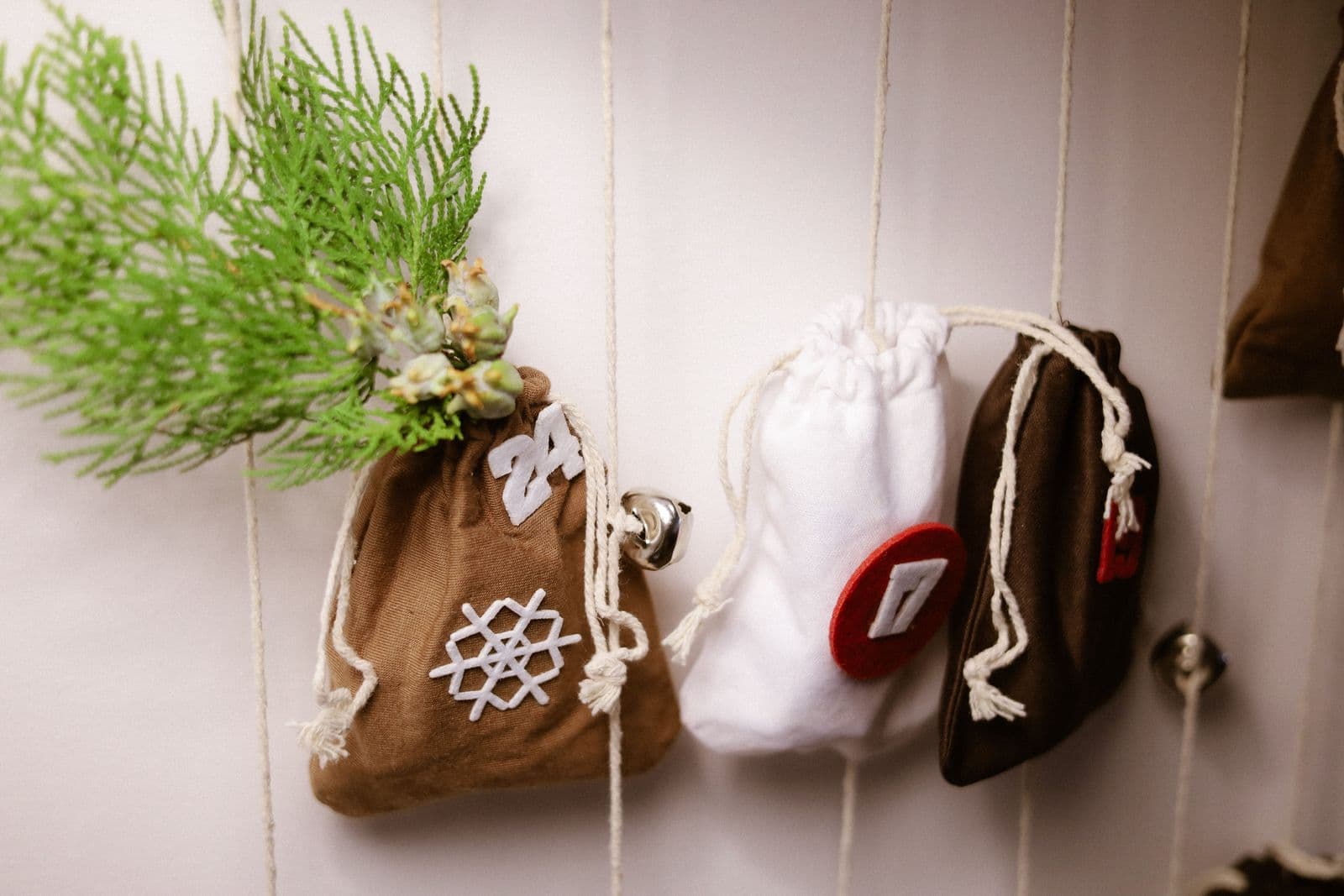
Envelope or bag garlands. Numbered kraft bags or envelopes clipped to a length of twine, strung along a mantel or a stair rail. The cheapest reusable option, the easiest to make, and the most flexible on size. It also scales to a long wall in a way the boxed formats do not.
Branch and pouch. A bare branch in a heavy vase with twenty-four small drawstring pouches hung from it. This is the one that looks most deliberate in a room where the decor is restrained, and it fits a Scandinavian scheme particularly well. If that is the direction your house leans, Scandinavian hygge Christmas decor covers the wider palette.
Whichever you pick, buy or build it in a color and material that suits the room it will live in for a month. This is the part people skip, and it is the difference between a calendar that gets displayed and one that ends up on the back of a bedroom door.
Five filling systems that actually work
Here is where most of the value is, and where most of the money is wasted.
Activities. Twenty-four slips of paper, each with one thing you do that evening. Drive to see the lights. Hot chocolate and one Christmas movie. Make paper snowflakes. Call a grandparent. Pajamas and the tree lights only.
This is the cheapest system and the one that produces the actual memories, and it has a practical advantage nobody mentions: you can reorder the slips on the morning of a bad day. Tuesday turns out to be a disaster, so Tuesday becomes "read by the tree" and the gingerbread house moves to Saturday. A calendar full of objects cannot flex like that.
Keep two or three genuinely low-effort slips in reserve for the weeks when December stops being charming. Our Christmas movie picker is a reasonable way to settle the film without a twenty-minute negotiation.
Books. Wrap twenty-four picture books in plain paper and stack them in a basket. One is unwrapped and read each night. You can build the set slowly from thrift stores for very little, and unlike almost everything else in this article, the contents are still there next year. The best Christmas books for kids has the shortlist if you are starting from nothing.
The wrapping is doing real work here. A familiar book becomes an event when it is a parcel.
One collection, split twenty-four ways. Buy a single larger thing and divide it. A bulk bag of LEGO bricks. A set of art supplies. A pack of trading cards. A jigsaw split into daily handfuls, so the puzzle is finished on Christmas Eve. This gets you the daily-object feeling at a fraction of the cost, and it avoids twenty-four unrelated trinkets.
Consumables. Tea, coffee, hot chocolate stirrers, good chocolate, hair ties, stickers, bath things. The test is whether the item disappears by February. Anything that disappears cannot become clutter, which is the quiet failure mode of the whole tradition.
Ornaments. Twenty-four small ornaments, one hung each evening, so the tree fills up across December and the last one goes on for Christmas Eve. Slow, lovely, and it builds a collection with a story attached. It also solves what to do with a tree that goes up on December 1 and has nothing left to do until the 25th.
Matching the system to the household
The systems above are not interchangeable, and the mismatch is what makes people give up in year two.
| Situation | What tends to work |
|---|---|
| Toddlers | Activities and books. Small objects are a choking hazard and the anticipation is the point at that age anyway. |
| Elementary-age children | One collection split across the days, or a mix of activities and small consumables. |
| Teenagers | Consumables and money-adjacent things. Activity slips read as compulsory family time, which is a difficult sell. |
| Several children | One shared calendar of activities, not one calendar each. Separate calendars turn every morning into a comparison. |
| Adults, no children | A single good consumable calendar, or a shared activity list. |
| First year of the tradition | Activities. It costs nothing, so if the format does not suit you, you have lost an evening rather than a hundred dollars. |
The multiple-children row is the one worth underlining. Two calendars means two sets of contents that get compared every single morning for twenty-four consecutive days. One shared calendar of things you do together removes the entire problem.
Adult calendars, honestly
The adult advent calendar has become a large category and most of it is not good. The pattern is a box of twenty-four miniatures from a brand you have no relationship with, priced at roughly what the full-size products would cost.
The ones that work follow the same consumable rule. A tea or coffee calendar from a roaster you already like. Chocolate from an actual chocolatier rather than a supermarket assortment. A beauty calendar from a brand whose products you already buy, where the miniatures are things you will finish.
The ones that disappoint are the assortment boxes, because the economics only work if most of the twenty-four items are things nobody would choose. You are buying two things you want and twenty-two you tolerate.
If you are building rather than buying, an adult calendar is the easiest one to make well: twenty-four envelopes, half with something small, half with something to do. A walk somewhere with lights. A specific record played all the way through. One evening with the phone in a drawer.
Building one this weekend
If you want the simplest version that still looks intentional:
- Twenty-four small kraft envelopes, numbered with a marker or a rubber stamp.
- A length of jute twine strung along a mantel, a stair rail, or a bare wall.
- Miniature wooden clothespins to hang the envelopes.
- A single sprig of something green tucked behind the twine at each end.
That is under twenty dollars, takes an evening, stores in a shoebox, and reads as deliberate rather than crafty. If you want it to look more finished, keep the palette to two colors and let the numbers be the only pattern. The same restraint principle runs through Christmas crafts that don't look homemade.
For the contents, write the twenty-four activity slips in one sitting in November, while you still find the whole idea charming. Writing them on December 1 is how the tradition dies in its first week.
The budget conversation
Decide the total before you decide anything else, then divide by twenty-four. That single piece of arithmetic prevents the failure that ends this tradition in most households, which is per-door inflation.
A dollar a day is genuinely workable if you lean on activities and consumables. Two dollars a day is comfortable. Past about three, you have quietly built a second Christmas that arrives in installments, and next year's expectations are set at the new level.
The activity system is free, which is worth saying plainly, because it is also the one children remember. Nobody recalls the specific plastic thing behind door eleven. They recall that in December you drove around looking at lights with the heating on and the radio playing.
If you are running the whole season to a number, the Christmas budget planner will hold the advent line alongside everything else, and how to save for Christmas covers getting there without December doing the damage.
The short version
Buy the frame once and refill it. Choose activities if you want the memories, books if you want something that lasts, consumables if you want the daily object without the clutter. Pick the system before you buy the container. Set the total and divide by twenty-four.
And write the slips in November. That is the only step people skip, and it is the one the whole thing rests on.
Share this guide
Frequently asked questions
When does an advent calendar start?
What are good advent calendar fillers that are not candy?
Are reusable advent calendars worth it?
How much should I spend filling an advent calendar?
What is a good advent calendar for adults?
How do I make a DIY advent calendar?
Keep reading
Elf on the Shelf Ideas Sorted by How Tired You Are
The tradition fails in the second week, every year, for the same reason: it escalates. Forty ideas sorted into ten-second, two-minute, and weekend tiers, plus the recovery line for the morning you forget.
Stocking Stuffer Ideas That Do Not End Up in a Drawer
Stockings fail because they get filled last, in a panic, from whatever is near the register. A six-slot structure that works for any recipient, real ideas for each slot, and the categories to stop buying entirely.
Christmas Gift Wrapping Ideas: Treat the Pile as One Picture
The reason some gift piles look styled and yours looks like a pile is not skill or budget. It is that the good ones were composed as a single object. The palette rule, the one repeated detail, and the folds that make cheap paper look expensive.
Prefer pen & paper?
The Christmas Planner
A 25-page printable kit covering budget, gifts, hosting, and decor, built on the same planning logic as this tool. Print it once, keep it in a binder, and reuse it every year.
Or grab 3 pages free first.
Decor that suits the home you have.
Seasonal decorating tips and the occasional new tool, straight to your inbox. One list, no spam.