By Brian · October 14, 2026
Christmas Gift Wrapping Ideas: Treat the Pile as One Picture
The reason some gift piles look styled and yours looks like a pile is not skill or budget. It is that the good ones were composed as a single object. The palette rule, the one repeated detail, and the folds that make cheap paper look expensive.
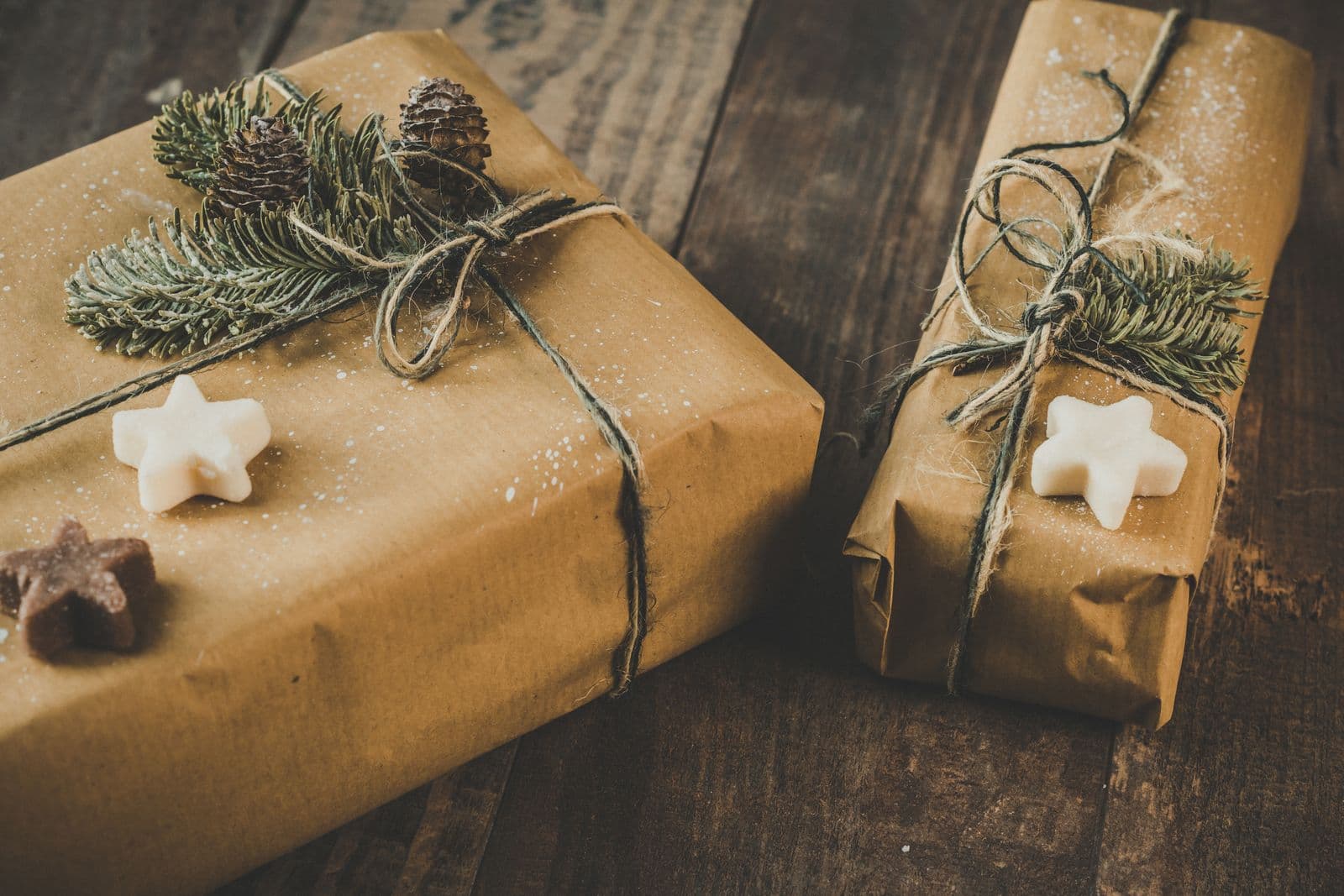
Somewhere on your feed in early December there is a photograph of a gift pile that looks like a magazine shoot, and somewhere in your house there is a pile that looks like a pile.
The difference is not skill, and it is almost never budget. Anyone can fold paper around a box. The difference is that the good pile was composed as a single object and yours was assembled one gift at a time over three weeks.
That is a fixable problem, and it costs less than what you are probably spending now.
One palette for everything
Here is the whole trick, and it is the same principle that makes a house exterior read from the street rather than looking like a collection of parts.
Pick one paper and one ribbon color and use them on every single gift.
Not one per person, not one per family, one for the entire pile. The moment there are six patterns under the tree, the eye reads clutter no matter how neatly each individual parcel is folded. When everything matches, the eye reads intent, and it does so even if the paper cost four dollars a roll.
Three combinations that reliably work:
- Kraft and one color. Plain brown kraft paper with a narrow ribbon in deep green, burgundy, or black. The most forgiving option and the hardest to get wrong.
- Solid white or cream with natural ties. Butcher paper, jute twine, and a sprig of something green. Reads Scandinavian and suits a restrained room.
- One dark solid. Forest green or a deep red paper with gold or cream ribbon. More dramatic, and it needs sharper folds because dark paper shows every crease.
If you want the pile to sit inside the room's existing scheme rather than fight it, our color palette extractor will pull the actual colors out of a photo of the room, which is a faster way to choose than holding rolls up against the wall.
One exception is worth allowing. A single patterned paper used for the children's gifts only, so they can spot theirs instantly, breaks the rule for a good reason and still looks deliberate because the pattern is confined to a group.
Then repeat one detail
A matched palette gets you most of the way. One repeated detail finishes it.
Choose exactly one and apply it to every parcel:
- A sprig of cedar, fir, or eucalyptus tucked under the ribbon
- A cinnamon stick tied into the knot
- A plain kraft tag with the name handwritten
- A dried orange slice
- A small brass bell
- A single sprig of dried lavender or a bay leaf
The repetition is the design. Twenty parcels each with a different clever finish looks like twenty separate ideas. Twenty parcels with the same sprig looks like a decision.
This is also where bows from a bag go wrong. The stick-on bow is a generic finish, and it announces itself as one. A three-inch piece of cedar costs nothing and reads as considered. If you do want ribbon to be the star, the best Christmas ribbon and bows covers the difference between ribbon that holds a shape and ribbon that goes limp by Christmas Eve.
The folding part
Wrapping technique is about four things, and none of them take practice.
Cut the paper to size before you start. Roll the box across the paper to get the width, allowing about two inches of overlap on the join. For the ends, you want roughly half the box depth of paper standing up on each side. Too much paper at the ends is the single most common cause of a lumpy parcel, because all that excess has to fold somewhere.
Fold a hem on the overlapping edge. Turn the last inch of the top edge under itself so you get a clean folded line rather than a cut one. This one step does more for the finished look than anything else on this list, and it takes three seconds.
Crease every edge deliberately. Run a thumbnail or the flat of your hand hard along each fold. Sharp creases are what separate a wrapped gift from a covered one. Dark and matte papers reward this most.
Hide the tape. Double-sided tape under the hem means no tape visible anywhere on the parcel. A roll costs a couple of dollars and it is the cheapest upgrade in the whole exercise. Failing that, fold the end of ordinary tape back on itself to make a loop and place it underneath.
For anything round, soft, or spiky: put it in a box. This is not a compromise, it is the answer. Trying to fold flat paper around a curve produces a tape sculpture. Shoe boxes, mailer boxes, and cereal boxes turned inside out all work.
If you want to know how much paper to actually buy, the gift wrap calculator sizes it from your list instead of the traditional method of buying four rolls and running out on the last two gifts.
Fabric, and the sustainability question
Wrapping paper is the part of Christmas with the worst waste arithmetic, and there are two genuinely good fixes rather than the usual guilt.
Furoshiki-style fabric wraps. A square of fabric, folded around the gift and knotted at the top. It takes about twenty seconds once you have done it twice, it handles awkward shapes far better than paper, and the wrap becomes part of the gift or comes back to you next year. Fat quarters from a fabric store, cotton scarves, or cut squares of linen all work. A stack of these in one color is also, conveniently, the matched-palette rule solved permanently.
Uncoated kraft with paper tape. Fully recyclable as a single unit, with no need to pick plastic tape off before it goes in the trash.
What to avoid is easy to identify with the scrunch test: scrunch the paper in your fist and let go. If it stays scrunched, it is usually recyclable. If it springs back, there is plastic or foil in it and it usually is not. That test rules out most glitter paper, most metallic paper, and anything with a shiny plastic coating, which is also the paper that photographs worst under tree lights.
Ribbon is the other offender. Plastic curling ribbon is not recyclable and does not survive being reused. Cotton, jute, velvet, and grosgrain all store flat in an envelope and come out fine next year.
Tags, briefly
Handwritten, on plain card, in one pen.
Printed sticker labels are the fastest way to undo everything above. A plain kraft tag with a name written in a decent pen matches the repeated-detail rule and takes ten seconds.
If your handwriting is genuinely poor, block capitals in a fine black marker look intentional in a way that cursive attempts do not.
One practical note that saves an argument every year: write the tags as you wrap, not afterwards. A pile of finished parcels with no names is a problem that gets solved by unwrapping corners.
Set up once, wrap in one session
Wrapping badly is usually a symptom of wrapping in five-minute bursts on the floor while something else is happening.
Clear a table. Put out the paper, the double-sided tape, the ribbon, the tags, one pen, and a pair of sharp scissors. Do the lot in one sitting with something on in the background. An hour and a half of that beats three weeks of ten-minute attempts on the carpet, and it is the only way the pile ends up looking like one thing.
Two practical additions. Keep a trash bag next to you for offcuts, because paper scraps are what makes the job feel chaotic. And wrap the largest gifts first, so you are cutting the big pieces while the roll is full.
Where the pile lands matters too. A tree skirt or collar gives the stack a defined edge instead of letting it dissolve into the floor, and the best tree skirts and collars covers which suit which tree.
The short version
One paper. One ribbon color. One repeated natural detail on every parcel.
Cut the paper to size, hem the overlapping edge, crease hard, hide the tape. Box anything awkward. Write the tags as you go.
Do it in one sitting rather than five. The pile under the tree is on display for a month, which makes it the longest-running piece of decor in the house, and almost nobody treats it that way.
Share this guide
Frequently asked questions
How do I make cheap wrapping paper look expensive?
How much wrapping paper do I need?
How do you wrap an awkwardly shaped gift?
What can I use instead of a bow?
Is it cheaper to use gift bags or wrapping paper?
How do I wrap gifts sustainably?
Keep reading
The Best Christmas Gifts (by Who You're Shopping For)
An editorial Christmas gift guide organized by recipient: the host, the hostess, the new homeowner, the teacher, the cook, the hard-to-shop-for person, the minimalist, and the kid who has everything. Specific picks with reasoning, not generic listicles.
Christmas Gift Ideas by Budget: $25, $50, and $100 That Feel Generous
A gift's warmth has almost nothing to do with its price band. How to give well at $25, $50, and $100: what each budget does best, the categories that overperform, and the traps that make any budget feel thin.
Christmas Stockings: How to Choose, Hang, and Fill Them (by Style)
The most personal piece of Christmas decor, done right. How to choose stockings by decorating style, the heirloom and needlepoint options worth keeping, how to hang them with or without a mantel, and what to actually put inside.
Prefer pen & paper?
The Christmas Planner
A 25-page printable kit covering budget, gifts, hosting, and decor, built on the same planning logic as this tool. Print it once, keep it in a binder, and reuse it every year.
Or grab 3 pages free first.
Decor that suits the home you have.
Seasonal decorating tips and the occasional new tool, straight to your inbox. One list, no spam.