Christmas in
Venezuela
Celebrated: December 16-24 (Misas de Aguinaldo) and December 24 (Nochebuena)
Signature traditions
- 1.Roller-skating to early-morning Mass, a famous Caracas tradition in which streets were once closed to traffic so the faithful could skate to the Misas de Aguinaldo between December 16 and 24; it has faded in recent years but survives at neighborhood scale
- 2.Making hallacas as a multi-generational family assembly line over several days; each relative is assigned a station: filling the dough, spooning the stew, folding the plantain leaves, tying the strings
- 3.'Gaitas zulianas,' the Christmas music of Venezuela, originally from Zulia state, played everywhere from grocery stores to family gatherings from late November onward
- 4.'Parrandas,' neighborhood caroling groups that travel house to house with traditional instruments (cuatro, maracas, furruco, tambora) and stay for a drink and a plate at each stop
- 5.Children sleep with their shoes near the bed on the night of January 5 so the Three Kings can leave gifts inside them on the morning of January 6 (Día de los Reyes)
What's on the table
Hallacas and pan de jamón
The Christmas table centers on hallacas: corn dough filled with a slow-cooked stew of beef, pork, and chicken plus olives, raisins, and capers, all wrapped in plantain leaves and boiled. Alongside: pan de jamón (a sweet bread spiral filled with ham, olives, and raisins), ensalada de gallina (creamy chicken-and-potato salad), and dulce de lechosa (green papaya simmered in spiced sugar syrup) for dessert.
The iconic decoration
Nacimientos and the Niño Jesús
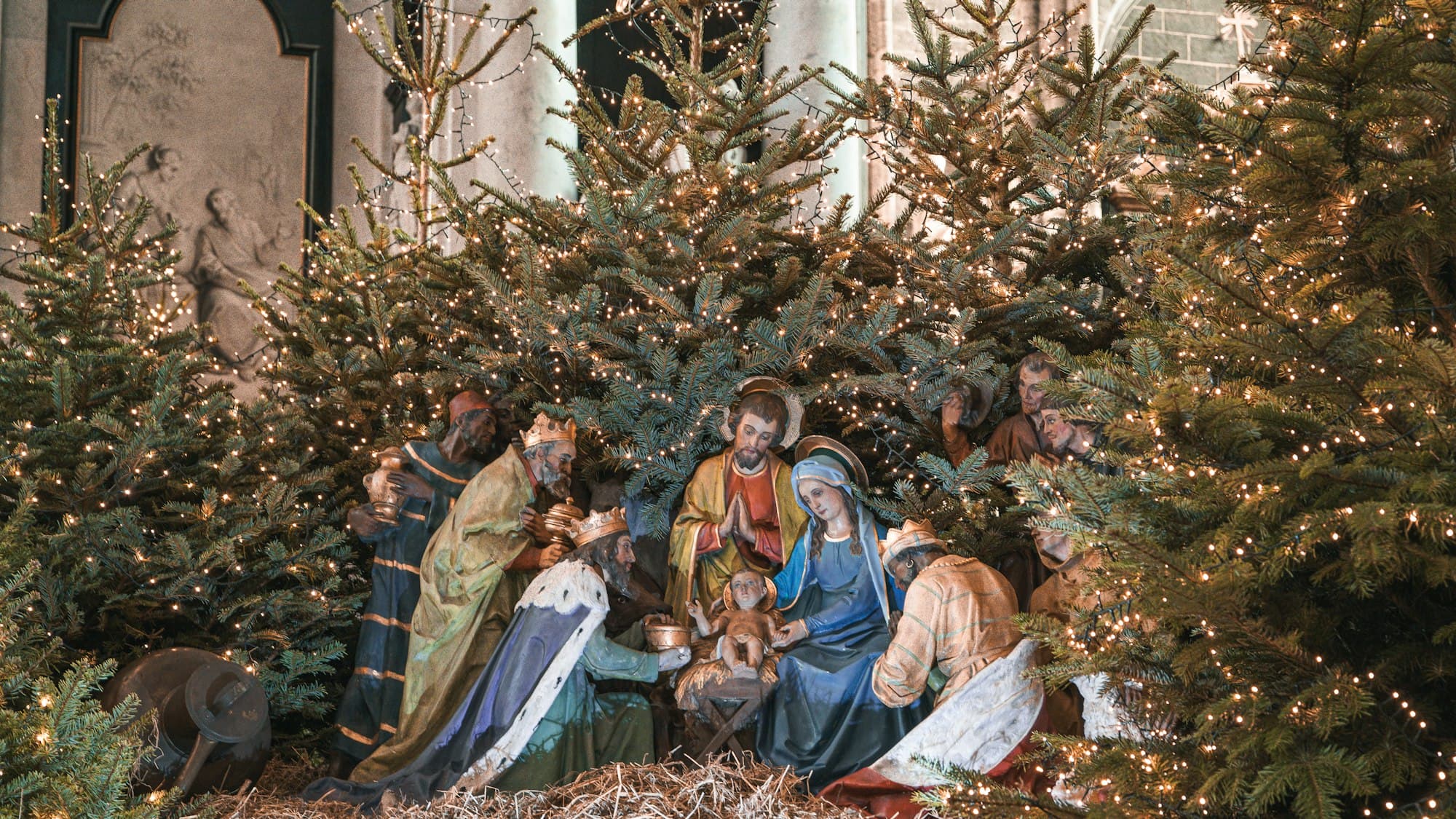
Elaborate nacimientos (nativity scenes) are the heart of Venezuelan Christmas decoration, often expanding to fill an entire room and built up year after year with new figurines, moss landscaping, miniature villages, and tiny twinkling lights. Trees are popular too, especially in urban homes, but the nacimiento came first and remains spiritually central. The figure of the baby Jesus is placed in the manger only at midnight on Christmas Eve.
How gifts are given
El Niño Jesús (the baby Jesus) traditionally brings gifts at midnight on Nochebuena, with families opening them immediately after the Christmas Eve dinner. Santa Claus has become increasingly common in urban Venezuelan homes through American cultural influence. A second round of gifts arrives from the Three Kings on January 6.
But who delivers yours?
There are eight cultural Christmas gift-givers around the world — Santa Claus, La Befana, the Yule Lads, Ded Moroz, Sinterklaas, the Three Kings, Christkind, and Joulupukki. Take the 6-question quiz to find out which one matches you.
Take the gift-giver quizDid you know?
In Caracas, residents historically roller-skated through the empty pre-dawn streets to the Misas de Aguinaldo, the Catholic masses held at dawn between December 16 and 24. The city government would close major streets to vehicle traffic before 8 AM so the skaters could glide through safely. The tradition says children would tie a long piece of string to their big toe and dangle it out the bedroom window overnight so passing skaters could tug it as a wake-up call.
The shape of the season
A Venezuelan Christmas is loud, warm, musical, and centered on family and faith. It builds through December, peaks on Nochebuena (Christmas Eve, December 24), and carries on through Día de los Reyes (Three Kings' Day, January 6). The spiritual spine of the run-up is the Misas de Aguinaldo, nine early-morning Masses held from December 16 to 24, but what everyone remembers is the food, the music that starts in November, and, in Caracas, the roller skates.
Roller-skating to dawn Mass
This is the tradition that makes the rest of the world look twice. In Caracas, people traditionally traveled to the early-morning Misas de Aguinaldo on roller skates, gliding through the streets in the pre-dawn dark. At its height the custom was so established that the city government would close major roads to vehicle traffic until 8 a.m. on those December mornings so the skaters could move safely. The crisis years thinned las patinatas considerably, and today the skating survives mostly at smaller neighborhood scale, but the memory is beloved and the custom still turns up around churches and plazas each December. After Mass, neighbors gather for coffee, hallacas, and music as the sun comes up. No one is entirely sure how a tropical capital adopted roller-skating to church as a Christmas ritual. Some link it to children skating off energy before the holiday, others to it simply being a fun, communal way to get to a 4 or 5 a.m. service. Either way, it's pure Caracas.
There's a charming companion custom: children would tie a long piece of string to a big toe before bed and dangle the other end out the window overnight, so that the skaters passing in the early morning could give it a tug and wake them for Mass.
Hallacas: the family assembly line
If there is one dish that is Venezuelan Christmas, it's the hallaca. Picture a tamale turned into a project: a thin corn dough spread on plantain leaves, filled with a slow-cooked stew (guiso) of beef, pork, and chicken studded with olives, capers, raisins, and bits of pepper, then folded, tied with string, and boiled.
Crucially, hallacas are never made alone. Families set up a multi-day assembly line, and everyone gets a station: one person spreads the dough, another spoons the guiso, another lays the olives and raisins just so, another folds the leaves, another ties the strings. Recipes are guarded and argued over, batches run into the dozens or hundreds, and the day of making hallacas is itself one of the high points of the season, as much a family reunion as a cooking task.
Gaitas and parrandas
Venezuelan Christmas has its own soundtrack, and it arrives early. From late November, gaitas zulianas (a folk style born in Zulia state, driven by the cuatro, furruco, maracas, and tambora) play everywhere, from supermarkets to living rooms. And the music comes to your door: parrandas (also called aguinaldos) are roving groups of friends and neighbors who travel house to house playing and singing, expecting to be welcomed in for a drink and a plate of hallacas at each stop before moving on to the next. It's caroling with rhythm, food, and a lot more staying power.
The nacimiento and the Niño Jesús
While Christmas trees are common in urban homes, the heart of Venezuelan Christmas decoration is the nacimiento (also pesebre), the nativity scene. These are not small. A family nacimiento often expands to fill a whole corner or even a room, built up year after year with new figurines, moss and sawdust landscaping, miniature villages, little rivers, and tiny twinkling lights. The one figure deliberately missing until the last moment is the baby Jesus. El Niño Jesús is placed in the manger only at midnight on Nochebuena, the emotional peak of the whole season.
And it's El Niño Jesús, traditionally, who brings the children's gifts, left for them to open right after the midnight Christmas Eve dinner. (Santa Claus / San Nicolás has muscled in through American influence, especially in cities, and many children now get gifts from both.) A second round arrives from the Three Kings on January 6.
At the table
Beyond the hallacas, the Nochebuena spread is generous and specific:
- Pan de jamón: a soft, slightly sweet bread rolled around ham, olives, and raisins, then baked into a spiral. A Christmas-season staple no table is without.
- Ensalada de gallina: a creamy hen-and-potato salad, the cool counterpoint to the rich mains.
- Pernil: roast pork leg, often served alongside.
- Dulce de lechosa: green papaya simmered slowly in brown-sugar syrup with cloves, the traditional Christmas dessert.
It all comes together for the big meal late on Christmas Eve, eaten near midnight, after which the gifts are opened.
If you wanted to borrow this tradition
What Venezuela can teach any family is to make the cooking the celebration. The hallaca assembly line turns meal prep into the main event: a whole day of family working shoulder to shoulder, with assigned jobs and a delicious payoff. Even if you never make a hallaca, the model travels: pick one ambitious holiday dish, give everyone a station, and let the making-of-it be the gathering, not just a chore before the gathering.
The nacimiento-built-over-years is another lovely habit, a single decoration that grows a little each Christmas as you add a figure or a building, becoming a family heirloom rather than something you buy new. And holding the gift exchange at midnight on Christmas Eve, right after the meal, gives the night a destination that a quiet morning unwrapping doesn't quite match.
Did you know
- In Caracas, streets historically closed to cars before 8 a.m. during the Misas de Aguinaldo so people could roller-skate to dawn Mass, a custom that now survives at neighborhood scale. Children once tied string to a toe and hung it out the window so passing skaters could tug it as a wake-up call.
- Hallacas are made in family assembly lines, with each relative assigned a station. The day of making them is one of the most anticipated gatherings of the Venezuelan Christmas.
- The baby Jesus figure is kept out of the family nativity scene until the stroke of midnight on Christmas Eve, when placing him in the manger marks the emotional high point of the celebration.
More from South America



Bring a little of it home
Borrowing one tradition from somewhere else is how most of the traditions on this page started.
Free AI tool
See your own home decorated
Upload one photo and watch your room or house transform, before you buy anything.
Interactive map
All 41 countries
Gift-givers, feast tables, and the surprising customs most articles skip.
City guides
Lights worth the drive
The best displays in 40 US cities, including the free neighborhoods.
More Christmas traditions in South America
Christmas ideas for your own home.
Seasonal decorating tips and the occasional new tool, straight to your inbox. One list, no spam.