Christmas in
United States
Celebrated: December 24 (Christmas Eve) and December 25 (Christmas Day)
Signature traditions
- 1.Decorating an evergreen Christmas tree with lights, ornaments, and a star or angel topper
- 2.Hanging stockings on the mantel, filled overnight by Santa Claus
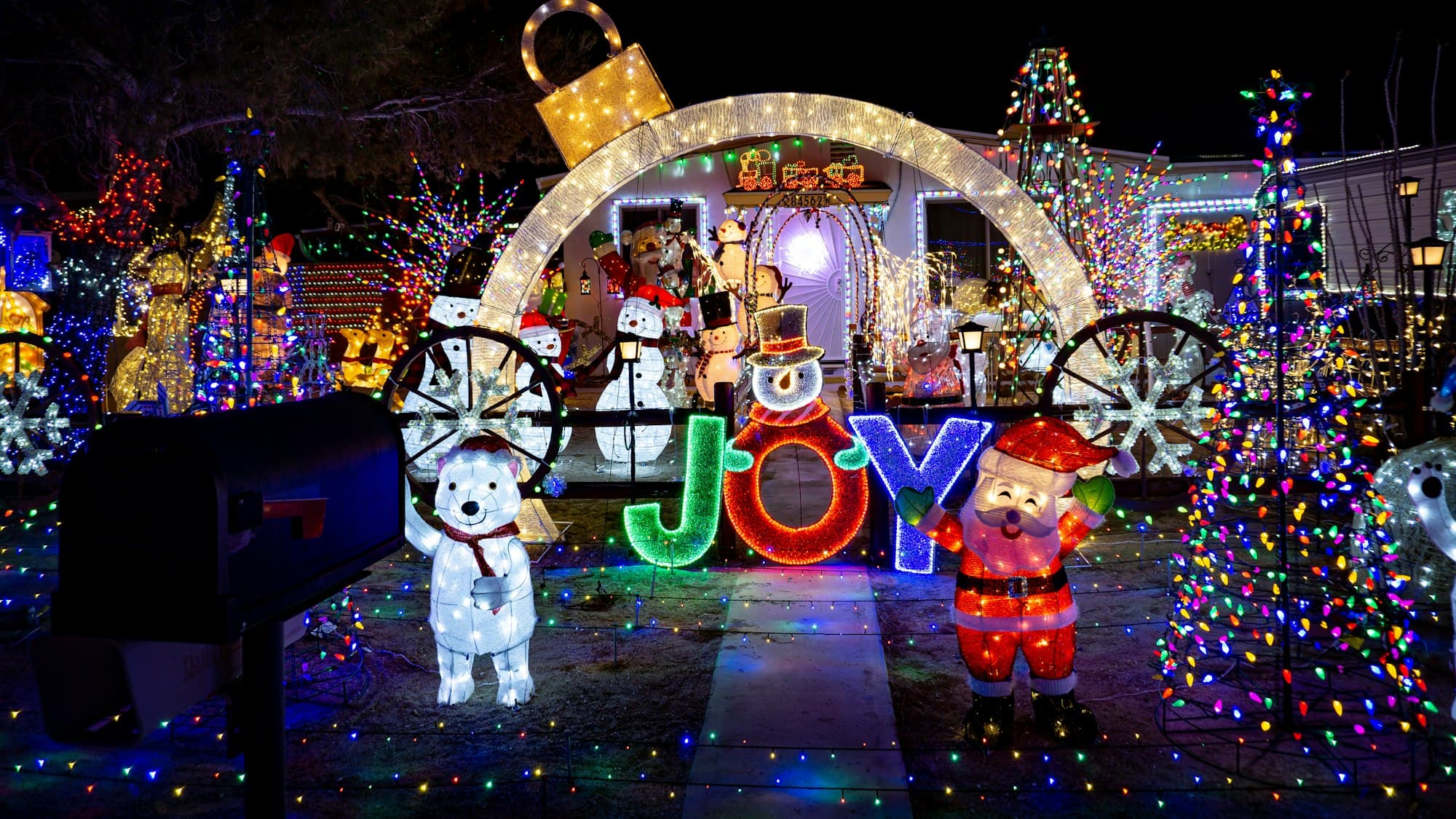
- 3.Driving around to look at neighborhoods of houses lit up with elaborate displays
- 4.Sending paper Christmas cards with annual family photos
- 5.Christmas morning gift exchange followed by a large family meal
What's on the table
Roast turkey or ham, cookies for Santa
Christmas dinner is typically a roast (turkey, ham, or beef) with sides like mashed potatoes, green bean casserole, and pies. Children leave milk and cookies for Santa on Christmas Eve.
The iconic decoration
Lit Christmas tree and outdoor lights
An evergreen tree (real or artificial) covered in lights and ornaments anchors the living room. Outside, homeowners string warm-white or multi-color lights along the roofline, on bushes, and in yard displays.
How gifts are given
Santa Claus delivers gifts overnight on Christmas Eve, leaving them under the tree. Family members also exchange wrapped gifts on Christmas morning.
But who delivers yours?
United States's gift-giver is Santa Claus. But there are eight cultural Christmas gift-givers worldwide — Santa, La Befana, the Yule Lads, Ded Moroz, Sinterklaas, the Three Kings, Christkind, and Joulupukki. Take the 6-question quiz to find your match.
Take the gift-giver quizDid you know?
NASA satellite imagery shows American cities glowing 20 to 50 percent brighter around Christmas and New Year's than during the rest of the year, thanks to the national obsession with holiday light displays.
The shape of the season
American Christmas doesn't start on a date. It starts the moment the Thanksgiving leftovers hit the fridge. The Friday after Thanksgiving (Black Friday) is the unofficial starting gun, and from late November the country shifts into a five-week sprint of shopping, decorating, parties, and travel that ends, abruptly, on the afternoon of December 25. Unlike much of Europe, where the celebration centers on Christmas Eve and stretches to Epiphany, the American holiday is front-loaded into the run-up and peaks on a single morning.
That morning is the heart of it. The defining image of an American Christmas is children running downstairs at dawn on December 25 to a pile of gifts under a lit tree, stockings bulging on the mantel, all of it left overnight by Santa Claus. Christmas Eve has its rituals (a church service, a big dinner, leaving cookies out), but the payoff is Christmas morning, and the whole machinery of the season builds toward it.
The tree and the lights
The Christmas tree anchors the American living room. Roughly a quarter of households still buy a real cut tree each year; the rest use increasingly realistic artificial ones. It goes up anywhere from the day after Thanksgiving to mid-December, gets covered in lights and a mix of heirloom and themed ornaments, and is topped with a star or an angel. Beneath it, the wrapped gifts accumulate over the weeks, and half the fun is the pile growing.
Outside is where Americans go big. Stringing lights along the roofline, wrapping the shrubs, and staging the yard is a national pastime that ranges from a tasteful run of warm-white bulbs to full-on competitive spectacles with synchronized music and tens of thousands of lights. Loading the family into the car to drive slowly through a well-lit neighborhood, hot chocolate in hand, is its own beloved ritual. (If you're planning your own display, our free Christmas light calculator tells you exactly how many bulbs you'll need.)
At the table
There's no single national Christmas dish. The meal is "a big roast and the sides everyone expects." The roast is usually turkey, ham, or a beef roast like prime rib. The supporting cast is regional and familial: mashed potatoes, green bean casserole, sweet potatoes, dinner rolls, and a lineup of pies (pumpkin, pecan, apple) for dessert. Eggnog, rich, spiced, and often spiked, is the signature drink of the season.
On Christmas Eve, children leave a plate of cookies and a glass of milk out for Santa (and increasingly a carrot or two for the reindeer), to be mysteriously half-eaten by morning. Baking cut-out sugar cookies and building gingerbread houses are family activities in their own right.
Santa and the stocking
The American Santa Claus, a jolly, heavyset man in a red fur-trimmed suit who lives at the North Pole, keeps a list of who's naughty and nice, and delivers presents by reindeer-drawn sleigh on Christmas Eve, is largely an American literary and commercial invention. The 1823 poem "A Visit from St. Nicholas" ("'Twas the night before Christmas") fixed the reindeer, the chimney, and the rooftop sleigh; cartoonist Thomas Nast drew the rotund, bearded figure through the late 1800s; and twentieth-century advertising (Coca-Cola's 1930s campaigns most famously) cemented the red-and-white look worldwide.
Stockings hung on the mantel are filled overnight with small gifts and candy. A more recent addition is the Elf on the Shelf (introduced in 2005): a scout elf that "watches" the kids' behavior and reports to Santa, repositioned around the house each night by parents while the children sleep. It's a tradition barely two decades old that now feels permanent.
The social season
Outside the home, American Christmas is intensely social and only loosely religious for many. Workplaces hold holiday parties; friend groups and offices run Secret Santa and White Elephant gift exchanges. Shopping malls install a Santa for photos with kids. Made-for-TV Christmas romance movies (the Hallmark Channel genre) run on a loop. Live broadcasts of the lighting of the Rockefeller Center tree in New York and the National Christmas Tree near the White House mark the season's opening. And a single 1994 pop song, Mariah Carey's "All I Want for Christmas Is You," has become such a fixture that its annual return to the top of the charts is treated as a season-marker in itself.
Regional and cultural variety
For a country this size and this diverse, "American Christmas" is really a hundred local ones layered on top of the national template:
- In the Southwest and in Mexican-American homes, tamales are the Christmas Eve dish, and luminarias / farolitos (paper-bag lanterns) line walkways and rooftops, especially in New Mexico.
- Italian-American families keep the Feast of the Seven Fishes on Christmas Eve, a multi-course seafood dinner.
- In Hawaii, "Mele Kalikimaka" greets a tropical Christmas of beaches and Santa arriving by outrigger canoe.
- Scandinavian, German, Polish, and other immigrant communities keep their old-country dishes and customs alive within the broader American frame.
What's distinctly American
What sets the American version apart is its scale and its commercialism. Americans spend more per household on Christmas than almost anyone, and the season is as much an economic event as a religious or familial one. It's also unusually secularized and inclusive: the generic "Happy Holidays" coexists with "Merry Christmas," and the cultural celebration of tree, lights, gifts, Santa, and music is observed by many families with no religious attachment to it at all. All of it adds up to a holiday that's enormous, warm, a little frantic, deeply nostalgic, and exported, through American movies and music, to living rooms all over the world.
Did you know
- Americans collectively spend over a billion dollars a year on Christmas lights, enough electricity to power Las Vegas for about half a month.
- The "Christmas creep" is real and measurable: decorations and music now routinely appear in stores before Halloween, and the retail "holiday season" is tracked as a distinct economic quarter.
- The reindeer Rudolph, with his red nose, isn't ancient folklore. He was invented in 1939 for a Montgomery Ward department-store promotional booklet, then made famous by a 1949 song.
More from North America

Bring a little of it home
Borrowing one tradition from somewhere else is how most of the traditions on this page started.
Free AI tool
See your own home decorated
Upload one photo and watch your room or house transform, before you buy anything.
Interactive map
All 41 countries
Gift-givers, feast tables, and the surprising customs most articles skip.
City guides
Lights worth the drive
The best displays in 40 US cities, including the free neighborhoods.
More Christmas traditions in North America
Christmas ideas for your own home.
Seasonal decorating tips and the occasional new tool, straight to your inbox. One list, no spam.