Christmas in
Mexico
Celebrated: December 16 to January 6 (with Three Kings Day on January 6)
Signature traditions
- 1.Las Posadas, nine nights of processions reenacting Mary and Joseph's search for shelter, ending December 24
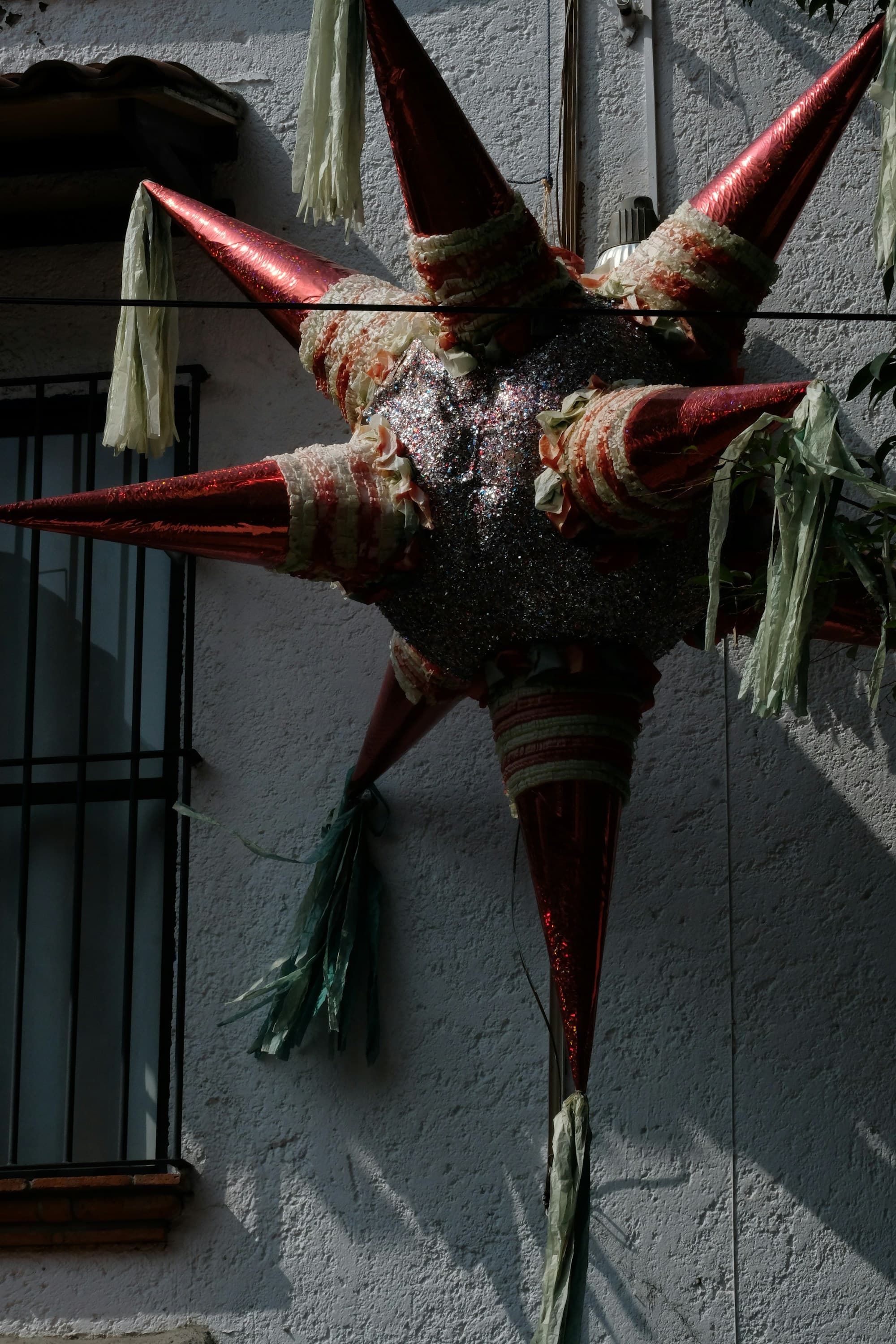
- 2.Breaking a star-shaped piñata at gatherings, traditionally with seven points representing the seven deadly sins
- 3.Misa de Gallo (Rooster's Mass) at midnight on Christmas Eve
- 4.Lighting farolitos (small paper lanterns) along walkways and plazas in some regions, especially Oaxaca
- 5.Three Kings Day (Día de los Reyes) on January 6, when most children receive their gifts
What's on the table
Tamales, bacalao, and ponche
Christmas Eve dinner often features tamales, bacalao (salt cod stew), romeritos (greens with mole), and ponche navideño, a hot fruit punch with sugarcane and cinnamon.
The iconic decoration
Nacimiento and poinsettias
The nacimiento (nativity scene) is more central than the tree in many homes. Poinsettias (known locally as flores de Nochebuena) are everywhere; the plant is native to Mexico.
How gifts are given
Most children receive gifts on January 6 from the Three Kings, who leave them in shoes left out the night before. Some families also exchange gifts on Christmas Eve.
But who delivers yours?
Mexico's gift-giver is The Three Kings. But there are eight cultural Christmas gift-givers worldwide — Santa, La Befana, the Yule Lads, Ded Moroz, Sinterklaas, the Three Kings, Christkind, and Joulupukki. Take the 6-question quiz to find your match.
Take the gift-giver quizDid you know?
The poinsettia's association with Christmas began in 16th-century Mexico, where a legend tells of a poor girl whose roadside weeds bloomed into red flowers when she presented them at a Christmas Eve service.
The shape of the season
Mexican Christmas runs longer and richer than the American version. The cultural season opens on December 12 with the feast of La Virgen de Guadalupe, the country's patron saint and one of the most important religious figures in Mexican life, and runs through Día de la Candelaria on February 2. In between are two of the most distinctive Christmas traditions anywhere in the world: the nine nights of Las Posadas, beginning December 16, and the late-night Christmas Eve dinner known as La Cena de Nochebuena.
The rhythm is communal. Mexican Christmas is rarely a private family affair conducted behind closed doors. It's a neighborhood-level event: processions through streets, parties that move from house to house, public concerts, town-square nativity scenes, and a heavy social calendar that runs almost continuously from mid-December through Three Kings Day on January 6.
Las Posadas
The heart of Mexican Christmas is Las Posadas ("The Inns"), a series of nine nightly processions, one per night from December 16 through December 24, that re-enact Mary and Joseph's search for shelter in Bethlehem.
The format is theatrical and consistent across the country. Each night, a group of neighbors gathers and walks through the streets carrying candles and a small statue or image of the holy family. They stop at a designated house (a different one each night, by neighborhood arrangement). Two singers stand outside, playing the role of Mary and Joseph, and sing a traditional verse asking for shelter (posada). From inside the house, more singers, playing innkeepers, sing back, initially refusing. After several verses back and forth, the innkeepers recognize the holy family and welcome them in. The whole group then enters the house.
What follows is the party. Posada parties always include:
- Tamales, wrapped in corn husks, fillings vary by region (chicken in green salsa, pork in red salsa, sweet pineapple)
- Atole or champurrado, warm, thick, masa-based drinks (champurrado is the chocolate version)
- Buñuelos, crispy fried dough drizzled with syrup or sprinkled with cinnamon sugar
- Ponche navideño, a fruit punch simmered with sugarcane, tamarind, tejocotes (Mexican hawthorns), apples, prunes, hibiscus, and cinnamon, optionally spiked with tequila or rum for adults
- A piñata, traditionally a seven-pointed star representing the seven deadly sins, broken open by blindfolded children with a stick. The candy inside represents virtue overcoming sin.
The pattern repeats: nine nights, nine houses, nine processions, nine parties. The ninth and final posada, on December 24, culminates in the family attending Misa de Gallo (midnight Mass, literally "Rooster's Mass") together.
The tradition is genuinely religious in origin but functions today as a community-bonding ritual that crosses devotional lines. Many Mexican neighborhoods organize posadas through community centers, schools, or workplaces in addition to (or instead of) church-led ones.
La Cena de Nochebuena
The Mexican Christmas Eve dinner, La Cena de Nochebuena, is the meal of the year. It happens late, after the final posada and Midnight Mass; families often don't sit down to eat until 11 PM or midnight. The menu varies wildly by region and family, but several dishes appear consistently:
- Bacalao a la Vizcaína: salt cod stewed with tomato, olives, capers, potatoes, and peppers, a Basque-Mexican dish that's become central to Mexican Christmas Eve tables, especially in central Mexico.
- Romeritos: a wild herb (similar to seepweed) cooked in mole sauce with potatoes, dried shrimp patties, and nopales (cactus paddles). Distinctively Mexican; rarely served outside the Christmas season.
- Pavo relleno: stuffed turkey, a more recent American-influenced addition that's become standard in many households alongside the older dishes.
- Pierna: roasted pork leg, popular in northern Mexico and increasingly common elsewhere.
- Ensalada de Nochebuena: a Christmas Eve salad of beets, apples, oranges, jicama, peanuts, pomegranate, and lettuce, dressed with a sweet vinaigrette. The colors (red, white, green) match the Mexican flag and the salad is treated as the visual centerpiece of the table.
Tamales are also served, sometimes as a course in themselves, sometimes as part of the spread. The meal extends for hours. Wine, tequila, and rompope (Mexican eggnog with rum) flow. Children open one small gift after midnight Mass; the main gift exchange comes either later that night or on the morning of December 25.
Inside the home
The most distinctive Mexican Christmas decoration is the nacimiento, the nativity scene. In many homes it's far more central than the tree. The Mexican version is elaborate and grows over the course of the season:
- Baby Jesus is not placed in the manger until midnight on December 24
- The three Magi are placed across the room or on a different shelf and "travel" toward the manger over the twelve days of Christmas, arriving on January 6
- The nacimiento itself often includes a built landscape: moss, miniature houses, a small fountain or stream, shepherds, animals, the entire village of Bethlehem
The Christmas tree (árbol de Navidad) is also common, decorated with colored lights, ornaments, and often paper or felt traditional Mexican figures: pajaritos (small birds), estrellas (stars), and miniature versions of regional artisan crafts.
The most visible exterior decoration is the piñata, the flor de Nochebuena (poinsettia, a plant native to Mexico, where it grows wild as a large shrub), and farolitos, small paper lanterns lit with candles, lining walkways and rooflines.
In many parts of Mexico, especially in the southwest US-border states and in Oaxaca, luminarias (paper bags filled with sand and a candle) line driveways and sidewalks during the posada nights. The American Southwest's tradition of lining streets with paper-bag lanterns at Christmas is a direct import of this Mexican practice.
Día de los Reyes Magos
January 6, Three Kings Day, Día de los Reyes Magos, is when many Mexican children actually receive their main gifts. The Three Kings (Melchior, Caspar, and Balthazar) bring the gifts, leaving them by the children's shoes overnight (children leave a shoe by the bed or door, often with hay or water for the kings' camels).
The day's signature food is rosca de reyes, Three Kings cake. It's a large oval-shaped sweet bread topped with candied fruit (red and green pieces representing the jewels in the kings' crowns) and decorated with strips of pastry. Hidden inside the bread is a small plastic figurine of baby Jesus. Whoever cuts a slice that contains the figurine is obligated to host the tamale party on February 2, Día de la Candelaria, which is the official end of the Christmas season.
Rosca de reyes is sold in every Mexican bakery from late December through January 6. Modern versions have multiple hidden figurines per bread (which means multiple unlucky tamale hosts), and some bakeries sell figurine-free versions for those who'd rather skip the obligation.
How gifts are given
Mexican Christmas has three to four gift-giving moments depending on region and family:
- December 24 (Nochebuena): Some smaller gifts, especially for younger children, after Midnight Mass
- December 25 (Navidad): A growing tradition, more recent and American-influenced, with gifts under the tree
- January 6 (Día de los Reyes Magos): The traditional main gift day. The Three Kings bring the gifts.
Many Mexican families now do gifts on both December 25 and January 6, with one being designated as the "real" main exchange and the other being smaller. Older traditional families lean toward January 6 as the main day; modernized urban families lean toward December 25.
Santa (Santa Claus or Papá Noel) has been imported via American media and now also delivers gifts in many homes, usually on December 24/25, but the Three Kings remain the more authentic and culturally important gift-givers.
If you wanted to borrow this tradition
A piñata at the Christmas Eve party is where to start. It's silly, communal, easy to source (any party supply store), and provides a structured moment for kids that breaks up the wait for the gift exchange. The traditional seven-pointed star version is widely available, but any piñata works. Fill it with small candy and cheap toys; let each child have one swing blindfolded; let the gathered group sing the traditional song while it sways.
Tamales for Christmas dinner travels beautifully. They freeze well, can be made days in advance, and feel distinctly seasonal. A simple tamale party (gather a group, make several batches together, eat them with atole) is a great alternative to the standard cookie-exchange format that dominates American December.
The rosca de reyes on January 6 is a charming way to extend Christmas past the December 25 commercial peak. Most American supermarket bakeries don't make them, but Mexican bakeries in most US cities do, and ordering one (or making one yourself) and gathering family on Three Kings Day to slice it is a quiet, deeply traditional way to close the holiday season.
Did you know
- The poinsettia, the ubiquitous American Christmas flower, is Mexican. It grows wild as a large shrub in southern Mexico, and the Aztecs cultivated it under the name cuetlaxóchitl. It was introduced to the US in the 1820s by Joel Roberts Poinsett, the first US Minister to Mexico, hence the English name.
- The seven-pointed piñata star design represents the seven deadly sins (pride, greed, lust, envy, gluttony, wrath, sloth). Breaking it is a symbolic triumph over sin; the falling candy represents grace.
- Rompope, the Mexican eggnog, was created by nuns in the convents of Puebla in the 17th century. The recipe (eggs, milk, sugar, cinnamon, vanilla, rum) is still made by some Mexican religious communities and sold under the brand Santa Clara.
More from North America

Bring a little of it home
Borrowing one tradition from somewhere else is how most of the traditions on this page started.
Free AI tool
See your own home decorated
Upload one photo and watch your room or house transform, before you buy anything.
Interactive map
All 41 countries
Gift-givers, feast tables, and the surprising customs most articles skip.
City guides
Lights worth the drive
The best displays in 40 US cities, including the free neighborhoods.
More Christmas traditions in North America
Christmas ideas for your own home.
Seasonal decorating tips and the occasional new tool, straight to your inbox. One list, no spam.