Christmas in
Ukraine
Celebrated: December 25 (since 2023, when Ukraine officially shifted from the January 7 Orthodox date to the December 25 Western date as a deliberate break from Russian liturgical calendar)
Signature traditions
- 1.Sviata Vechera (Holy Supper) on Christmas Eve: a 12-course meatless feast representing the 12 apostles, beginning when the first star appears in the evening sky
- 2.Kutia, sweet wheat berry porridge with poppy seeds, honey, and nuts, eaten ceremonially as the first dish, with the eldest tossing a spoonful at the ceiling for good luck (if it sticks, the harvest will be good)
- 3.Didukh, a sheaf of wheat representing ancestors, placed in the corner of the home on Christmas Eve and kept through the holiday season as the spiritual focal point of the room
- 4.Koliadky (Christmas carols): groups of carolers travel between homes singing traditional Ukrainian Christmas songs, often dressed in elaborate folk costumes, sometimes carrying a large star on a pole
- 5.Pavuky (straw 'spider' ornaments): geometric ornaments made of straw, hung from the ceiling above the Christmas table, symbolizing hard work and family unity
What's on the table
The 12 dishes of Sviata Vechera
Christmas Eve dinner is meatless and runs to 12 distinct dishes: kutia (wheat berry porridge with poppy seed and honey), borscht with vushka (mushroom-stuffed dumplings), varenyky (sauerkraut or potato-stuffed dumplings), holubtsi (cabbage rolls with rice and mushrooms), pickled herring, smoked or pickled fish, bean dishes, sauerkraut, mushroom dishes, breads, uzvar (a dried-fruit drink), and various honey-and-poppy-seed sweets. The number 12 is fixed; the specific dishes vary by family.
The iconic decoration
Didukh, the wheat sheaf
The didukh, a tall sheaf of wheat tied with red ribbon, stands in the most prominent corner of the home from Christmas Eve through January 13 (Old New Year), representing the family's ancestors. It is one of the oldest Slavic Christmas traditions, predating Christianity in Ukraine by centuries. Pavuky (straw spider ornaments) hang above the Christmas table; embroidered rushnyky (ritual cloths) drape across icons.
How gifts are given
Sviatyi Mykolai (St. Nicholas) brings small gifts to good children on the night of December 5-6 (St. Nicholas Day moved from December 19 to December 6 with the 2023 calendar switch), placing them under pillows. Larger Christmas gifts are exchanged on December 25 in modern Ukraine, with families opening them after the Christmas Eve service or on Christmas morning.
But who delivers yours?
There are eight cultural Christmas gift-givers around the world — Santa Claus, La Befana, the Yule Lads, Ded Moroz, Sinterklaas, the Three Kings, Christkind, and Joulupukki. Take the 6-question quiz to find out which one matches you.
Take the gift-giver quizDid you know?
Ukraine officially moved Christmas from January 7 (Orthodox calendar) to December 25 (Western calendar) in 2023, a deliberate cultural decision to align with European countries and break from the Russian Orthodox liturgical calendar. The shift was both religious and political, formalized by the Orthodox Church of Ukraine and the Ukrainian Greek Catholic Church and observed nationally. Many Ukrainian families now celebrate on both dates as the transition settles.
The shape of the season
Ukrainian Christmas, Rizdvo, is one of the most ritually rich and ancient Christmas traditions in Europe, layering deep Slavic agrarian customs that predate Christianity onto Orthodox and Greek-Catholic observance. Its heart is Sviata Vechera, the Holy Supper on Christmas Eve, a twelve-dish, meatless feast governed by centuries of ceremony, eaten by candlelight under a sheaf of wheat that represents the family's ancestors.
The season's most consequential recent change is its date. For centuries, Ukrainian Christmas fell on January 7, following the Julian calendar of the Orthodox Church. But in 2023, in a deliberate cultural and political break from the Russian Orthodox liturgical calendar, Ukraine officially moved Christmas to December 25, aligning with the rest of Europe. The shift was formalized by the Ukrainian Orthodox Church and observed nationally, and as the change settles, many Ukrainian families now mark both dates: December 25 as the new official Christmas, and January 7 as the old one some still keep.
The full season runs from St. Nicholas Day (December 6, since the 2023 calendar switch) through Epiphany and the old "Malanka" New Year in mid-January.
Sviata Vechera: the Holy Supper
The center of Ukrainian Christmas is Sviata Vechera, the Holy Supper on Christmas Eve. It is governed by a tight sequence of rituals, and it is the meal around which the entire season turns.
It begins with the first star. The family fasts through the day of Christmas Eve, and the supper cannot begin until the first star appears in the evening sky, commemorating the Star of Bethlehem that led the Magi. A child is sent to watch the window; when the star is spotted, the meal begins.
Twelve meatless dishes. The Holy Supper consists of twelve dishes, one for each of the twelve apostles, and every one of them is meatless and dairy-free, in keeping with the Nativity Fast that continues until Christmas Day. The number twelve is fixed; the specific dishes vary by region and family.
The first dish is kutia. The supper always opens with kutia, a ceremonial dish of boiled wheat berries mixed with poppy seeds, honey, and chopped nuts. Kutia is the oldest and most symbolically loaded dish on the table: the wheat for eternal life and the family's connection to the land, the honey for sweetness, the poppy seeds for the departed. In a striking old custom, the head of the household takes the first spoonful of kutia and tosses it up at the ceiling. If the grains stick, the coming year's harvest and the family's bees will thrive.
The didukh and the table
Two ritual objects define the Ukrainian Christmas Eve table and the room around it.
The didukh. In the most honored corner of the home stands the didukh, a sheaf of wheat (or rye), bound with ribbon, that represents the spirits of the family's ancestors gathered to share the feast. The word means roughly "grandfather spirit." The didukh is one of the oldest surviving Slavic Christmas traditions, predating Christianity in the region by centuries, a pre-Christian harvest and ancestor rite absorbed into the Christian feast. It stands from Christmas Eve through the Old New Year (mid-January), the symbolic guest of honor at every meal.
Hay and garlic on the table. Beneath the white tablecloth, a layer of hay or straw is spread, recalling the manger where Christ was laid. A clove of garlic is sometimes placed at each corner of the table for protection and health. And an extra place is set for absent family members and for the souls of the dead, who are believed to join the Holy Supper.
Pavuky overhead. Hanging above the table, some homes still display pavuky, intricate geometric ornaments woven from straw in the shape of spiders or stars, symbolizing industry, family unity, and good fortune. (The pavuk connects to a Ukrainian folk tale in which a poor family's bare tree was decorated overnight by spiders whose webs turned to silver and gold in the morning light, a likely origin of tinsel.)
At the table
Beyond the opening kutia, the twelve dishes of Sviata Vechera typically include:
- Borscht, in the Christmas version, a clear or beet-based broth served with vushka ("little ears"), tiny dumplings stuffed with wild mushroom.
- Varenyky, boiled dumplings filled with sauerkraut, potato, or mushroom (the meatless fillings, for the fast).
- Holubtsi, cabbage rolls stuffed with rice and mushrooms rather than the usual meat.
- Fish, baked, fried, or pickled herring; fish is the permitted protein on the fast day.
- Bean and mushroom dishes, sauerkraut, and boiled potatoes.
- Pampushky, soft bread rolls, or other Christmas breads.
- Uzvar, a dark, sweet drink of stewed dried fruits (apples, pears, prunes), the traditional Holy Supper beverage, sometimes called the "liquid cousin" of kutia.
- Honey-and-poppy-seed sweets to close.
Christmas Day, December 25, breaks the fast. Meat returns to the table, and the meals become richer and more relaxed.
Koliadky: the carols
Ukraine has one of the richest carol traditions in Europe. After the Holy Supper and through the days of Christmas, groups of koliadnyky (carolers) travel from house to house singing koliadky, traditional Ukrainian Christmas carols, many of them ancient, blending Christian themes with older pre-Christian midwinter songs of abundance and good fortune. The carolers are often in elaborate folk costume, and a central figure carries a large, many-pointed star on a pole (the zirka, representing the Star of Bethlehem) which spins or glows as they sing.
In exchange for their songs and blessings on the household, the carolers receive food, sweets, and small money gifts. The most famous Ukrainian carol, Shchedryk, was arranged in 1916 by the composer Mykola Leontovych and traveled the world as the melody of "Carol of the Bells," one of the most recognizable Christmas tunes on earth, and a Ukrainian export few outside the country realize is Ukrainian.
Inside the home
The Ukrainian Christmas home centers on the didukh in the corner and the hay-laid Holy Supper table. Embroidered ritual cloths (rushnyky), long linen towels worked in red-and-black geometric patterns, drape across the family icons, which hold the place of honor on the eastern wall. The pavuky hang overhead.
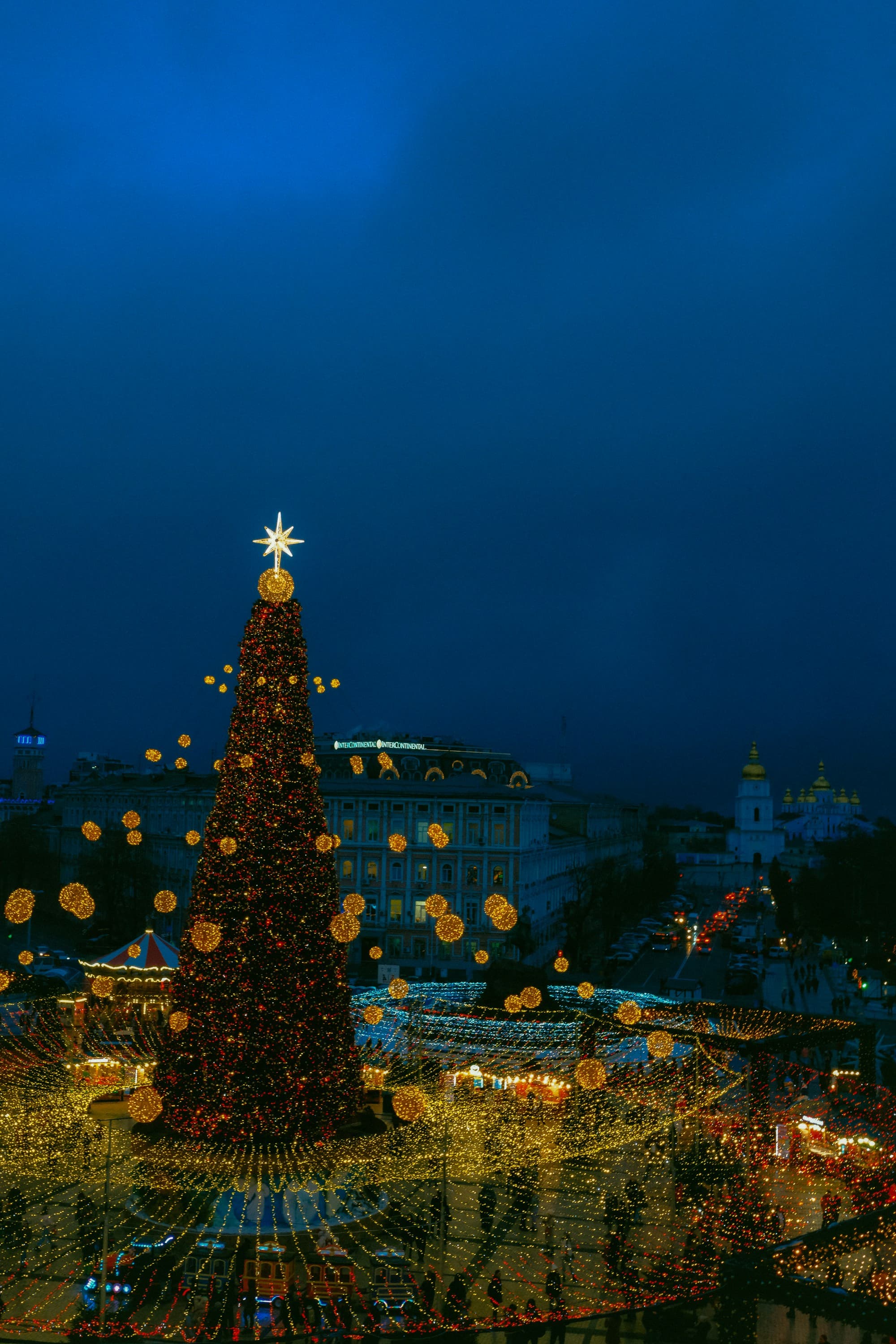
The Christmas tree (yalynka) is also widespread, especially in urban homes, decorated with glass ornaments, straw stars and pavuky, and lights, topped with a star. In the cities, enormous public Christmas trees, most famously in Kyiv's Sofiyivska Square, beneath the golden domes of St. Michael's Cathedral, anchor the season's public celebrations.
How gifts are given
Sviatyi Mykolai (St. Nicholas) is the principal Ukrainian gift-bringer for children, arriving on the night of December 5–6 (St. Nicholas Day moved from December 19 to December 6 with the 2023 calendar switch). Children traditionally find his small gifts under their pillows in the morning: sweets and a small present for the good, and a twig or small lump of coal as a gentle warning for the naughty.
The larger Christmas gift exchange now falls around December 25, with families opening gifts after the Christmas Eve Holy Supper or on Christmas Day, as the new calendar settles in. (Under the old Julian calendar, this fell on January 6–7, and some families still keep that date.) The Soviet-era figure of Did Moroz (Grandfather Frost), tied to a secular New Year, has been increasingly set aside in favor of the traditional St. Nicholas as Ukraine reclaims its own Christmas customs.
If you wanted to borrow this tradition
Kutia is the most meaningful Ukrainian Christmas dish to bring to a table, and it's approachable: boiled wheat berries (available at most health-food stores) mixed with honey, poppy seeds, and chopped walnuts. Served as the ceremonial first taste of a Christmas Eve meal, even a single shared spoonful, it carries centuries of symbolism (the grain for life, the honey for sweetness) and roots the meal in something older than any single religion.
The didukh and the extra place setting together make a profound, understated adoption: a sheaf of wheat in the corner to honor the family's ancestors, and an empty seat set for those who can't be present or are no longer living. It reorients the Christmas table around remembrance and continuity in a way few Western customs do.
And "Carol of the Bells" is already in every American Christmas playlist. Knowing it as Shchedryk, a Ukrainian carol, and seeking out a traditional Ukrainian choral recording of it, is a small way to connect the familiar tune to its origin.
Did you know
- The melody of "Carol of the Bells" is Ukrainian. It began as Shchedryk, a folk-based shchedrivka (a New Year's well-wishing song) arranged by Mykola Leontovych in 1916; it premiered in Kyiv, toured the West with the Ukrainian National Chorus, and was given English lyrics in 1936. Its origin as a Ukrainian song is largely unknown to the millions who hear it every December.
- In 2023 Ukraine officially moved Christmas from January 7 to December 25, a deliberate break from the Russian-aligned Orthodox calendar and a reassertion of Ukrainian cultural alignment with Europe. The change was both religious and political, and many families now observe both dates as the transition settles.
- The didukh, the ancestral wheat sheaf, is one of the oldest continuously observed Christmas customs in Europe, a pre-Christian Slavic ancestor-and-harvest rite that has survived more than a thousand years by folding itself into the Christian feast rather than being replaced by it.
More from Europe



Bring a little of it home
Borrowing one tradition from somewhere else is how most of the traditions on this page started.
Free AI tool
See your own home decorated
Upload one photo and watch your room or house transform, before you buy anything.
Interactive map
All 41 countries
Gift-givers, feast tables, and the surprising customs most articles skip.
City guides
Lights worth the drive
The best displays in 40 US cities, including the free neighborhoods.
More Christmas traditions across Europe
Christmas ideas for your own home.
Seasonal decorating tips and the occasional new tool, straight to your inbox. One list, no spam.