Christmas in
Switzerland
Celebrated: December 24 evening (the main event) and December 25-26
Signature traditions
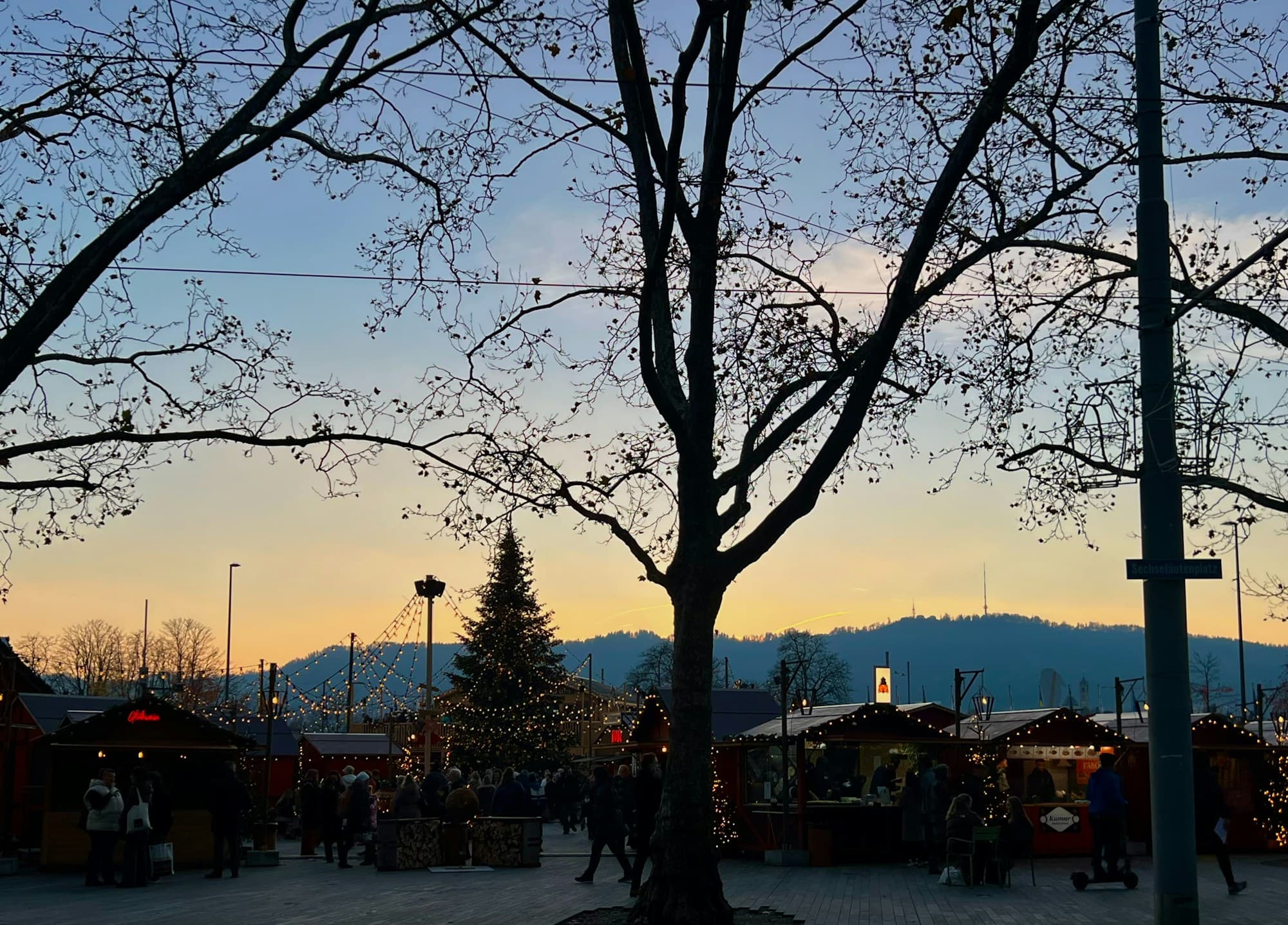
- 1.Christmas markets: Zurich's Christkindlimarkt at the main station, Basel's market in Barfüsserplatz, and Montreux's lakeside market are some of the most beautiful in Europe
- 2.Advent calendars and Advent candles: the four-Sunday wreath tradition is taken seriously, with one new candle lit each Sunday leading to Christmas
- 3.Fondue chinoise, a meat fondue (thinly sliced beef cooked in broth at the table) eaten specifically on Christmas Eve in many Swiss families, especially in the French-speaking regions
- 4.Christmas cookies (Weihnachtsguetzli) baked in massive batches during December (Mailänderli, Brunsli, Zimtsterne, Spitzbuben, Anisbrötli) and exchanged with neighbors
- 5.Singing 'Stille Nacht' (Silent Night, originally composed in 1818 just across the border in Austria) at Christmas Eve church services across all four language regions
What's on the table
Fondue chinoise and roast goose
Fondue chinoise (thin slices of beef cooked at the table in a pot of seasoned broth, served with multiple sauces and rice) is the most distinctive Swiss Christmas Eve dinner. In German-speaking regions, roast goose with red cabbage and potato gratin is more common. The cookie tradition is universal: Mailänderli (lemon shortbread), Brunsli (chocolate-almond), and Zimtsterne (cinnamon stars) are baked by the kilogram and gifted in tins.
The iconic decoration
Christmas tree with real candles
The Swiss Christmas tree is famously traditional: real fir or spruce, lit with actual wax candles in clip-on candleholders, decorated with straw ornaments and red wooden hearts. Many Swiss families still light the candles only for short periods on Christmas Eve, with a bucket of water nearby. LED candles are more common in modern households but the real-candle tradition persists in older families.
How gifts are given
Christkindli (the Christ child, a winged angelic figure) delivers gifts on the evening of December 24 in Swiss-German cantons. In French-speaking cantons, Père Noël is more common. Gifts are exchanged after Christmas Eve dinner, often before Midnight Mass.
But who delivers yours?
There are eight cultural Christmas gift-givers around the world — Santa Claus, La Befana, the Yule Lads, Ded Moroz, Sinterklaas, the Three Kings, Christkind, and Joulupukki. Take the 6-question quiz to find out which one matches you.
Take the gift-giver quizDid you know?
Switzerland is one of the few countries with four national-language Christmas greetings, and which one you hear depends on the canton: Frohi Wiehnachte in Swiss German (the majority), Joyeux Noël in the French-speaking western cantons (Geneva, Vaud, Neuchâtel, Jura), Buon Natale in Italian-speaking Ticino, and Bun Nadal in Romansh-speaking parts of Graubünden. A holiday card sent within Switzerland often includes all four to acknowledge the federal multilingualism.
The shape of the season
Swiss Christmas (Weihnachten, Noël, Natale, or Nadal, depending on which of the country's four language regions you're in) is shaped by Switzerland's defining feature: it is four cultures in one small country. A Christmas in German-speaking Zurich, French-speaking Geneva, Italian-speaking Lugano, and Romansh-speaking Graubünden share a calendar and a deep Alpine winter, but differ in their gift-bringers, their foods, and even the words they use to say "Merry Christmas."
What unites them is the season's rhythm: a serious, candle-lit Advent leading to the cultural peak of Christmas Eve, December 24, when the tree is lit and gifts are exchanged in the evening, followed by two quieter holidays on December 25 and 26. Switzerland keeps Christmas restrained and warm rather than loud. Fewer inflatable lawn ornaments, more real candles, hand-baked cookies, and the glow of Christmas markets in cold, clear mountain air.
Advent
Advent is observed seriously across all four Swiss regions. The four-Sunday Adventskranz (Advent wreath), an evergreen ring holding four candles, one lit each successive Sunday, sits on the family table, and the lighting of the first candle marks the real start of the Swiss Christmas season in late November.
Advent calendars are everywhere, including a charming Swiss village version: in some towns, twenty-four houses each decorate one window as a giant communal Advent calendar, unveiling a new illuminated window display each evening of December, so the whole village becomes a walkable calendar.
And the season's social anchor is the Christmas market (Weihnachtsmarkt / marché de Noël). The markets at Zurich (including the famous indoor Christkindlimarkt in the main railway station, with a Christmas tree hung entirely with Swarovski crystals), Basel (one of Switzerland's largest, in Barfüsserplatz and Münsterplatz), Montreux (along the shore of Lake Geneva), and Lucerne fill the cold weeks with wooden stalls, mulled wine, raclette, roasted chestnuts, and handcrafts.
Christmas Eve
Heiligabend / le réveillon, December 24 is the heart of the Swiss Christmas. In the evening, after dark, the family gathers; in many homes the Christmas tree is revealed and lit for the first time that night, and the gifts are exchanged. Many Swiss attend a Christmas Eve church service or Midnight Mass, and the singing of Stille Nacht ("Silent Night"), composed in 1818 just over the border in Austria, in the shared German-speaking Alpine culture, is a fixture.
The Christmas Eve dinner has no single national menu, because Switzerland has four food cultures, but a few dishes recur:
- Fondue chinoise: the most distinctively Swiss Christmas Eve dinner, especially in the French- and German-speaking regions. Thin slices of raw beef are cooked by each diner in a communal pot of simmering seasoned broth at the table, then dipped in an array of sauces and eaten with rice, potatoes, and pickles. It's the Swiss answer to a long, social, everyone-cooks-their-own holiday meal, closely related to the Dutch gourmetten and a relative of cheese fondue, but lighter and more festive. Fondue bourguignonne (cooked in hot oil instead of broth) is the richer variant.
- Roast goose, duck, or capon: more traditional in German-speaking households, served with red cabbage, chestnuts, and Spätzli (soft egg noodles) or potato gratin.
- Regional specialties: in Italian-speaking Ticino, the menu leans toward risotto, braised meats, and panettone; in French-speaking regions, more toward French-influenced festive dishes.
The Christmas cookie tradition
The Swiss bake Weihnachtsguetzli (Swiss-German for Christmas cookies) in enormous quantities through December. The cookie-baking is one of the most beloved and universal Swiss Christmas customs, often a multi-generational kitchen project spanning several weekends. The canonical Swiss cookies:
- Mailänderli: buttery lemon shortbread cut in shapes and glazed with egg yolk for a golden sheen.
- Brunsli: dense, chewy chocolate-almond cookies spiced with cinnamon and clove, naturally gluten-free.
- Zimtsterne: cinnamon stars, ground-almond and cinnamon cookies cut as stars and topped with a bright white meringue glaze.
- Spitzbuben: almond shortbread sandwiches with a window cut in the top showing red jam filling.
- Anisbrötli / Springerli: anise-flavored cookies pressed in carved wooden molds to leave a raised picture on top, a very old Swiss-German tradition.
Tins of these are exchanged with neighbors and friends throughout the season; a household's particular cookie repertoire is a small matter of family identity.
Inside the home
The Swiss Christmas tree (Weihnachtsbaum / sapin) is famously traditional: often a real fir or spruce, and in the most conservative households still lit with actual wax candles clipped to the branches (with a bucket of water kept nearby), rather than electric lights. The tree is decorated with straw stars, red wooden hearts, glass baubles, and Lebkuchen (gingerbread) shapes. In many homes the tree isn't put up and decorated until December 24 itself, kept secret from younger children until the evening reveal.
Real candlelight defines the Swiss Christmas aesthetic more broadly: Advent candles on the table, candles in windows, and the warm, restrained glow that suits the long Alpine winter nights. The home smells of fir, beeswax, simmering fondue broth, and the cinnamon-and-anise spice of the cookie baking.
How gifts are given
The gift-bringer depends on the language region:
- In German-speaking Switzerland (the majority of the country), gifts are traditionally brought by the Christkindli, the Christ Child, depicted as a radiant, angelic, winged child figure (the same tradition as the German and Austrian Christkind), on the evening of December 24.
- In French-speaking Switzerland (Geneva, Vaud, Neuchâtel, Jura), the gift-bringer is Père Noël (Father Christmas), closer to the international Santa.
- In Italian-speaking Ticino, gifts may come from Babbo Natale on Christmas, and some families also observe the Italian tradition of small gifts from the Befana witch at Epiphany (January 6).
In all regions, the main gift exchange happens on the evening of December 24, around the tree, after dinner and often before or after the Christmas Eve church service. Earlier in the season, Samichlaus (St. Nicholas) makes his own visit on December 6, walking through towns and villages in his red bishop's robes with his companion Schmutzli (a dark-cloaked figure), handing out peanuts, mandarins, and chocolate to children. This is a separate event from the Christmas gift-giving.
If you wanted to borrow this tradition
For an American table, the Swiss import that earns its keep is the fondue chinoise. The equipment is simple (a fondue pot or tabletop burner), the prep is minimal (thin-sliced beef, a good broth, a spread of sauces), and the experience, everyone cooking their own small portions across a long, slow, conversational meal, is exactly the kind of relaxed, social Christmas Eve dinner that a single served roast can't match. It's also forgiving of mixed eating preferences, since everyone controls their own plate.
The Christmas cookie repertoire is a delightful tradition for anyone who bakes. Pick two or three Swiss cookies (Zimtsterne, the cinnamon stars; Brunsli, the chocolate-almond; and Mailänderli, the lemon shortbread, make a beautiful, contrasting trio), bake them in quantity over an afternoon, and gift tins to neighbors. The variety and the giving are the heart of it.
And the village Advent calendar idea scales down happily to a single street or building: neighbors each "open" one decorated, illuminated window on a successive evening of December, turning the whole block into a shared countdown. It takes little more than a sign-up sheet to build the kind of communal Christmas warmth the Swiss markets capture.
Did you know
- Switzerland is the only country where the standard Christmas greeting changes by region across four official languages: Frohi Wiehnachte (Swiss German), Joyeux Noël (French), Buon Natale (Italian), and Bun Nadal (Romansh). A Christmas card sent within Switzerland often prints all four to honor the country's federal multilingualism.
- The Zurich main railway station hosts one of Europe's most photographed indoor Christmas trees, a roughly 50-foot fir decorated entirely with thousands of Swarovski crystals, glittering above the daily commuter crush in the station hall.
- The clipping of real lit wax candles to the Christmas tree, once universal and still practiced in traditional Swiss households, is the origin of the modern electric tree light. Switzerland is among the last places where you can still find Christmas trees genuinely lit by open flame, candle by candle, on Christmas Eve.
More from Europe



Bring a little of it home
Borrowing one tradition from somewhere else is how most of the traditions on this page started.
Free AI tool
See your own home decorated
Upload one photo and watch your room or house transform, before you buy anything.
Interactive map
All 41 countries
Gift-givers, feast tables, and the surprising customs most articles skip.
City guides
Lights worth the drive
The best displays in 40 US cities, including the free neighborhoods.
More Christmas traditions across Europe
Christmas ideas for your own home.
Seasonal decorating tips and the occasional new tool, straight to your inbox. One list, no spam.