Christmas in
South Korea
Celebrated: December 25 (national holiday)
Signature traditions
- 1.Christmas is a national public holiday, the only East Asian country where it is, reflecting the strong Christian community
- 2.Korean Christmas cake (sponge cake with whipped cream and strawberries) sold in every bakery from December 22
- 3.Couples celebrate with romantic dates rather than family gatherings (much like Japan)
- 4.Massive themed light displays in Seoul (Cheonggyecheon Stream, Myeongdong) and other major cities
- 5.Christmas Eve church services among Christian communities, often elaborate with carol concerts
What's on the table
Christmas cake and fried chicken
Korean Christmas cake (light sponge with whipped cream and strawberries) is a near-universal Christmas Eve dessert. Fried chicken (already the romantic-date food of choice in Korea) is the most common Christmas Eve meal for couples and friend groups.
The iconic decoration
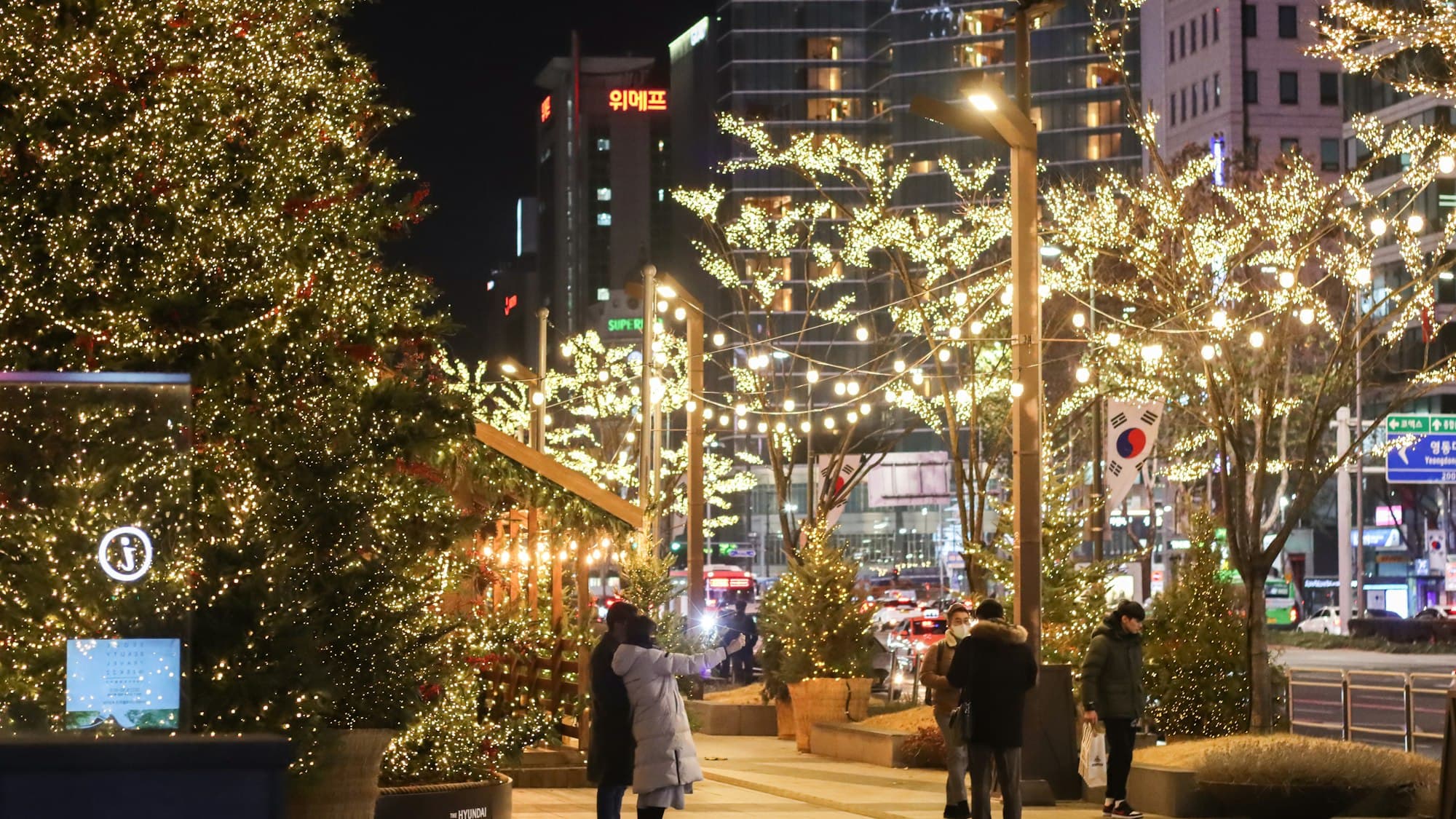
Streetscape illuminations
Major shopping districts in Seoul, Busan, and Incheon stage themed light displays from late November. Home decorations are more common in Christian households; secular celebrants enjoy public displays as the main visual experience.
How gifts are given
Christmas in South Korea is more couple-focused than family-focused. Gifts are typically exchanged between romantic partners and close friends. Children of Christian families receive gifts from Santa Halabeoji ('Grandfather Santa').
But who delivers yours?
There are eight cultural Christmas gift-givers around the world — Santa Claus, La Befana, the Yule Lads, Ded Moroz, Sinterklaas, the Three Kings, Christkind, and Joulupukki. Take the 6-question quiz to find out which one matches you.
Take the gift-giver quizDid you know?
South Korea is the only country in East Asia where Christmas Day is a public holiday. About 30% of South Koreans identify as Christian (the highest proportion in East Asia), which has shaped the country's enthusiastic embrace of the season relative to its neighbors.
The shape of the season
South Korea is the Christmas outlier of East Asia, the one country in the region where December 25 is a national public holiday. That status reflects a large Christian population (around 30%, the highest in East Asia), and it gives the Korean Christmas a stronger footing than the purely commercial versions in neighboring countries. Yet outside church communities, the celebration looks less like a family holiday and more like a romantic one: a couples' day of dates, dazzling city light displays, sponge cake, and, distinctively, fried chicken.
A romantic holiday, not a family one
For most South Koreans, Christmas is a day for couples and friends rather than extended family. Where Western Christmas centers on the family gathering, the Korean version centers on a date: dinner out, a walk through the illuminated streets, a small gift exchange between partners. The big family-and-feasting holiday in Korea is Seollal (Lunar New Year) and Chuseok (the autumn harvest festival); Christmas is the romantic, festive, lights-and-cake occasion. In that sense it resembles Christmas in Japan: a borrowed holiday repurposed around young couples.
Christmas cake and fried chicken
Two foods define the Korean Christmas Eve. The first is Christmas cake, a light sponge layered with fresh whipped cream and strawberries, which appears in every bakery from around December 22 and is a near-universal Christmas Eve dessert. The second is fried chicken, already Korea's beloved date-and-gathering food (often paired with beer as chimaek), which becomes the default Christmas Eve meal for couples and friend groups. The combination of a strawberry sponge cake and a bucket of Korean fried chicken is a perfectly Korean Christmas, and a world away from a roast turkey.
The light displays
The main visual experience of a secular Korean Christmas is the city itself. From late November, Seoul, Busan, and Incheon stage elaborate themed light displays in their major districts: the Cheonggyecheon stream lit up through downtown Seoul, the shopping streets of Myeongdong, department-store facades, and more. People go out specifically to see the illuminations, take photos, and soak up the atmosphere. Home decoration is more common in Christian households; for everyone else, the public displays are the decoration.
Christmas in the churches
Because the Christian community is so substantial, the religious side of Korean Christmas is real and visible. Christmas Eve church services, often with elaborate carol concerts and music, draw large congregations, and many churches and Christian neighborhoods are brightly decorated. For these families, Christmas is both the romantic-cultural event everyone enjoys and a significant religious observance, the dual identity that comes from being the one East Asian nation that made the day a national holiday.
How gifts are given
Korean Christmas gifting is, like the holiday itself, more couple-focused than family-focused: gifts are typically exchanged between romantic partners and close friends rather than across the family. In Christian families, children receive gifts from Santa Halabeoji, "Grandfather Santa," the Korean Father Christmas. But the lavish, family-wide gift exchange Westerners associate with Christmas morning isn't the norm; that energy goes to the dates, the cake, and the lights.
If you wanted to borrow this tradition
The most fun Korean import is the food pairing: a strawberry-and-cream sponge "Christmas cake" plus fried chicken is a delightful, low-stress alternative to the heavy traditional roast: festive, shareable, and easy. It's a reminder that the Christmas meal can be whatever feels celebratory to you, not a fixed menu.
More broadly, Korea (like Japan) shows how appealing the lights-and-romance version of Christmas can be: a holiday built around going out into a beautifully lit city with someone you love, rather than staying in. If your Christmas has become all obligation, the Korean model (a date, a walk through the lights, cake) is a charming counterpoint.
Did you know
- South Korea is the only country in East Asia where Christmas Day is a national public holiday, a reflection of its large Christian population, the highest proportion in the region at around 30%.
- The standard Korean Christmas Eve meal for couples and friends is chimaek (fried chicken and beer), followed by a strawberry-and-cream sponge "Christmas cake" from the local bakery.
- The Korean Father Christmas is Santa Halabeoji, literally "Grandfather Santa."
More from Asia



Bring a little of it home
Borrowing one tradition from somewhere else is how most of the traditions on this page started.
Free AI tool
See your own home decorated
Upload one photo and watch your room or house transform, before you buy anything.
Interactive map
All 41 countries
Gift-givers, feast tables, and the surprising customs most articles skip.
City guides
Lights worth the drive
The best displays in 40 US cities, including the free neighborhoods.
More Christmas traditions across Asia
Christmas ideas for your own home.
Seasonal decorating tips and the occasional new tool, straight to your inbox. One list, no spam.