Christmas in
Philippines
Celebrated: September 1 through the first Sunday of January, the Feast of the Three Kings (the world's longest Christmas season)
Signature traditions
- 1.The Christmas season starts on September 1, the moment any 'ber' month begins, decorations and music appear
- 2.Simbang Gabi, nine consecutive dawn Masses from December 16 to 24, attended faithfully even in the dark
- 3.Hanging a parol (a star-shaped bamboo lantern) in every home
- 4.Noche Buena, a midnight feast on Christmas Eve
- 5.Children visiting godparents to receive aguinaldo (gift money) on Christmas Day
What's on the table
Lechon, bibingka, and puto bumbong
Noche Buena features lechon (whole roasted pig), pancit (long noodles for long life), and queso de bola (a wax-covered Edam cheese). After Simbang Gabi mass, vendors sell bibingka (rice cake) and puto bumbong (purple sticky-rice tubes) outside churches.
The iconic decoration
The parol
The parol is a five-pointed star lantern, traditionally made from bamboo and Japanese paper, lit from within. It represents the Star of Bethlehem and hangs on nearly every Filipino home throughout the season.
How gifts are given
Children visit their godparents (ninong and ninang) on Christmas Day or shortly after, receiving aguinaldo (gift money in envelopes). Santa Claus delivers gifts to children on Christmas Eve in many families.
But who delivers yours?
There are eight cultural Christmas gift-givers around the world — Santa Claus, La Befana, the Yule Lads, Ded Moroz, Sinterklaas, the Three Kings, Christkind, and Joulupukki. Take the 6-question quiz to find out which one matches you.
Take the gift-giver quizDid you know?
The Philippines has the longest Christmas season in the world. Christmas songs start playing in stores on September 1, when the first 'ber' month (September, October, November, December) arrives, that's roughly four months of Christmas, a third of the year.
The shape of the season
The Philippines runs the longest Christmas season in the world. It begins, by general cultural consensus, on September 1, the first of the "Ber months" (September, October, November, December), when shopping malls start playing Christmas music, Christmas decorations appear in stores, and radio stations begin their seasonal programming. It runs through Tres Reyes (Three Kings) on the first Sunday of January, by which point the country has been in Christmas mode for roughly four months.
This isn't a marketing exaggeration. By mid-September, most Filipino homes have already put up at least their parol (the iconic Filipino Christmas lantern), and the seasonal greeting "Merry Christmas" is in casual use. By December 1, the country is in full festive mode, with every street, every mall, and every jeepney lit up. The official church-calendar season is shorter and more traditional (Advent through January 6), but the cultural season is unmatched anywhere.
The Philippines is also one of the most Christian countries in Asia (over 80% Catholic, due to 300+ years of Spanish colonial rule), and Filipino Christmas is the most important holiday of the year by a wide margin. It's bigger, longer, and more emotionally charged than any other celebration.
Simbang Gabi
The most distinctive religious tradition is Simbang Gabi, or "Night Mass," a series of nine masses held in the predawn hours on the nine days leading up to Christmas (December 16 through December 24). The masses traditionally start at 4:00 AM and are timed so worshippers can attend, eat breakfast, and still go to work.
The tradition originated in the Spanish colonial period as a way for rural farmers to attend Mass before their long workdays in the fields. Popular belief holds that completing all nine Simbang Gabi masses earns a special blessing or the granting of a wish (a devotional custom, not formal doctrine), and millions of Filipinos make a real effort to attend all nine each year.
The atmosphere at Simbang Gabi is unlike any other Mass. Churches are packed in the cold predawn dark. Outside, vendors sell bibingka (rice cake baked in clay pots with banana leaves, topped with salted egg and grated coconut) and puto bumbong (steamed purple rice cake served on banana leaves with butter, sugar, and coconut). The Mass itself often includes traditional Filipino Christmas songs and ends with families lingering in the church grounds eating the breakfast vendors' food and chatting before heading off to start the day.
For Filipinos in the diaspora (and there are millions), Simbang Gabi is one of the most missed traditions. Most Filipino-American Catholic churches now run their own version, often shifted to evening hours (7:00 or 8:00 PM) to accommodate work schedules. Filipino communities in cities like Los Angeles, San Diego, Honolulu, and Jersey City run elaborate Simbang Gabi programs each December.
The parol
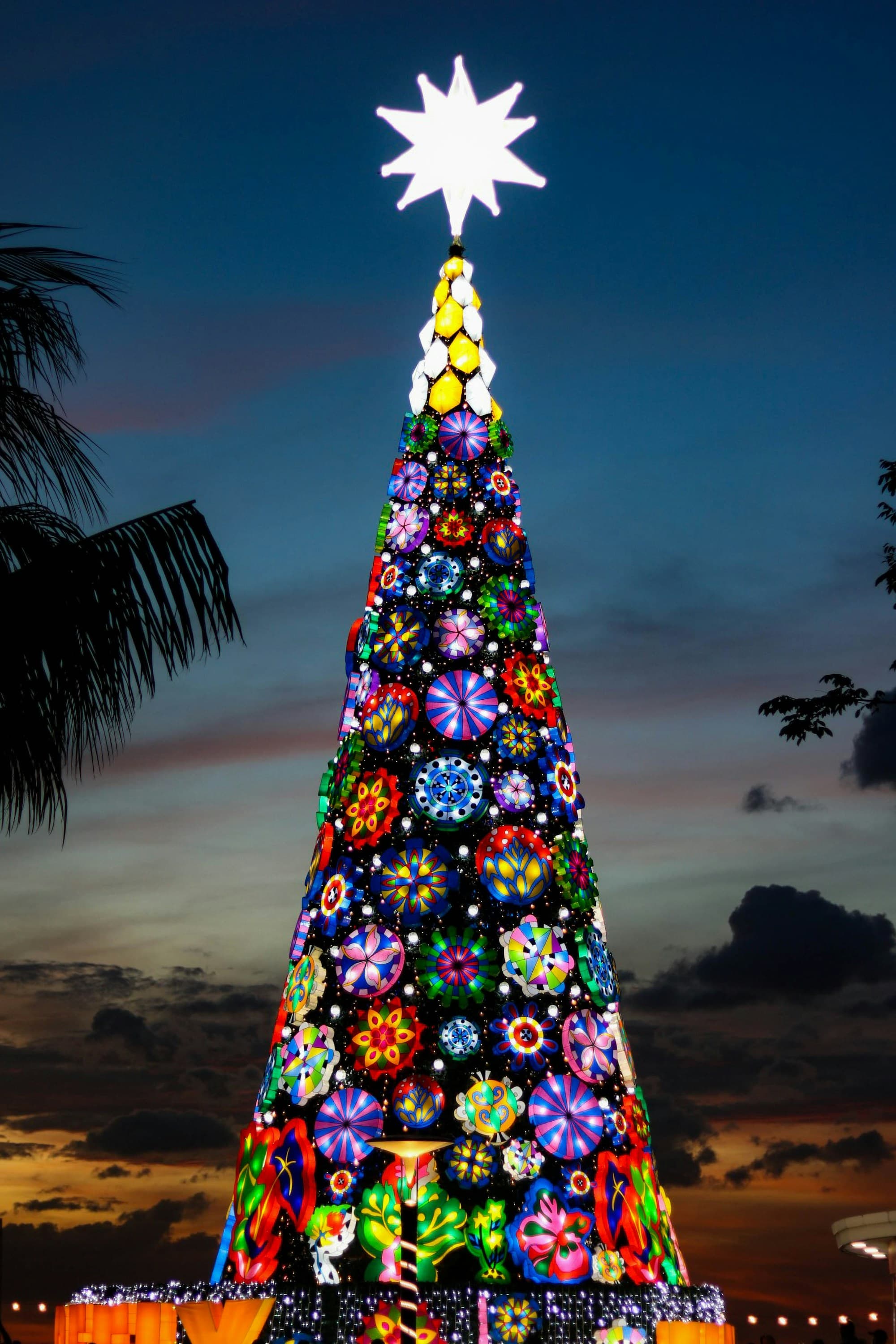
If you visit the Philippines in December, the most striking visual you'll see is the parol, a star-shaped lantern, traditionally made of bamboo and papel de Japón (Japanese tissue paper), illuminated from within. Parols hang from every house, every storefront, every jeepney, and every electric pole. They're the country's signature Christmas decoration and one of the most beautiful in any Christmas culture.
The traditional parol is a simple five-pointed star with two trailing fabric "tails" hanging from the bottom two points. The frame is bamboo, the panels are colored translucent paper, and the light source was originally a candle (now almost always an LED or small light bulb). The shape represents the Star of Bethlehem; the parol is fundamentally a religious object even though it functions decoratively.
Modern parols have evolved into an extraordinary craft form. The most elaborate are made in the city of San Fernando, Pampanga, the country's "Christmas capital." The annual San Fernando Giant Lantern Festival, held the Saturday before Christmas Eve, features parols up to 20 feet across, with synchronized lighting controlled by complex electrical mechanisms (originally hand-cranked rotors, now computerized) that produce dancing patterns of light. Each barangay (neighborhood) in San Fernando enters one giant parol, and the festival is one of the country's most beloved Christmas spectacles.
The simpler home parol, typically two to four feet across and hung from a window or the front porch, is the version most Filipinos encounter daily. Many families make their own; many more buy them in markets that start selling parols in September. The handmade ones, often produced in cottage workshops in Pampanga and Bulacan, are sold by street vendors throughout the month.
Noche Buena
The Christmas Eve dinner, Noche Buena (the same Spanish term used in Mexico), is the meal of the year. It happens after the family attends the Christmas Eve Mass (the ninth Simbang Gabi or a special midnight Mass) and is timed to begin around 10:00 PM and run past midnight.
The menu is dense and varies by family but consistently includes:
- Lechon: a whole roasted pig, the centerpiece of any major Filipino feast. The skin is crispy and lacquer-orange; the meat underneath is tender and pulled apart at the table.
- Hamon de Bola: a glazed Christmas ham, usually round in shape (the bola, or "ball"), bought from specific specialty makers and prized highly.
- Queso de Bola: a ball of Edam cheese in red wax, the traditional Christmas cheese, served sliced with the ham.
- Pancit: long noodles in various preparations (pancit canton, pancit malabon, pancit palabok). Long noodles symbolize long life and appear at almost every major Filipino celebration.
- Lumpia: Filipino spring rolls, both lumpiang shanghai (small, fried, meat-filled) and lumpiang sariwa (fresh, vegetable, served with peanut sauce).
- Bibingka and puto bumbong: the Simbang Gabi breakfast cakes, returning as Christmas Eve treats.
- Fruit salad: a Filipino-style fruit salad of canned tropical fruits, cream, and condensed milk. Distinct and beloved; not found this way anywhere else.
- Spaghetti: a sweet Filipino version of Italian-American spaghetti, made with banana ketchup-based sauce and sliced hot dogs. Strongly associated with children's birthdays and Christmas. Polarizing to anyone who didn't grow up with it; essential to anyone who did.
- Bibingkang malagkit: sticky rice cakes
- Buko salad: young coconut salad with kaong and nata de coco
Everyone is dressed up. Multiple generations sit at one (often very long) table. Kids run between the table and the parol-lit yard. The meal extends past midnight, when the family pauses to greet each other with Maligayang Pasko ("Happy Christmas"), and the children open their gifts.
How gifts are given
The Filipino gift-giving structure is unusual: it spans the entire season and includes both family and extended community gift exchanges.
- Throughout December: Aguinaldo, small gifts of money or sweets given by older relatives to younger relatives whenever they visit or come asking. Ninongs and ninangs (godparents) are particularly obligated to give aguinaldo to their godchildren throughout the season. Children visit their godparents specifically to collect.
- December 24 (Noche Buena): Main gift exchange happens after midnight, around the tree.
- December 25 (Pasko): Children visit relatives in their finest clothes to wish them Maligayang Pasko and (importantly) to ask for aguinaldo. The hand-kiss greeting, mano po, where the child takes the elder's hand and lightly touches it to their forehead, is the proper form.
- December 30 (Rizal Day): Not officially a Christmas day but falls within the season.
- January 1 (New Year's): Smaller gift exchange, more focused on the meal and the fireworks.
- First Sunday of January (Three Kings): Some Filipino families do a final gift exchange, mirroring the Mexican and Spanish traditions, though this is less universal.
The Christmas gift-giver in Filipino tradition is Santa Claus (imported from American influence during the US colonial period), though older Filipino traditions used the Three Kings. Gifts under the tree are typically attributed to Santa for younger children.
Inside the home
The Filipino Christmas home is multilayered. The parol is mandatory and goes up first, usually in September or early October. The Christmas tree (real are rare; artificial trees are universal) goes up around the start of December, decorated with colored lights, ornaments, and often miniature parol ornaments. Belen (the Filipino term for the nativity scene, from Bethlehem) is set up in a prominent place and treated with religious seriousness; baby Jesus, as in Mexican and Italian tradition, is only added at midnight on December 24.
The exterior of the house often includes additional parols, string lights along the roofline and windows, and small light-up belen tableaux in the front yard or porch. In subdivisions and barangays where the houses are close together, the effect is a continuous canopy of warm lights for blocks at a time.
Filipino Christmas music plays constantly. Specific songs are inescapable: Pasko Na Naman (a sentimental classic), Christmas in Our Hearts by Jose Mari Chan (the country's unofficial second national anthem during December; Filipinos make memes about how unavoidable it is), and Ang Pasko ay Sumapit (a traditional carol). Jose Mari Chan's image has become cultural shorthand for "Christmas season has begun." By mid-September, social media is flooded with memes featuring his face.
If you wanted to borrow this tradition
The parol is the most beautiful thing Filipino Christmas could hand an American home. Handmade Filipino parols are available from many Filipino-American crafts vendors and online sellers (Etsy has good options); a single illuminated parol in a front window from late November through January is a striking and unusual addition to any American home's Christmas decor. The light quality is gentler than Christmas string lights and the star shape gives the house's exterior a clear, simple visual focal point.
Noche Buena as a structured Christmas Eve dinner (rather than an afterthought before Christmas morning) is one of the most worthwhile imports from any Christmas culture. The Filipino version is heavily Catholic in framing, but the format (a late-night family dinner with multiple courses, ending in midnight gift-giving) works regardless of religious context. The specific dishes don't all travel (lechon is hard to roast in an American home; bibingka requires specialized equipment), but the structure is universal.
The September-through-January season length is harder to import (and many Americans wouldn't want to), but the idea of treating Christmas as a months-long cultural buildup, rather than a single-day commercial event, is worth considering. The American "Christmas season starts the day after Thanksgiving" rule is recent and arbitrary; Filipinos demonstrate that a longer season produces more anticipation, more community, and more accumulated joy.
Did you know
- The Philippines is one of only two majority-Catholic countries in Asia (with Timor-Leste). The Catholic foundation underpinning Filipino Christmas was established during 333 years of Spanish colonial rule, ending in 1898.
- The San Fernando Giant Lantern Festival winner is a major source of civic pride, and the giant parols take months of community work and serious barangay fundraising to build.
- Jose Mari Chan's album Christmas in Our Hearts (1990) has been certified Double Diamond in the Philippines and has sold more copies than any other album in Philippine music history. The title track is the most-played Christmas song in the country every year.
More from Asia



Bring a little of it home
Borrowing one tradition from somewhere else is how most of the traditions on this page started.
Free AI tool
See your own home decorated
Upload one photo and watch your room or house transform, before you buy anything.
Interactive map
All 41 countries
Gift-givers, feast tables, and the surprising customs most articles skip.
City guides
Lights worth the drive
The best displays in 40 US cities, including the free neighborhoods.
More Christmas traditions across Asia
Christmas ideas for your own home.
Seasonal decorating tips and the occasional new tool, straight to your inbox. One list, no spam.