Christmas in
Slovenia
Celebrated: December 6 (Miklavž), December 24-25, and December 31 (Dedek Mraz): three distinct gift-giving occasions
Signature traditions
- 1.Three separate gift-givers across the season: Miklavž (St. Nicholas) on December 6, Božiček (Father Christmas) on December 25, and Dedek Mraz (Grandfather Frost) at New Year; many Slovenian children receive gifts on all three
- 2.Blessing of the home (blagoslov) on Christmas Eve, when the family walks through the house with incense and holy water, blessing each room before the evening meal
- 3.Setting up the jaslice (nativity scene), a deeply rooted Slovenian tradition, often built up with moss, bark, and hand-carved figurines into an elaborate landscape
- 4.Baking potica (a rolled yeast cake with walnut, tarragon, or honey filling) for the Christmas table
- 5.Polnočnica (Midnight Mass) on Christmas Eve, followed by carol singing
What's on the table
Potica and the Christmas Eve table
Potica, a thin sheet of yeast dough rolled around a dense walnut (or tarragon, poppy seed, or honey) filling and baked in a ring, is the iconic Slovenian Christmas cake. The Christmas Eve meal is traditionally lighter and meatless; Christmas Day brings roast meats, klobasa (sausage), and žganci (buckwheat spoonbread). Christmas bread (kruhki) and dried-fruit dishes round out the season.
The iconic decoration
Jaslice (the nativity scene)
The jaslice is the spiritual centerpiece of a Slovenian Christmas, often more central than the tree. Families build elaborate nativity landscapes from moss, stone, bark, and figurines, sometimes filling an entire table or corner. Churches and towns mount large public jaslice; some Slovenian caves and gorges host living nativity scenes. The Christmas tree (smrečica) and Advent wreath complete the decor.
How gifts are given
Slovenia's three-gift-giver system reflects its layered history: Miklavž (St. Nicholas, Catholic tradition) brings gifts on December 6; Božiček (Father Christmas, Western influence) on December 25; and Dedek Mraz (Grandfather Frost, from the socialist Yugoslav era) at New Year. Many families observe all three, so Slovenian children may receive gifts on each occasion.
But who delivers yours?
There are eight cultural Christmas gift-givers around the world — Santa Claus, La Befana, the Yule Lads, Ded Moroz, Sinterklaas, the Three Kings, Christkind, and Joulupukki. Take the 6-question quiz to find out which one matches you.
Take the gift-giver quizDid you know?
Slovenia is one of the few countries with three distinct, widely-observed Christmas-season gift-givers, each from a different historical layer: the Catholic St. Nicholas (Miklavž), the Western Father Christmas (Božiček), and the secular socialist-era Grandfather Frost (Dedek Mraz). Rather than one replacing another, all three coexist, and many Slovenian children happily receive gifts from each in turn across December.
The shape of the season
Slovenian December, veseli december, "merry December," is the busiest gift-giving month in Europe, because Slovenia is the country with three Santas. St. Nicholas comes on December 6, Father Christmas on Christmas Eve, and Grandfather Frost around New Year's, and rather than choosing among them, Slovenians simply kept all three. The result is a season that runs nearly five weeks, from the first Nicholas processions in early December through Christmas and the New Year to Epiphany on January 6.
The layering isn't an accident; it's the country's twentieth century written into its holidays. Catholic Slovenia's old gift-bringer was St. Nicholas, Miklavž. The socialist Yugoslav decades suppressed Christmas (December 25 wasn't even a work-free day until it was restored in 1991, with independence) and promoted a secular winter figure instead. When Christmas returned, the Western Father Christmas arrived with it, and Slovenian families, pragmatically and rather sweetly, made room for everyone.
The three good men
Slovenians call them trije dobri možje, the three good men, and each has a distinct character and territory.
Miklavž (St. Nicholas) is the oldest and, for many families, still the most beloved. On the evening of December 5, children set out shoes or plates, and by morning Miklavž, robed as a bishop with miter and staff, has filled them with the traditional modest treasures: mandarin oranges, dried fruit, walnuts, carob, and chocolate. He arrives in town processions accompanied by angels and by the parkeljni, horned devils rattling chains, who theatrically menace the children whose behavior has been questionable. In many homes Miklavž, not Christmas, is when children receive their "real" presents.
Božiček (Father Christmas) is the newest arrival, the familiar red-suited figure who brings gifts on Christmas Eve, December 24, for the tree to yield up that night or on Christmas morning.
Dedek Mraz (Grandfather Frost) is the most distinctively Slovenian of the three. Introduced in the socialist era as a secular gift-bringer, he was deliberately dressed not like the Soviet original but like a Slovenian: a long grey sheepskin coat embroidered with folk motifs and a round dormouse-fur cap, an image drawn from the beloved folk illustrations of the painter Maksim Gaspari. He is said to live beneath Mount Triglav, the country's highest peak, and descends around New Year's to bring one more round of gifts. Far from fading with Yugoslavia, Dedek Mraz remains genuinely loved; his end-of-year processions still draw crowds of children in towns across Slovenia.
Jaslice, from the parlor to the cave
The jaslice, the nativity scene, is the emotional center of the traditional Slovenian Christmas home, older here than the Christmas tree. The first recorded nativity scene in Slovenia was displayed by the Jesuits in Ljubljana in 1644, and the custom worked its way from churches into farmhouses, where families still build their jaslice on Christmas Eve on a bed of green moss gathered from the forest, tucked into the bogkov kot, the "God's corner" of the room, or beneath the tree.
Slovenia has taken the nativity to places no one else has. In the Postojna Cave, the country's vast karst cavern, a Living Nativity is staged in the days after Christmas: costumed performers, more than a hundred of them, enact the Christmas story in tableaux spread along the illuminated underground route, accompanied by music threading through the chambers. It is billed as the world's largest living nativity in a cave, and walking the cool passages from scene to glowing scene is one of the most otherworldly Christmas experiences in Europe.
On Christmas Eve itself, many households still perform the old blessing of the home: the family moves through the house and farm buildings with incense and holy water, censing and sprinkling each room to bless it for the coming year, before praying together by the jaslice and, for many, heading out to polnočnica, midnight Mass.
At the table
One dish rules the Slovenian holidays without rival: potica. This is the national festive cake, a thin sheet of soft yeast dough spread generously with filling, rolled tight, and baked in a round earthenware mold with a central chimney called a potičnik, so it emerges as a handsome ring, sliced to show its spiral. The classic filling is ground walnuts with honey; poppy seed and the strikingly Slovenian tarragon potica (pehtranova potica) are close behind, and bakers' lore counts more than eighty traditional fillings, from cottage cheese to cracklings. Every family guards its recipe, every grandmother's is the best, and no Slovenian Christmas, Easter, or wedding happens without one.
Around the potica, the Christmas table follows the fast-then-feast rhythm: Christmas Eve dinner is traditionally simpler, often fish, with the great meal at Christmas lunch, typically a clear beef soup with homemade noodles, roast pork or poultry with sauerkraut or mlinci-style sides, štruklji (rolled dumplings, sweet or savory), and honey pastries. Mulled wine and honey brandy see the adults through the December markets.
Inside the home
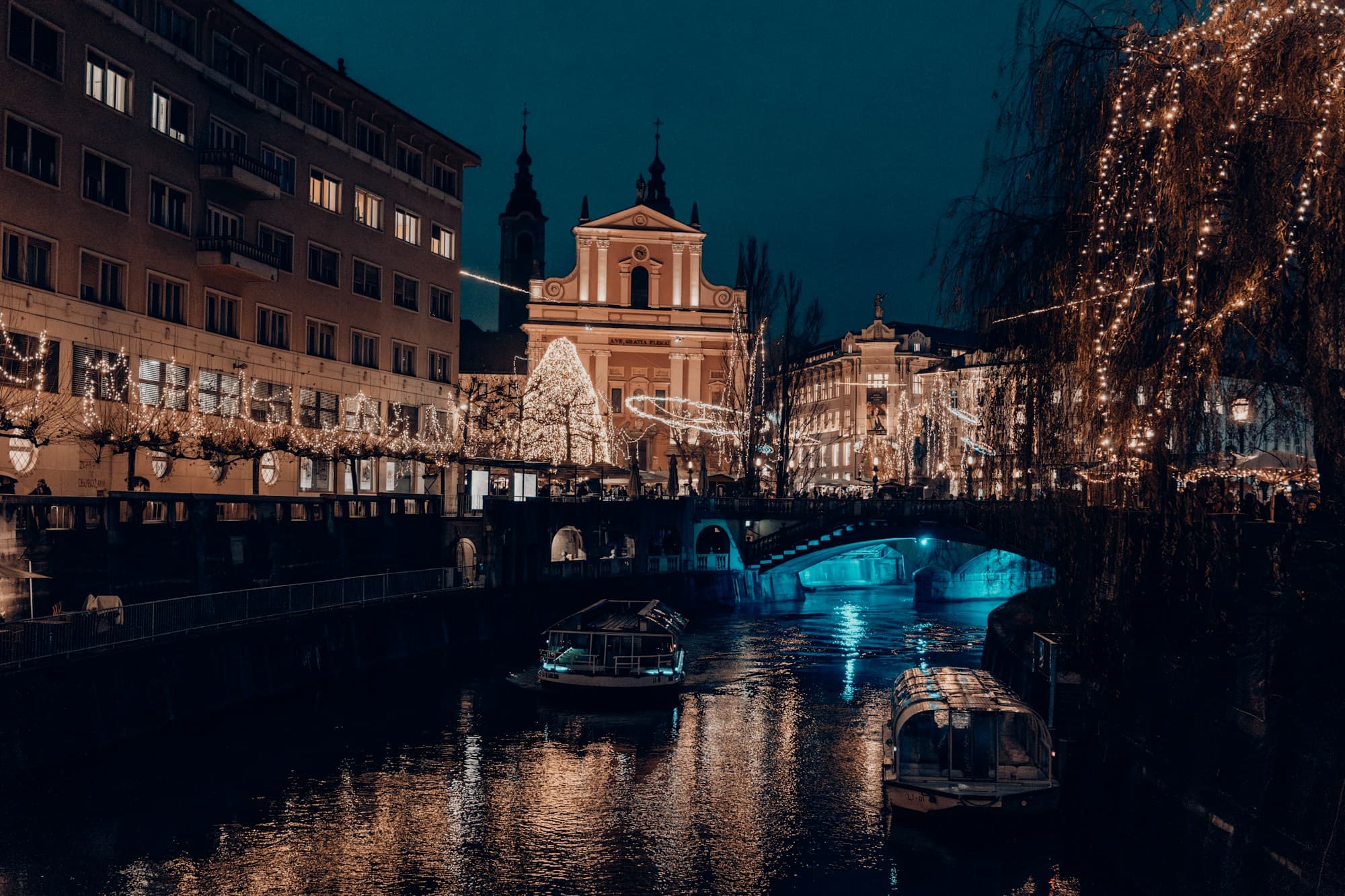
The Slovenian tree, the smrečica, traditionally went up on Christmas Eve itself, decorated with walnuts, apples, honey cookies, and straw ornaments before baubles took over, with the jaslice and its moss at its foot. In December the whole capital becomes a decoration: Ljubljana's holiday lighting, strung above the Ljubljanica River and through the old town, has for decades been designed by the artist Zmago Modic not as generic garlands but as a themed artwork, with suns, planets, and cosmic and philosophical motifs glowing overhead, which is why Ljubljana's lights look like no other city's.
How gifts are given
Three times, in short. Shoes or plates out for Miklavž on the night of December 5, filled with fruit, nuts, sweets, and often the year's main children's gifts, with the parkeljni's rod as the standing alternative. Presents under the tree from Božiček on Christmas Eve. And a final round from Dedek Mraz at New Year's, often delivered at town processions or workplace children's parties, his sheepskin coat and dormouse cap unchanged since the 1950s. Plenty of families lean on one giver more than the others, along lines of religion, politics, or simple habit, but most children, diplomatically, are visited by all three.
If you wanted to borrow this tradition
Bake a potica. Of all the great Central European Christmas breads it may be the most rewarding: the walnut-honey filling is simple, the tight spiral looks spectacular sliced, and a ring pan stands in acceptably for a potičnik. Make it once in December and you'll understand why Slovenians build every celebration around it.
The three-giver calendar is also worth a look for families who find that a single gift avalanche on December 25 flattens the season. Spreading small moments across December 6, Christmas Eve, and New Year's, fruit and chocolate in a shoe, the main gifts at Christmas, one last small parcel to open as the year turns, stretches the anticipation and gives the whole month a shape, which is precisely why Slovenian children consider their arrangement self-evidently superior.
Did you know
- Slovenia officially has three winter gift-bringers, St. Nicholas (December 6), Father Christmas (December 24), and Grandfather Frost (New Year's), a living record of the country's Catholic, socialist, and Western layers. December 25 was an ordinary working day in socialist Slovenia and only became a public holiday again in 1991.
- Dedek Mraz wears a dormouse-fur cap and an embroidered sheepskin coat based on folk-art illustrations by the painter Maksim Gaspari, and is said to come down each winter from Mount Triglav, the three-peaked mountain on the national flag.
- The Postojna Cave hosts a Living Nativity each Christmas season, with over a hundred performers staging the story in scenes along the underground route, the world's largest living nativity performed inside a cave.
More from Europe



Bring a little of it home
Borrowing one tradition from somewhere else is how most of the traditions on this page started.
Free AI tool
See your own home decorated
Upload one photo and watch your room or house transform, before you buy anything.
Interactive map
All 41 countries
Gift-givers, feast tables, and the surprising customs most articles skip.
City guides
Lights worth the drive
The best displays in 40 US cities, including the free neighborhoods.
More Christmas traditions across Europe
Christmas ideas for your own home.
Seasonal decorating tips and the occasional new tool, straight to your inbox. One list, no spam.