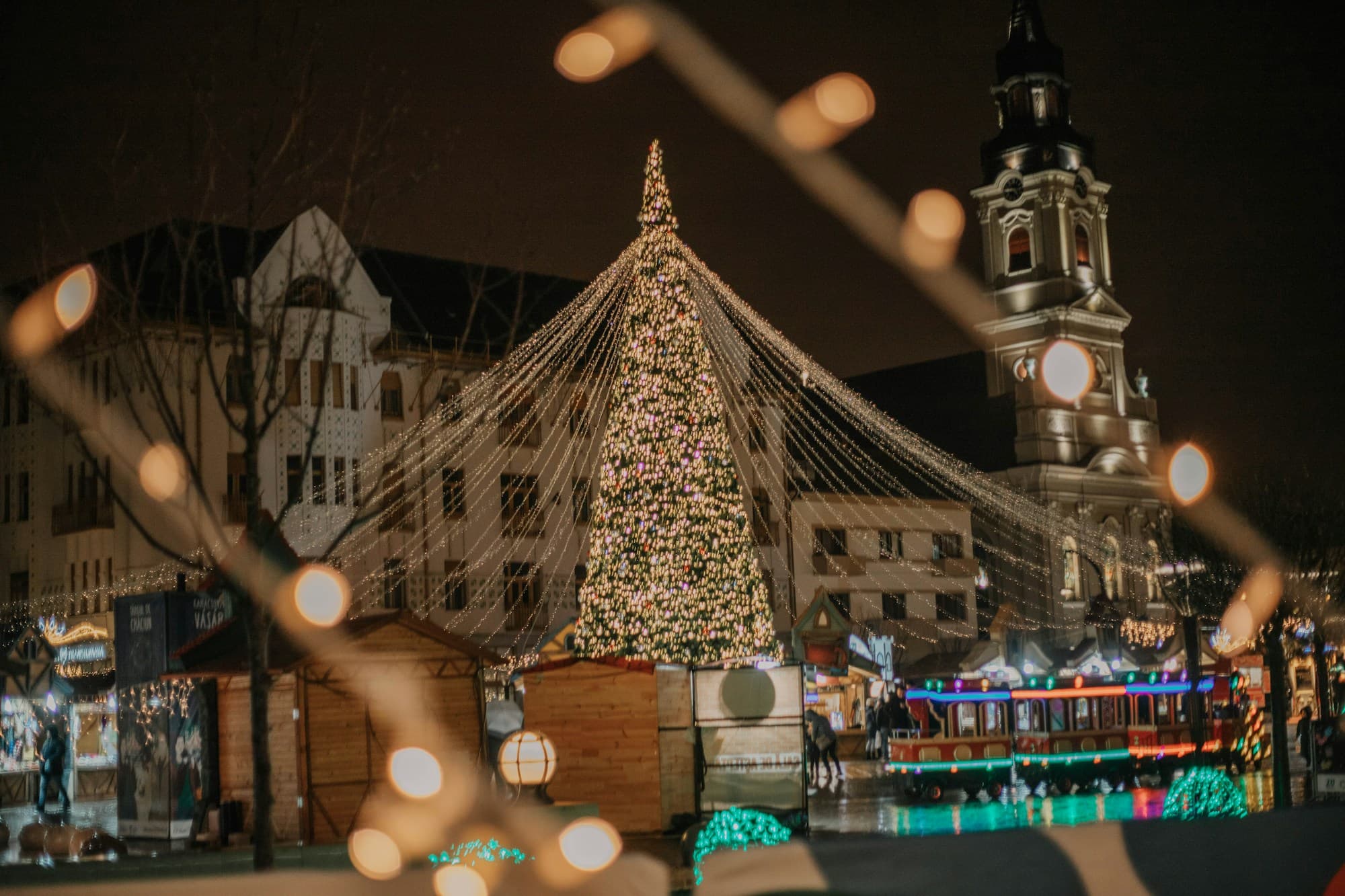
Christmas in
Romania
Celebrated: December 24-26 (with extensive lead-up from December 6, St. Nicholas Day)
Signature traditions
- 1.Colinde: groups of carolers travel between houses on the evenings before Christmas, singing traditional Romanian carols (one of the oldest preserved folk traditions in Europe) in exchange for cakes, fruit, and small money gifts
- 2.Capra and Ursul, folk dances performed by carolers wearing elaborate goat or bear costumes with carved wooden heads, originally pre-Christian agricultural rituals absorbed into Christmas tradition
- 3.Ignat (December 20), the day of the traditional pig slaughter, when rural Romanian families butcher the pig that will provide meat for the entire holiday season
- 4.Sorcova: on New Year's Day, children visit relatives carrying decorated sticks (sorcove), tapping them lightly on each person and reciting a wish for health and prosperity in exchange for small money gifts
- 5.Plugușorul (the little plough), a New Year's Eve ritual where boys go house to house with a small plough or whip, wishing a good harvest year and receiving treats and coins
What's on the table
Sarmale and cozonac
Sarmale (cabbage rolls stuffed with seasoned ground pork, rice, onions, and herbs, slow-cooked in tomato and sauerkraut) are the iconic Christmas dish, eaten as the main course on Christmas Eve. Cozonac, a sweet braided yeast bread filled with walnut, poppy seed, or cocoa-Turkish-delight, is the dessert centerpiece. Tochitură (pork stew), piftie (pork aspic with garlic), and a series of pork preparations from the ignat slaughter fill the rest of the holiday meals.
The iconic decoration
Steaua and embroidered textiles
Steaua, the carolers' star (a large illuminated paper or wooden star on a pole), is carried through villages and towns by groups of singers, representing the Star of Bethlehem. Inside homes, traditional embroidered Romanian textiles (ștergare and table runners in red, black, and white geometric patterns) cover surfaces for the season. The Christmas tree is decorated with hand-painted ornaments and walnuts wrapped in foil.
How gifts are given
Moș Nicolae (St. Nicholas) leaves small gifts in children's polished boots on the night of December 5-6. Moș Crăciun (Father Christmas) delivers the main Christmas gifts on Christmas Eve, after the family Christmas dinner. Children typically open one gift on Christmas Eve and the rest on Christmas morning.
But who delivers yours?
There are eight cultural Christmas gift-givers around the world — Santa Claus, La Befana, the Yule Lads, Ded Moroz, Sinterklaas, the Three Kings, Christkind, and Joulupukki. Take the 6-question quiz to find out which one matches you.
Take the gift-giver quizDid you know?
The Romanian Capra (goat) dancers wear hand-carved wooden goat heads with hinged jaws that clack rhythmically as the dancer moves. The costumes are family heirlooms in some villages, passed between generations. In 2013 UNESCO inscribed Romanian men's group caroling (colindatul de ceată, a nomination shared with Moldova) on its intangible cultural heritage list, and the Capra and Ursul dances remain among the most distinctive folk-Christmas survivals in Europe.
The shape of the season
Romanian Christmas, or Crăciun, is among the most folk-rich winter celebrations in Europe, a season thick with caroling, masked dances, ritual slaughter, and customs that reach back through Orthodox Christianity into far older agrarian and pre-Christian roots. It runs long: from St. Nicholas Day (December 6) through the twelve days of caroling to Christmas (December 25–26), and onward through New Year's and Epiphany (January 6), with distinctive rituals marking each stage.
What sets Romanian Christmas apart is the sheer survival of its folk traditions. In a country where the rural village and the Orthodox calendar shaped life for centuries, the caroling (colinde), the masked goat and bear dances, and the New Year's rituals haven't faded into nostalgia. They're still performed, still costumed, still passed between generations. In 2013, UNESCO inscribed Romanian men's group caroling (colindatul de ceată bărbătească, a nomination shared with Moldova) on its intangible cultural heritage list.
Colinde, the carols
The defining sound of a Romanian Christmas is the colinde, traditional carols sung by groups of carolers (colindători) who travel from house to house on the evenings before Christmas. Romanian colinde are among the oldest preserved folk-song traditions in Europe, many of them centuries old, blending the Nativity story with far older themes of harvest, fertility, and the turning of the year.
The carolers (often children and young people, sometimes whole village groups) go door to door, sing their colinde on the doorstep or in the courtyard, and in return are given colaci (ring-shaped sweet breads), apples, walnuts, and small money gifts. To turn carolers away is considered deeply unlucky; to welcome them is to invite a blessing on the household for the year. The carols themselves are specific to occasions. There are Christmas colinde, New Year's colinde, and Epiphany ones, each with its own melodies.
Capra and Ursul, the masked dances
The most spectacular Romanian winter custom is the masked folk dance, performed by carolers especially around New Year's, in which costumed performers enact ancient animal figures:
- Capra ("the goat"): a dancer in an elaborate costume topped with a carved wooden goat's head whose hinged jaw clacks rhythmically as the dancer moves, snapping in time to drums and pipes. The Capra dance is a survival of a pre-Christian fertility and renewal rite: the goat "dies" and is "reborn" in the course of the dance, enacting the death and rebirth of the year. The carved goat heads are family heirlooms in some villages, passed down and worn only in this season.
- Ursul ("the bear"): a dancer wrapped in a real or simulated bear pelt, who performs a heavy, stamping dance, often "tamed" by a handler, accompanied by drums. The bear dance, especially strong in the Moldavia region of northeastern Romania, is believed to drive out the old year's evil and bring health and fertility for the new, the bear's stamping symbolically "treading down" misfortune.
These masked processions, with their drums, pipes, clacking goat jaws, and stamping bears, fill Romanian town squares and village streets in the days around New Year, and they are among the most distinctive folk-Christmas survivals anywhere in Europe.
Ignat, the Christmas pig
In rural Romania, the practical heart of the Christmas food tradition is Ignat, December 20, the traditional day of the pig slaughter (tăierea porcului). On St. Ignatius's day, families that raise a pig slaughter it to provide the meat for the entire Christmas season, in a daylong ritual that is part necessity, part ceremony, and traditionally a community event with neighbors helping and sharing.
From the Ignat pig come the staples of the Romanian Christmas table: cârnați (sausages), caltaboși (offal sausage), tobă (head cheese), jumări (pork cracklings), slănină (cured fatback), and the pork for the roasts and stews to follow. The day's work traditionally ends with the pomana porcului ("the pig's alms"), a meal of freshly fried pork shared among everyone who helped.
At the table
Romanian Christmas food is hearty and meat-rich once the Nativity Fast (Postul Crăciunului, November 15 through December 24) ends at Christmas. The Ignat pig slaughter on December 20 happens during the fast, under traditional dispensation, with the feasting saved for Christmas itself. The table centers on a few iconic dishes:
- Sarmale, the king of the Romanian Christmas table: cabbage rolls (or, in summer, vine-leaf rolls) stuffed with seasoned minced pork, rice, onion, and herbs, slow-cooked for hours in a pot layered with sauerkraut, smoked pork, and tomato until meltingly tender. Sarmale are eaten throughout the Christmas season, often served with mămăligă (polenta) and a dollop of sour cream.
- Tochitură: a rich pork stew of several cuts and sausages in a garlicky, paprika-tinged sauce, served with polenta and a fried egg.
- Piftie / răcitură: pork aspic, chunks of meat set in a garlic-laden jellied broth, served cold, a beloved Christmas starter.
- Cozonac: the iconic Romanian Christmas sweet bread, a rich, eggy, braided yeast loaf swirled with a dense filling of ground walnuts, poppy seeds, or cocoa and Turkish delight (rahat). Baking cozonac is a serious household undertaking, and a well-risen, generously filled loaf is a point of family pride.
New Year's: Sorcova and Plugușorul
The Romanian winter season extends vividly into New Year, with two more distinctive customs:
- Plugușorul ("the little plough"): on New Year's Eve, groups of boys and young men go house to house enacting an agricultural good-luck rite, reciting a long rhythmic verse about ploughing and sowing while cracking whips, ringing bells, and sometimes pulling a small decorated plough. It's a wish for a fertile, abundant farming year, rewarded with treats and coins.
- Sorcova: on New Year's Day, children visit relatives carrying a sorcova, a small decorated stick or bouquet of bright artificial flowers, and gently tap each person while reciting a rhyming wish for health, happiness, and long life ("Sorcova, vesela..."), in exchange for sweets and small money gifts.
Inside the home
The Romanian Christmas home blends the Orthodox and the folk. Icons hold the place of honor, often draped with embroidered ritual cloths in the red-black-and-white geometric patterns of Romanian folk textile. The carolers' steaua, a large illuminated star on a pole, sometimes with a small painted nativity scene at its center, is carried through the streets and represents the Star of Bethlehem.
The Christmas tree (pom de Crăciun) is decorated with hand-painted ornaments, walnuts wrapped in shiny foil, and lights. Traditional handwoven carpets and embroidered linens cover surfaces for the season, and the home fills with the smell of sarmale simmering, cozonac baking, and the smoke and spice of the Ignat pork.
How gifts are given
Moș Nicolae, St. Nicholas, comes first, on the night of December 5–6, leaving small gifts and sweets in children's polished boots left by the door (and, by tradition, a small twig or nuielușă as a warning for those who misbehaved). Moș Nicolae's day opens the Romanian gift-giving season.
The main Christmas gifts come from Moș Crăciun ("Old Man Christmas," the Romanian Father Christmas) on Christmas Eve, after the family supper. Children typically open one gift on Christmas Eve and the rest on Christmas morning. The Soviet-influenced Moș Gerilă (Father Frost), promoted under the communist regime to secularize the holiday, has largely given way again to Moș Crăciun since 1989.
If you wanted to borrow this tradition
Sarmale are the Romanian dish to adopt, and they repay every minute spent on them: cabbage rolls stuffed with seasoned pork and rice, slow-cooked for hours in sauerkraut and smoked meat until tender. They're a make-ahead dish that actually improves on the second day, freeing the cook, and they bring a deep, savory, distinctly Eastern-European character to a Christmas table. Serve with polenta and sour cream.
The caroling-and-colaci exchange maps neatly onto a neighborhood or church-group setting: carolers go door to door singing, and households reward them with a small ring-shaped sweet bread, fruit, nuts, or coins. The Romanian version's warmth, the idea that turning away carolers is unlucky and that welcoming them blesses the home, gives the old custom of caroling a meaning that the fading American version has mostly lost.
And the Sorcova is a charming little New Year's custom for families with children: a small decorated stick or bouquet, a gentle tap on each relative, and a recited wish for a healthy and happy year, rewarded with a treat. It's a sweet way to extend the season's blessings into the new year.
Did you know
- The bear-dance season culminates on December 30 in Comănești, in Moldavia, where hundreds of dancers parade through town in real bear pelts, some weighing as much as 110 pounds (50 kg) and passed down through generations. The festival now draws spectators from as far away as Japan.
- In 2013 UNESCO inscribed men's group caroling (colindatul de ceată bărbătească), a joint Romania-Moldova nomination, on its list of Intangible Cultural Heritage. The masked Capra and Ursul processions aren't part of that inscription, but they remain among Europe's most vital surviving folk-Christmas traditions.
- Under the communist regime, December 25 was an ordinary working day in Romania and public celebration of Christmas was suppressed. The provisional government restored Christmas as a public holiday within days of the December 1989 revolution, and that same month Romanians celebrated it openly for the first time in roughly 40 years.
More from Europe



Bring a little of it home
Borrowing one tradition from somewhere else is how most of the traditions on this page started.
Free AI tool
See your own home decorated
Upload one photo and watch your room or house transform, before you buy anything.
Interactive map
All 41 countries
Gift-givers, feast tables, and the surprising customs most articles skip.
City guides
Lights worth the drive
The best displays in 40 US cities, including the free neighborhoods.
More Christmas traditions across Europe
Christmas ideas for your own home.
Seasonal decorating tips and the occasional new tool, straight to your inbox. One list, no spam.