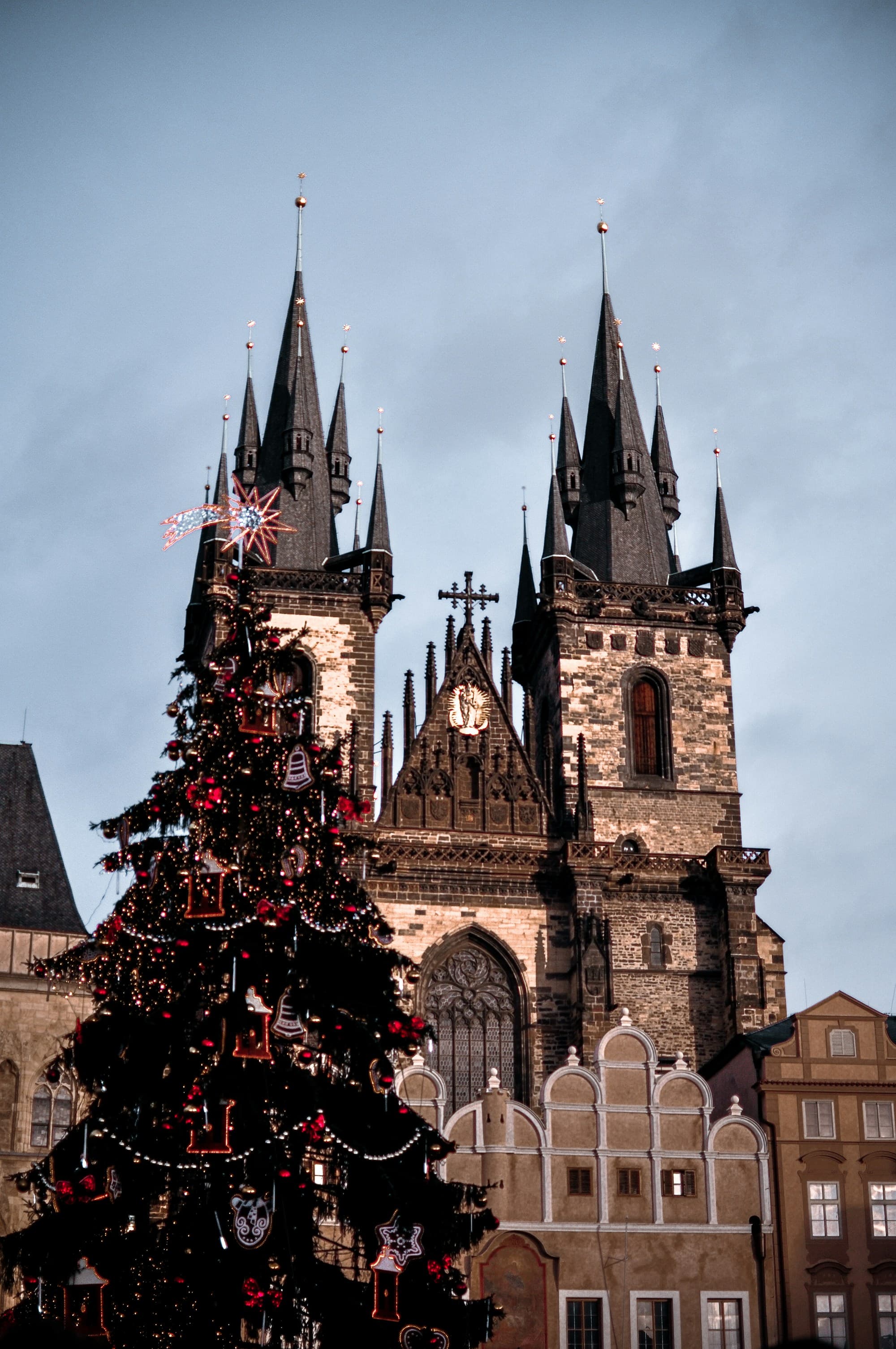
Christmas in
Czech Republic
Celebrated: December 24 (Štědrý den) is the main event, with Christmas Eve dinner and gift exchange that evening
Signature traditions
- 1.Christmas carp (kapr), a live carp bought a few days before Christmas, traditionally kept alive in the family bathtub before being killed and prepared for Christmas Eve dinner
- 2.Ježíšek (Baby Jesus) delivers gifts on the evening of December 24, ringing a small bell to signal his arrival before disappearing unseen
- 3.Cutting an apple crosswise on Christmas Eve: a five-pointed star pattern inside means good health; a cross-shaped core means illness in the coming year
- 4.Pouring molten lead (or now wax, for safety) into cold water on Christmas Eve and reading the future from the resulting shape
- 5.Single women throwing a shoe over their shoulder toward the front door: if the toe points to the door, they'll marry in the coming year
What's on the table
Smažený kapr a bramborový salát (fried carp with potato salad)
Christmas Eve dinner centers on fried, breaded carp served with cold Czech-style potato salad (potatoes, mayo, pickles, peas, carrots, hard-boiled egg). Vánočka, a sweet braided yeast bread with raisins and almonds, appears alongside coffee through the season. A clear fish soup (rybí polévka) is often served as the starter.
The iconic decoration
Betlém and the Christmas tree
The betlém (nativity scene) is the spiritual centerpiece of Czech Christmas, often hand-carved from wood and added to year over year. Trees go up on Christmas Eve afternoon (not earlier), decorated with hand-painted glass ornaments (Czech blown glass is one of the country's traditional crafts), straw stars, and candles. Lights are strung along windows facing the street.
How gifts are given
Ježíšek (literally 'little Jesus,' a winged angelic child figure) brings gifts on the evening of December 24. Children are sent into another room while parents arrange the gifts under the tree; a small bell rings to signal Ježíšek has come and gone. Gifts are opened immediately after Christmas Eve dinner.
But who delivers yours?
There are eight cultural Christmas gift-givers around the world — Santa Claus, La Befana, the Yule Lads, Ded Moroz, Sinterklaas, the Three Kings, Christkind, and Joulupukki. Take the 6-question quiz to find out which one matches you.
Take the gift-giver quizDid you know?
The Christmas carp tradition is so embedded in Czech culture that carp vendors set up tanks in supermarket parking lots and town squares in mid-December, selling live fish to families who carry them home in plastic bags. A small but growing movement of 'carp liberation' has emerged: families buy the carp, name it, and then release it back to a river instead of eating it, sometimes after keeping it in the bathtub for several days.
The shape of the season
Czech Christmas, or Vánoce, turns almost entirely on one day: Štědrý den, the "Generous Day," December 24. Christmas Eve is when the tree is lit, the carp is fried, the family gathers, and the gifts appear, all compressed into a single charged evening that runs from a day of fasting through the festive supper to the moment the gifts are discovered under the tree. December 25 and 26 are quieter holidays for visiting and rest; the 24th is the event.
The season is built on a distinctive blend of deep Central European Catholic tradition and a thick layer of folk superstition and fortune-telling that survives more vividly in the Czech Republic than in most of Europe. Even thoroughly secular Czech families (and the Czech Republic is one of the least religious countries in Europe) keep the full ritual shape of Štědrý den: the fasting, the carp, the gift-bringer, the predictions of the year to come.
Štědrý den, the Generous Day
The rituals of December 24 follow a sequence observed across the country.
The fast and the golden pig. Tradition holds that anyone who fasts through the day of December 24, eating nothing until the evening supper, will be rewarded with a vision of zlaté prasátko, the "golden piglet," a symbol of luck and plenty, appearing on the wall before dinner. It's told to children as gentle motivation to make it to supper, and the golden pig has become one of the most beloved images of Czech Christmas, appearing in films, ads, and decorations.
The supper begins with the first star. Like much of Central Europe, the Czech Christmas Eve supper waits for the first star to appear in the evening sky. Then the family sits down, and the meal itself carries small rituals: an extra place is sometimes set for an unexpected guest, the table may have fish scales tucked under the plates or under the tablecloth (a charm for wealth in the coming year), and no one should leave the table until the meal is over, lest they bring bad luck.
Ježíšek brings the gifts. Gifts in the Czech Republic are brought not by Santa but by Ježíšek, literally "little Jesus," the Christ Child, an unseen, ageless figure with no fixed image (unlike Santa, Ježíšek is never depicted, which Czechs rather like). During the supper, while the family is at the table, Ježíšek is said to slip into the room, leave the gifts under the tree, and ring a small bell to signal he has come and gone. The children, hearing the bell, rush in to find the gifts already there. The bell-ring is the emotional peak of the Czech Christmas, a moment of magic engineered by whichever adult quietly slipped away to ring it.
The Christmas carp
The defining Czech Christmas tradition is the carp (kapr). For Štědrý den supper, the traditional main course is fried, breaded carp served with cold Czech potato salad, and the carp arrives in the most theatrical way imaginable.
In the days before Christmas, large tubs of live carp appear on street corners, in markets, and outside supermarkets across the country. Vendors stand beside the tubs in rubber aprons; customers choose a live fish, which is either killed and cleaned on the spot or, in the full traditional version, taken home alive and kept in the family bathtub for a day or two until Christmas Eve, when it's killed, filleted, and cooked.
The bathtub carp is a genuine, widespread Czech experience. Generations of Czech children have a Christmas memory of a large fish swimming in the tub, often named, sometimes becoming a temporary pet. This has produced a counter-tradition: a growing number of Czech families now buy the carp, keep it briefly, and then release it back into a river instead of eating it, a kind of "carp liberation," sometimes after the children have grown too attached. Animal-welfare campaigns have pushed against the live-carp street trade, but the tradition persists, and the tubs still appear every December.
A second carp custom: each diner keeps one of the carp's scales and tucks it into their wallet for the year, to ensure money never runs out.
At the table
The Czech Christmas Eve supper is traditionally built around fish, since December 24 was historically a fast day:
- Smažený kapr, fried, breaded carp, the centerpiece, served with cold bramborový salát (Czech potato salad: potatoes, carrots, peas, pickles, hard-boiled egg, and a heavy mayonnaise dressing). The potato salad is itself a fiercely defended family recipe; Czechs argue about it the way Germans argue about Christmas markets.
- Rybí polévka, a clear fish soup made from the carp's head and trimmings, often the opening course.
- Vánočka, a sweet braided yeast bread (similar in look to challah or a braided brioche), studded with raisins and almonds, baked in an elaborate woven plait and dusted with sugar. It's eaten through the season with coffee.
The cookie tradition is enormous. Czech households bake dozens of varieties of vánoční cukroví (Christmas cookies): linecké (linzer-style jam sandwiches), vanilkové rohlíčky (vanilla crescents), gingerbread (perníčky), coconut and walnut cookies, and more, often beginning weeks in advance and storing them in tins. A well-stocked Czech Christmas household will have eight to fifteen kinds of cookie on offer, and the variety is a quiet point of pride.
The fortune-telling
The Czech Christmas Eve is unusually rich in divination customs, the folk fortune-telling rituals performed after the supper, more vividly alive here than in most of Europe:
- Cutting the apple. Each person cuts an apple crosswise (through the middle, not stem to base). If the core shows a clean five-pointed star, the person will have a healthy, happy year. If it shows a cross or a four-pointed shape, illness or misfortune is said to follow.
- Pouring lead (or wax). Molten lead, now usually wax, for safety, is poured into a bowl of cold water, and the hardened shape it forms is "read" for clues about the coming year, like reading tea leaves.
- Floating walnut-shell boats. Half walnut shells are fitted with tiny candles and floated in a basin of water. If a person's little boat sails to the center or across the basin, they'll travel and thrive; if it clings to the edge or sinks, they'll stay home or struggle.
- The shoe toss. An unmarried woman throws a shoe over her shoulder toward the door. If it lands with the toe pointing toward the door, she'll marry and leave home within the year; if the heel points to the door, she'll stay single another year.
These customs are performed half in fun now, but they're performed, and the apple-cutting especially is near-universal on Czech Christmas Eve.
Inside the home
The Czech Christmas tree (vánoční stromeček) traditionally goes up on December 24 itself, decorated the same day it's revealed, though many modern families put it up earlier. It's hung with hand-blown glass ornaments (the Czech lands, especially the area around Jablonec, have a centuries-old glass-ornament craft tradition that supplies much of the world), straw stars, gingerbread, wrapped sweets, and lights or candles, with a star or comet at the top.
The betlém, the nativity scene, is a deeply rooted Czech tradition, often hand-carved from wood and built up over years into elaborate landscapes. Some Czech towns are famous for their betlémy; the mechanical nativity in Třebechovice pod Orebem, with some 370 carved figures, roughly half of them animated, is a national cultural treasure.
The home fills with the smell of frying carp, vánočka baking, and the spice of dozens of cookies, with candles in the windows and the betlém glowing in a corner.
How gifts are given
Ježíšek (the Christ Child) brings the gifts on the evening of December 24, leaving them under the tree during the supper and ringing a bell to announce his departure. Children open them immediately after the meal. There's no waiting for Christmas morning. Ježíšek deliberately has no face or fixed form, which Czechs consider part of the charm: he is pure idea, never a man in a costume.
St. Nicholas (Mikuláš) has his own separate day, the evening of December 5, when Mikuláš, accompanied by an angel and a devil (čert), visits children, quizzes them on their behavior, and hands out small treats (or, for the naughty, a lump of coal or a potato from the devil). But Mikuláš is a December 5 figure, distinct from the Christmas gift-giving, which belongs entirely to Ježíšek.
If you wanted to borrow this tradition
The bell-ring gift reveal is the most charming Czech Christmas custom to import, and it's effortless. Instead of gifts appearing overnight, have one adult slip away unnoticed during Christmas Eve dinner, place the gifts under the tree, and ring a small bell from another room. The children, told that Ježíšek (or whatever gift-bringer your family uses) has just come and gone, rush in to find the gifts already there. The bell turns gift-giving into a single magical moment rather than a morning of unwrapping, and the unseen, never-depicted gift-bringer sidesteps the whole "is Santa real" machinery.
The apple-cutting fortune is a lovely, free, after-dinner ritual for any Christmas table: each person cuts an apple crosswise and looks for the five-pointed star inside (apples almost always show one, so it's a happy outcome by design). It is a small moment of shared ceremony that costs nothing.
And the Czech cookie spread, eight to fifteen kinds of small Christmas cookie, baked ahead and stored in tins, is a delightful tradition to adopt for anyone who likes to bake. The variety is the point.
Did you know
- The Czech Republic is among the most secular countries in Europe (surveys regularly find a majority of Czechs are non-religious), yet the full ritual structure of Štědrý den, including a gift-bringer literally named "little Jesus," is observed almost universally. The traditions have become cultural rather than religious, kept for their own sake.
- The Czech lands are one of the world's historic centers of glass Christmas-ornament production. The hand-blown glass baubles on Christmas trees across Europe and North America are, in large part, a Czech (and neighboring German) craft export dating to the 19th century.
- The phrase Štědrý den ("Generous Day") and the figure of zlaté prasátko (the golden piglet seen by those who fast) are deeply embedded in Czech culture: the piglet stars in a beloved Kofola soft-drink commercial that airs every December, and the fasting motif turns up in classic Czech Christmas films like Pelíšky.
More from Europe



Bring a little of it home
Borrowing one tradition from somewhere else is how most of the traditions on this page started.
Free AI tool
See your own home decorated
Upload one photo and watch your room or house transform, before you buy anything.
Interactive map
All 41 countries
Gift-givers, feast tables, and the surprising customs most articles skip.
City guides
Lights worth the drive
The best displays in 40 US cities, including the free neighborhoods.
More Christmas traditions across Europe
Christmas ideas for your own home.
Seasonal decorating tips and the occasional new tool, straight to your inbox. One list, no spam.