Christmas in
Croatia
Celebrated: December 6 (St. Nicholas), December 13 (St. Lucy, the wheat planting), and December 24-25
Signature traditions
- 1.Planting Christmas wheat on St. Lucy's Day (December 13): grains of wheat sown in a shallow dish, watered daily, growing into lush green grass by Christmas Eve, then tied with a ribbon in the Croatian red-white-blue and set on the table with a candle in the center
- 2.Burning the badnjak (Yule log) on Christmas Eve: an oak branch brought into the home and lit, its flame and sparks read as omens for the year's prosperity
- 3.Setting up jaslice (nativity scenes) and attending Polnoćka (Midnight Mass)
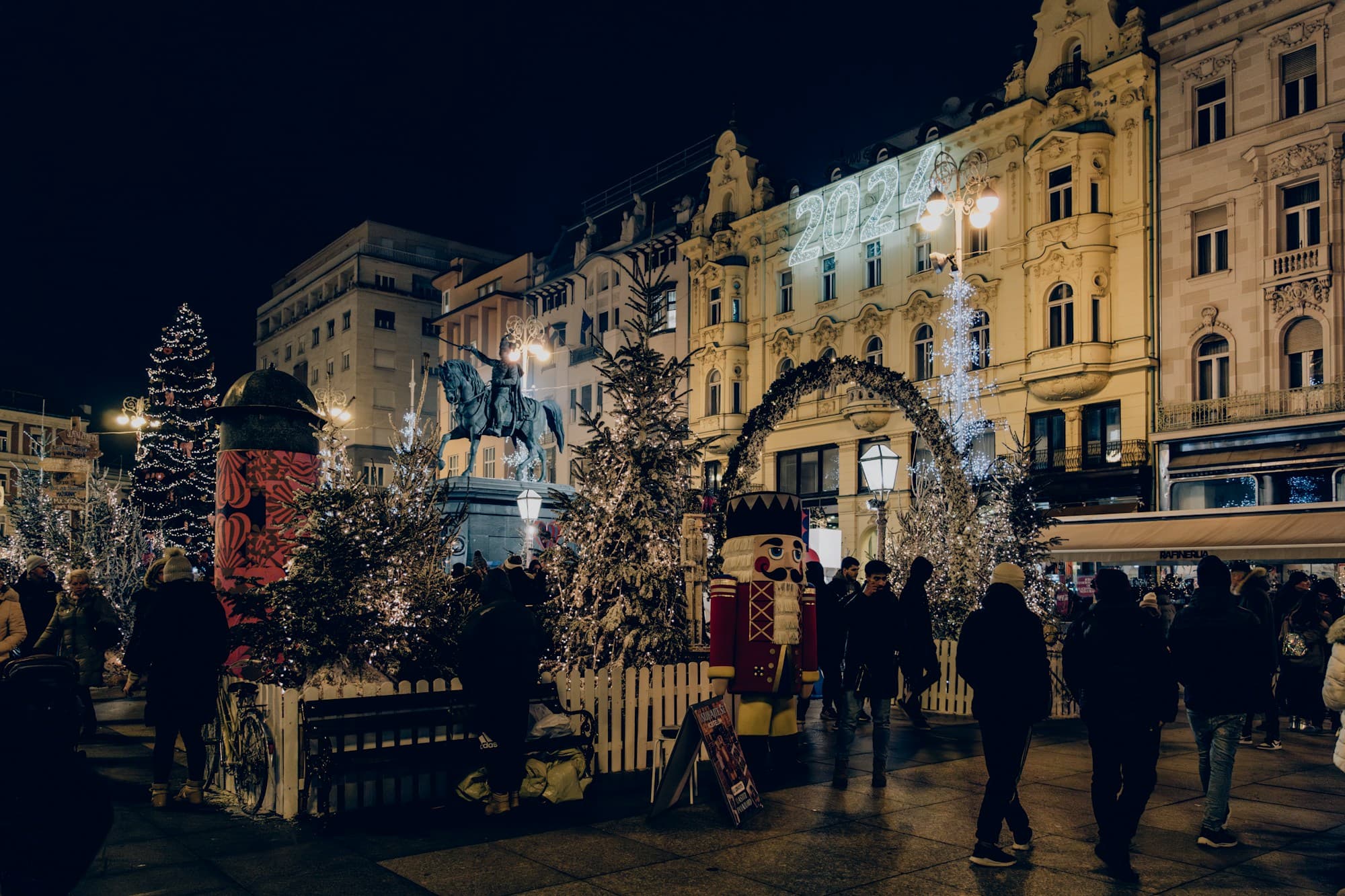
- 4.Zagreb's Advent, repeatedly voted Europe's best Christmas market, turns the capital's squares into weeks of lights, food stalls, ice rinks, and concerts
- 5.St. Nicholas (Sveti Nikola) filling children's polished boots with small gifts on December 6, with the threat of Krampus for the naughty
What's on the table
Bakalar, sarma, and fritule
Christmas Eve, a fast day, centers on bakalar (salt cod), stewed with potatoes or whipped into a spread. Christmas Day brings roast pork or turkey with mlinci (baked flatbread softened in drippings) and sarma (cabbage rolls). Fritule (small spiced doughnuts with citrus zest and rum, dusted in sugar) and orehnjača (walnut roll) are the iconic Croatian Christmas sweets.
The iconic decoration
The St. Lucy's wheat (pšenica)
The signature Croatian Christmas decoration is the dish of green wheat grown from grains planted on December 13. By Christmas it stands lush and tall, tied with a tricolor ribbon, often with a candle set in the middle; the height and density read as a forecast of the coming year's harvest and the family's fortune. The Christmas tree, Advent wreath, and jaslice complete the home.
How gifts are given
Sveti Nikola (St. Nicholas) brings small gifts in children's boots on December 6. The main Christmas gifts arrive on Christmas Day: in modern households from Djed Božićnjak (Father Christmas), and in more traditional Catholic families from the baby Jesus (Isusek), left under the tree.
But who delivers yours?
There are eight cultural Christmas gift-givers around the world — Santa Claus, La Befana, the Yule Lads, Ded Moroz, Sinterklaas, the Three Kings, Christkind, and Joulupukki. Take the 6-question quiz to find out which one matches you.
Take the gift-giver quizDid you know?
On St. Lucy's Day, December 13, Croatian families plant a dish of wheat grains and water it daily. By Christmas Eve it has grown into a thick stand of green grass, tied with a red-white-and-blue ribbon and centered with a candle: a living decoration that doubles as a folk barometer, since the taller and denser the wheat, the better the year's harvest and household luck are said to be.
The shape of the season
Croatian Christmas, Božić, is a deeply Catholic season that unfolds in careful stages, each with its own saint's day and its own small ritual. Advent is taken seriously here, not as a countdown but as a structure: St. Nicholas Day (December 6) for the children's boots, St. Lucy's Day (December 13) for planting the Christmas wheat, Badnjak (Christmas Eve, December 24) for fasting, feasting, and midnight Mass, then Christmas itself, St. Stephen's Day on the 26th, and Epiphany on January 6, when the tree traditionally comes down.
The country celebrates in two registers at once. In homes, the season is intimate and devout, built around the Advent wreath, the nativity scene, and sprouting wheat on the windowsill. In public, and above all in Zagreb, it has become one of Europe's great spectacles: the capital's Advent turns the whole city into a month-long festival.
Wheat on the windowsill
The loveliest Croatian Christmas custom needs nothing but a saucer, some soil, and a handful of grain. On December 13, St. Lucy's Day, families sow wheat seeds in a shallow dish, the božićna pšenica, Christmas wheat. Kept watered on a warm windowsill, the wheat sprouts and rises through the twelve days between Lucy and Christmas (Lucijini dani, Lucy's days), so that by Christmas Eve there stands a dense little field of living green in midwinter.
The wheat is tied around the middle with a ribbon in the red, white, and blue of the Croatian tricolor, and a candle is often set in its center. It goes beside the nativity scene or at the heart of the table, where the green blades stand for new life and the year's hoped-for abundance. Folk belief reads it like a forecast: tall, thick wheat promises a fertile, prosperous year; thin or patchy growth warns of a lean one. After the holidays the wheat isn't thrown away; it's traditionally given to the birds, so the blessing passes onward.
St. Lucy pulls a second duty in parts of northern Croatia, where she, rather than St. Nicholas, traditionally brought children their gifts, a custom still remembered in Zagorje and around Zagreb.
Advent in Zagreb
Zagreb's Advent is the modern Croatian Christmas phenomenon. What began as a modest market has grown into a city-wide festival running from late November through Epiphany: an ice rink circling the fountain in King Tomislav Square, illuminated pavilions and food stalls under the plane trees of Zrinjevac park where couples waltz to live orchestras, light installations in the Grič Tunnel beneath the Upper Town, and the streets between them thick with music and the smell of sausages, mulled wine, and frying dough. From 2016 through 2018, Zagreb was voted Europe's best Christmas market three years in a row in the European Best Destinations poll, a run that put the Croatian capital permanently on the winter map.
The market's essential treat is fritule, small deep-fried dough balls flavored with citrus zest, raisins, and a splash of rakija or rum, dusted with powdered sugar and eaten hot from a paper cone. They come from Dalmatia and Istria, but in December they belong to the whole country.
At the table
Croatian Christmas eating follows the Catholic rhythm of fast then feast. Christmas Eve is meatless, and the classic Badnjak dish is bakalar, dried salted cod, soaked for days beforehand and then cooked either na bijelo (whipped with olive oil, garlic, and potatoes into a rough, fragrant purée) or na crveno (stewed red with tomato). The soaking cod's aroma drifting through the stairwell is, for many Croatians, the true smell of December 24.
Christmas Day opens the feast proper:
- Sarma, sauerkraut leaves rolled around minced meat and rice, simmered for hours with smoked pork, the beloved centerpiece across inland Croatia, always better reheated the next day.
- Purica s mlincima, roast turkey with mlinci, thin sheets of baked pasta dough softened in the roasting juices, the pride of Zagreb and the Zagorje hills.
- Pečenka, roast suckling pig, in many regions, along with francuska salata, the mayonnaise-bound vegetable salad no festive table skips.
- For dessert, the great rolled cakes: orahnjača (walnut roll) and makovnjača (poppy-seed roll), plus fritule and ribbon-shaped fried kroštule along the coast.
Inside the home
The Croatian Christmas home is arranged around three things: the Advent wreath with its four candles, lit Sunday by Sunday; the jaslice, the nativity scene, set out on straw or moss, often with the baby Jesus added only on Christmas Eve; and the sprouting St. Lucy's wheat beside it.
The most Croatian ornament of all is the licitar, a hard, glossy, scarlet-red gingerbread heart, ornately iced in white and often set with a small mirror at its center. Licitars have been made by northern Croatian craftsmen since the Middle Ages, given as tokens of love at fairs and weddings, and hung on Christmas trees; in 2010 UNESCO inscribed the gingerbread craft of northern Croatia on its list of Intangible Cultural Heritage. A tree hung with red licitar hearts is instantly, unmistakably Croatian.
In Dalmatia an older layer survives: the badnjak log itself, from which Christmas Eve takes its name, was traditionally cut, brought into the house with a blessing, sprinkled with wine and wheat, and burned through the night, a custom still kept ceremonially in some towns and villages.
How gifts are given
Croatian children do well in December, because the gift-givers are layered. Sveti Nikola comes first, on the night of December 5 to 6: children polish their boots and set them on the windowsill, and Nicholas fills them with sweets, tangerines, and small presents. Alongside the treats, misbehaving children find a gilded twig, the šiba, left by Nicholas's dark companion Krampus and kept displayed all year as a gentle reminder.
The main gifts appear under the tree at Christmas, brought depending on the family by Djed Božićnjak (Grandfather Christmas, the Croatian Santa) or, in more traditional homes, by the Christ Child, mali Isus. Many families attend polnoćka, midnight Mass, on Christmas Eve, and open gifts either after the supper or on Christmas morning, greeting each other with "Čestit Božić", blessed Christmas.
If you wanted to borrow this tradition
Plant the Christmas wheat. On December 13, sow a handful of wheat berries (health-food stores sell them as wheatgrass seed) in a shallow bowl of damp soil, keep it on a bright windowsill, and by Christmas you'll have a vivid green centerpiece that cost pennies. Tie a ribbon around it, stand a candle in the middle, and let the children check its height daily; feeding it to the birds after New Year's completes the ritual. It is the rare tradition that is beautiful, symbolic, free, and genuinely fun to watch grow.
And make fritule once: a loose dough of flour, eggs, yogurt or milk, citrus zest, raisins, and a spoonful of rum, dropped by the spoonful into hot oil and rolled in powdered sugar. They fry up in minutes, disappear faster, and taste like a Croatian Christmas market sounds.
Did you know
- Zagreb's Advent was voted the best Christmas market in Europe three consecutive years (2016, 2017, and 2018), with a festival spread through tunnels, parks, and squares rather than a single market ground.
- The red licitar heart is such a national symbol that UNESCO recognized the gingerbread craft of northern Croatia as Intangible Cultural Heritage in 2010; the hearts are baked hard as ornament, not for eating, and traditionally carried a tiny mirror so the beloved recipient would see themselves at the heart's center.
- Croatian Christmas wheat doubles as an oracle: families read the height and thickness of the St. Lucy's Day wheat as a forecast of the coming year's prosperity, then give the green blades to the birds when the season ends.
More from Europe



Bring a little of it home
Borrowing one tradition from somewhere else is how most of the traditions on this page started.
Free AI tool
See your own home decorated
Upload one photo and watch your room or house transform, before you buy anything.
Interactive map
All 41 countries
Gift-givers, feast tables, and the surprising customs most articles skip.
City guides
Lights worth the drive
The best displays in 40 US cities, including the free neighborhoods.
More Christmas traditions across Europe
Christmas ideas for your own home.
Seasonal decorating tips and the occasional new tool, straight to your inbox. One list, no spam.