By Brian · October 16, 2026
Secret Santa Statistics: Who Does It, What It Costs, and What People Actually Want (2026)
Every published survey number on Secret Santa in one place: how many workplaces do it, the real budgets and how often people blow them, the pressure to take part, and the gifts people want and dread. Every figure sourced and dated.
Secret Santa gets written about every December, and almost every piece opens with a number that has no source attached. This page is the opposite: every figure below comes from a named survey with a date, a sample size and a link at the bottom, and where a number only exists in a press write-up rather than the original release, it says so.
The short version: most people who exchange gifts at the holidays do a Secret Santa, almost everyone sets a budget, most people blow it, a large minority would rather skip the whole thing, and the gift people dread most is a stuffed animal.
Who does Secret Santa
In the US, a 2023 OnePoll survey for Big Lots of 2,000 adults who celebrate Christmas and planned to join a gift exchange found that 84 percent take part in some kind of holiday exchange. Among them, 54 percent do a Secret Santa and 48 percent a White Elephant. The exchanges happen with extended family (68 percent), friends (64 percent) and coworkers (53 percent). That survey only survives in press coverage (StudyFinds, December 2023), so treat the exact figures as reported rather than audited.
The workplace numbers have a stronger source. Express Employment Professionals and The Harris Poll surveyed 1,000 US hiring managers and 1,000 US adults in June 2025 and found 64 percent of hiring managers say their employees regularly exchange gifts, and 54 percent of job seekers say gift exchanges are common where they work. The same study in Canada put the figures at 47 and 33 percent, with a sharp age gradient: 40 percent of Gen Z job seekers say exchanges are common against 13 percent of boomers.
In the UK, where Secret Santa is closer to a national institution, Confused.com's November 2025 survey of 2,000 adults found that among people who take part, 78 percent do it with work colleagues, 30 percent with friends and 26 percent with family, and 21 percent do two or more a year.
The budget, and how often people ignore it
Three-quarters of Americans in a gift exchange face a spending limit, averaging $49 per exchange, and they average six exchanges a season, for about $88 in total (Big Lots and OnePoll, 2023, via StudyFinds). The striking line in that survey is that 87 percent of people with a limit said they would probably go past it.
The UK data tells the same story with smaller numbers. Confused.com's 2025 survey found an average Secret Santa spend of 21 pounds a year and an average overspend of 14 pounds above the agreed limit, which is most of the budget again. The same survey found that doing a Secret Santa instead of buying for everyone saves the average participant about 75 pounds on Christmas gifts, which is the main reason families adopt it. instantprint's 2024 survey of 1,000 UK office workers found 48 percent spend 5 to 10 pounds, and only 1 percent would go above 30.
For gifts to colleagues more broadly, Empower's October 2024 survey of 2,000 US adults found 37 percent planned to buy for coworkers, averaging $116.50 across all of them, and 30 percent planned to buy for their boss, averaging $148.95. Those are totals across everyone on the list, not per gift, and they are a reminder that the office exchange is usually the cheapest part of the office gift season.
If you are the one setting the number, the common limits are $20 to $30 for workplaces and friend groups and $25 to $50 for families. The Secret Santa generator puts the budget on everyone's reveal page so nobody has to ask, and the gift budget calculator turns a season total into a per-person amount.
The pressure to take part
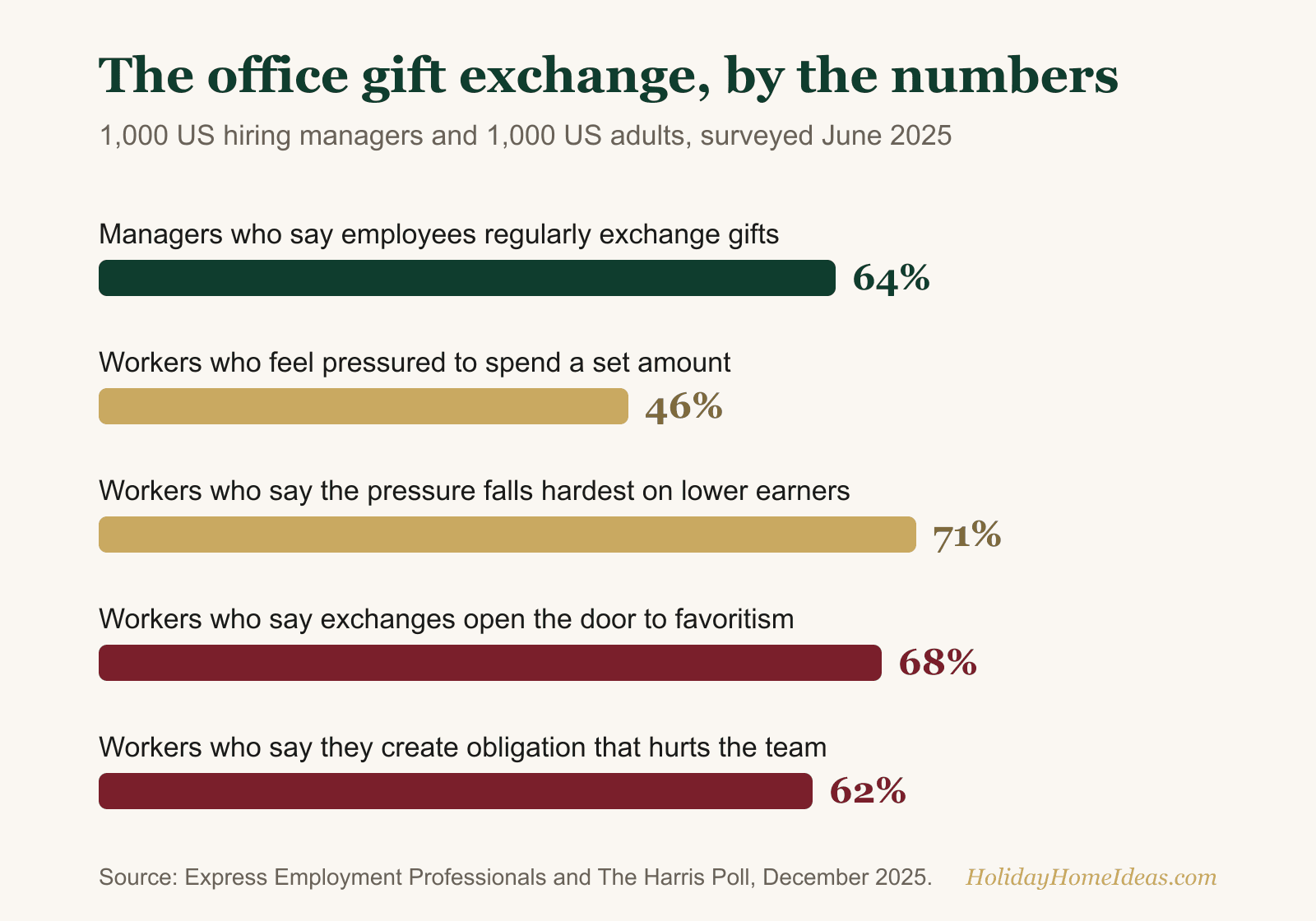
This is the part of the data that should change how offices run their exchange. In the Express and Harris Poll study, 46 percent of US job seekers say they feel pressured to spend a specific amount, and 71 percent say that pressure falls hardest on lower earners. More than half of hiring managers say employees feel compelled to give gifts to their direct reports (56 percent), their managers (55 percent) and their peers (52 percent), and over a third report a lot of, or extreme, pressure. On the receiving end, 68 percent of job seekers say gift exchanges open the door to favoritism and 62 percent say they create obligations that harm team dynamics.
The pressure shows up in behavior when money is tight. In October 2022, with inflation at its peak, Affirm and YouGov found 49 percent of Americans planned to skip spending on Secret Santa that year, up from 22 percent the year before, and 42 percent said they would give up receiving gifts if it meant not having to give them. In the UK in 2024, only 30 percent of office workers told instantprint they were ready to join their office Secret Santa, 31 percent would not, and 26 percent were undecided; 22 percent of those taking part said they join begrudgingly, and 32 percent think the tradition is losing steam.
No survey measures how often participation is required rather than voluntary. The honest reading of the numbers above is that an opt-in exchange with a low, firm limit is the version most people would actually choose.
What people want, and what they dread
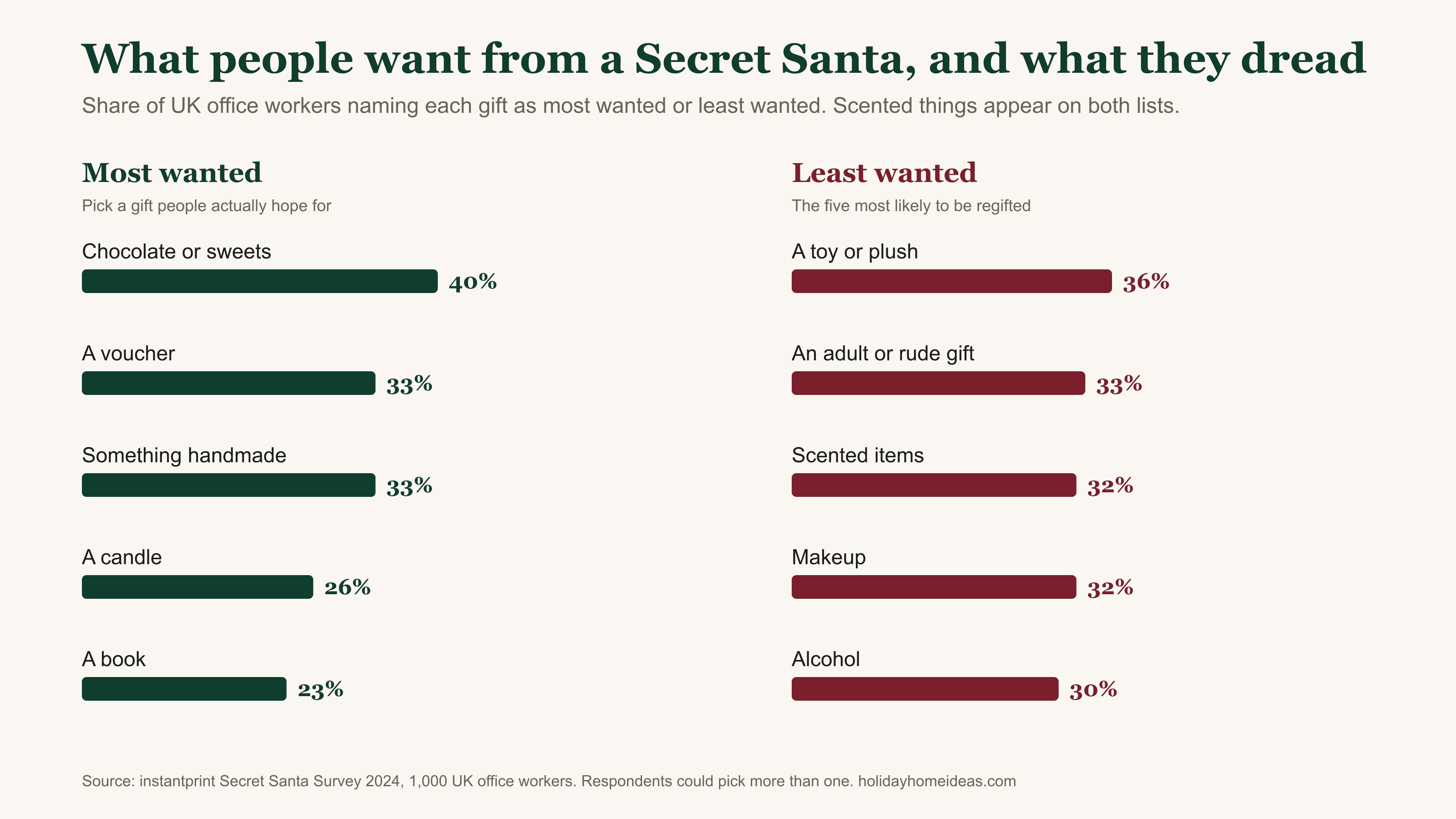
The gift data comes from the UK, where instantprint asks office workers every year. In the 2024 wave, the most wanted gifts were chocolate or sweets (40 percent), a voucher (33 percent), something handmade (33 percent), a candle (26 percent) and a book (23 percent). The least wanted were a toy or plush (36 percent), an adult or rude gift (33 percent), scented items (32 percent), makeup (32 percent) and alcohol (30 percent). The 2023 wave had the same three at the bottom: plush, rude, and "smellies."
Notice that candles make the wanted list and scented items make the dreaded one. The lesson is not that candles are safe; it is that a gift chosen for a specific person lands and a generic one does not. That is the whole reason the generator now lets each person leave a few lines of gift hints for whoever drew them.
What happens to the gifts people did not want: in the UK, 42 percent would donate an unwanted Secret Santa gift, 27 percent would regift it, 22 percent would keep it and 4 percent would sell it (instantprint, 2024). In the US, Empower found 42 percent of adults planned to regift to save money in the 2024 season, and an AP-NORC poll in December 2025 found a majority consider regifting acceptable, with secondhand gifts acceptable to 73 percent of adults under 45 against 58 percent of those older.
Family Secret Santa and the games
The clearest number on family draws is British: 26 percent of UK Secret Santa participants do it with family (Confused.com, 2025). The 75-pound saving in the same survey is the argument that wins the family over, and it is why the "one name each" draw has spread from offices to extended families as gift lists grew.
White Elephant, the pile-and-steal version, is nearly as common as Secret Santa in the US (48 percent against 54 percent in the Big Lots survey). The most detailed look at how it is played is older: a 2019 Harris Poll for Wish found 58 percent of Americans had played at some point, the average game had 11 players, and 64 percent said the ideal spending limit was $25 or less. For a share of people who use these formats specifically to lower the stress of the season, LendingTree's 2022 survey of 2,033 consumers found 7 percent use Secret Santa and 5 percent White Elephant for that reason, in a year when 56 percent said gift giving stressed them.
When people actually set it up
Search interest in "secret santa generator" in the US is close to zero for ten months of the year and then spikes once, in the first two weeks of December, before collapsing again by the first week of January (Google Trends, five-year view, read October 2026). The draw happens later than most organizers would like. If the exchange is before Christmas, drawing names in the last week of November gives everyone three weekends to shop, which is also the window in which the gift surveys say people are least likely to panic-buy a plush.
A short history
The phrase is older than the office game. The Oxford English Dictionary's earliest citation for "secret Santa," in the sense of an anonymous giver, is a 1933 Virginia newspaper headline, and the gift-exchange sense is dated to the 1980s. The person most associated with the name was Larry Stewart of Lee's Summit, Missouri, who handed out cash to strangers every December from 1979, roughly $1.3 million over 26 years, and was identified as Kansas City's "Secret Santa" only in November 2006, two months before he died. He was named after an existing phrase rather than inventing it, but he gave it the meaning most Americans attach to it.
Running one that people do not resent
The numbers point to four rules.
- Make it opt-in and say so. Between a third and a half of people would rather not take part. Let them.
- Set a low limit and put it on every reveal. $20 to $30 at work. The 87 percent who expect to overspend are mostly overspending by accident.
- Ask for hints. A gift chosen for a person beats any category. On our generator, each person's private link has a box for a few lines (sizes, a hobby, what not to buy) that only their Santa sees.
- Draw by the last week of November. Three weekends to shop is the difference between a thoughtful gift and a candle.
The Secret Santa generator is free, needs no accounts or email addresses, keeps couples from drawing each other, and lets the organizer play. If the budget question comes up first, our cost of Christmas study has the national spending and debt figures beside it.
Sources
- Express Employment Professionals and The Harris Poll, "Behind the Holiday Glow," released December 10, 2025: 1,000 US hiring decision-makers (June 2 to 28, 2025) and 1,000 US adults (June 12 to 27, 2025). Canadian release, same date: 500 hiring managers and 503 adults.
- Big Lots and OnePoll, November 8 to 9, 2023, 2,000 US adults who celebrate Christmas and planned to join a gift exchange, as reported by StudyFinds, December 23, 2023. No primary release located.
- Confused.com and OnePoll, 2,000 UK adults, October 29 to November 3, 2025, released November 25, 2025.
- instantprint, Secret Santa Survey 2024 (1,000 UK office workers, October 2024) and the 2023 wave (1,000, November 2023); 2024 gift category lists as reported by Talk Business, November 7, 2024.
- Affirm and YouGov, October 3 to 4, 2022, 1,217 US adults, released October 13, 2022.
- Empower, "Gifted," Wired Research, 2,000 US adults, October 8 to 21, 2024, released November 27, 2024.
- AP-NORC Center for Public Affairs Research, December 4 to 8, 2025, 1,146 US adults.
- LendingTree and Qualtrics, 2,033 US consumers, October 18, 2022, published December 5, 2022.
- Wish and The Harris Poll, 2,029 US adults, November 4 to 6, 2019, released December 9, 2019.
- Google Trends, "secret santa generator," United States, web search, past five years, read October 16, 2026.
- Oxford English Dictionary citations as reproduced by Barry Popik; Associated Press via NBC News, January 13, 2007, on Larry Stewart.
Share this guide
Frequently asked questions
How many people do Secret Santa?
What is a normal Secret Santa budget?
Do people stick to the Secret Santa budget?
What are the worst Secret Santa gifts?
Is Secret Santa mandatory at work?
Keep reading
The American Christmas Tree, by the Numbers
Real Christmas tree statistics, sourced: how many Americans put up a tree, real vs artificial, when trees go up and come down, and the 16,000 farms growing the real ones.
The Cost of Christmas 2026: What Americans Actually Spend
A data-backed look at how much Americans spend on Christmas: $890 per person, over $1 trillion nationwide, and where every dollar goes, from gifts to the tree to the electric bill.
Christmas Lights by the Numbers: Energy, Cost, and Safety Statistics
How much power American Christmas lights actually draw, what a display costs to run, what professionals charge to hang one, and what the injury and fire data really say. Every figure sourced.
Prefer pen & paper?
The Christmas Planner
A 25-page printable kit covering budget, gifts, hosting, and decor, built on the same planning logic as this tool. Print it once, keep it in a binder, and reuse it every year.
Or grab 3 pages free first.
Decor that suits the home you have.
Seasonal decorating tips and the occasional new tool, straight to your inbox. One list, no spam.