Christmas in
United Kingdom
Celebrated: December 24 (Christmas Eve) through December 26 (Boxing Day)
Signature traditions
- 1.Christmas crackers, paper tubes that pop open to reveal a paper crown, a joke, and a small toy
- 2.Watching the King's Christmas message on TV at 3 PM on Christmas Day
- 3.Pulling on the wishbone of the turkey after dinner
- 4.Boxing Day on December 26, originally for giving boxes of leftovers and money to servants and tradespeople
- 5.Hanging mistletoe in a doorway, then kissing whoever passes underneath
What's on the table
Roast turkey, Christmas pudding, and mince pies
Christmas dinner is a roast turkey with stuffing, pigs in blankets, brussels sprouts, and roast potatoes. Christmas pudding (a dense fruitcake doused in brandy and set alight) is the dessert. Mince pies (small spiced fruit tarts) are eaten throughout the season.
The iconic decoration
The Christmas cracker
Invented in 1847 by a London confectioner, Christmas crackers are now a near-universal British tradition. Each place setting has one; two people pull the ends until it pops, releasing a paper crown that everyone wears through dinner.
How gifts are given
Father Christmas (also called Santa Claus) delivers gifts overnight on Christmas Eve, leaving them at the foot of the bed in a stocking and under the tree.
But who delivers yours?
United Kingdom's gift-giver is Santa Claus. But there are eight cultural Christmas gift-givers worldwide — Santa, La Befana, the Yule Lads, Ded Moroz, Sinterklaas, the Three Kings, Christkind, and Joulupukki. Take the 6-question quiz to find your match.
Take the gift-giver quizDid you know?
The Queen's (now King's) Christmas message has been a tradition since 1932, when George V first broadcast it on radio. About 7-8 million Britons still watch live each year, making it one of the most-watched moments on UK television.
The shape of the season
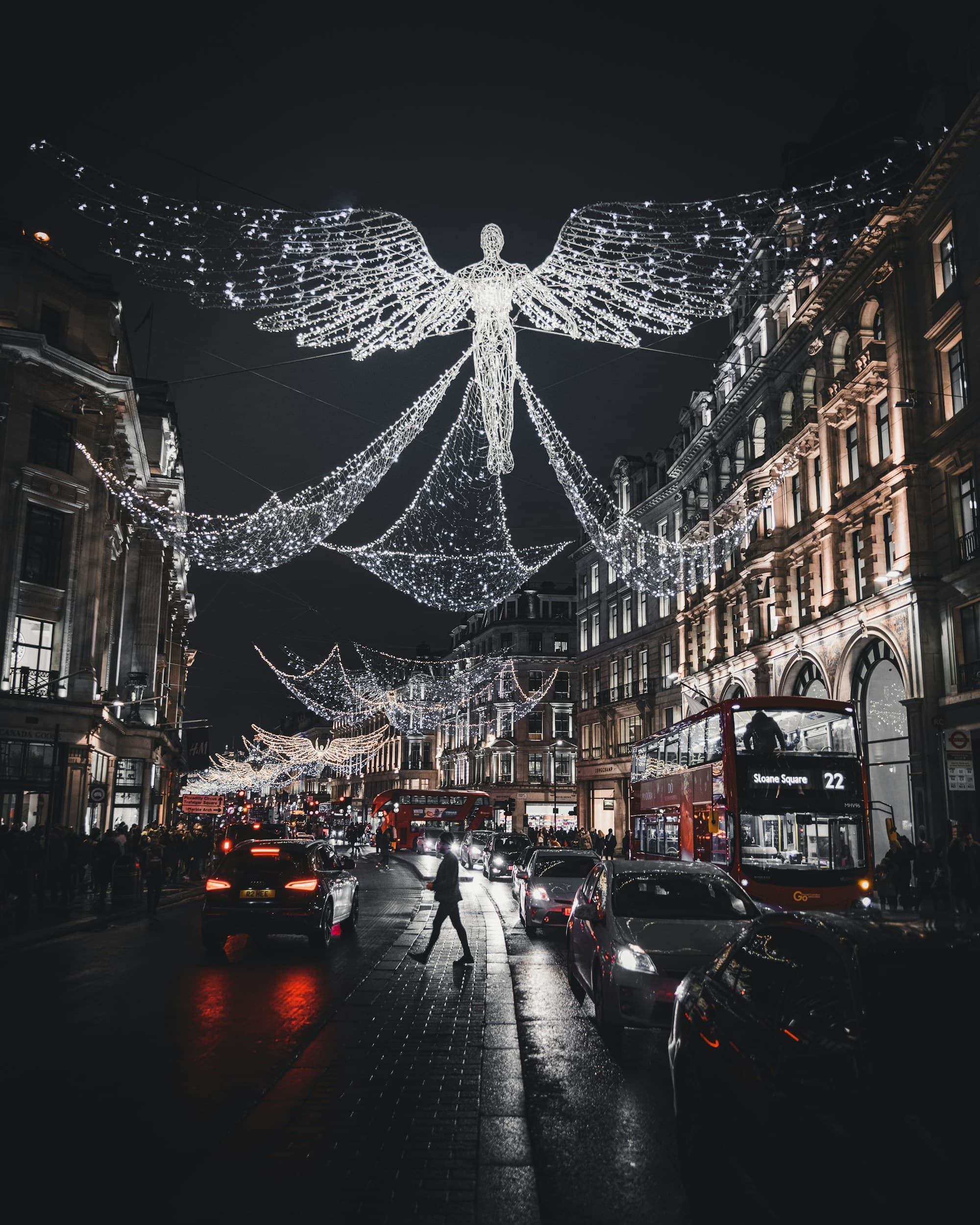
British Christmas runs from late November (when the lights go up in central London and the John Lewis Christmas advert drops, an event the country actually follows) through January 6 (Twelfth Night, when decorations come down; superstitiously, leaving them up later is bad luck). The cultural peak is two full days: Christmas Day, December 25, for the dinner and family gathering, and Boxing Day, December 26, for sport, sales, and a national exhale.
What separates British Christmas from its American cousin is how unhurried it feels. Christmas Day itself runs at a slow, almost ceremonial pace: late-morning gift exchange, mid-afternoon dinner that lasts hours, evening television by the fire. There's no rush to a second event, no movie-night opening, no dash to the next gathering. Boxing Day is built into the calendar precisely so December 25 can be unhurried.
Christmas crackers
The most British of all Christmas objects is the Christmas cracker, a cardboard tube wrapped in colorful paper, twisted at both ends like a giant sweet wrapper. Two people pull at opposite ends, a small powdered explosive (a "snap") goes off with a bang, and the contents spill out: a paper crown, a terrible joke, and a small plastic toy or trinket.
Crackers were invented by Tom Smith, a London confectioner, in 1847. He'd seen the French bonbon, a sweet wrapped in twisted paper, and decided British sweets should also pop. Tom Smith's originals held a sweet and a motto. His son Walter added the paper crown and the trinket around the turn of the century, and the jokes came later still.
The ritual is fixed and universal. At Christmas dinner, every place setting has a cracker. Before the meal begins, each person crosses arms with their two neighbors and pulls: left hand on one cracker, right hand on the next. The crackers go off in sequence around the table. Everyone reads their joke aloud (the jokes are always groan-worthy by design, the running gag of the British Christmas table), puts on their paper crown, and the crowns stay on for the entire meal. A grown adult in a paper crown over Christmas dinner is the canonical British Christmas image.
The crackers themselves vary wildly. Supermarket-budget ones contain truly disposable plastic toys. Mid-range ones (Marks & Spencer, John Lewis, Waitrose) contain modest but real items: a mini deck of cards, a magnifying glass, a small puzzle. High-end ones (Fortnum & Mason, Harrods, Liberty) contain silver-plated objects, leather goods, real jewelry. The "premium cracker" market is a multi-million-pound annual category.
The crowns stay on through dessert. The jokes are quoted around the table for the rest of the afternoon.
Christmas dinner
British Christmas dinner is structured, traditional, and remarkably consistent across the country. The menu, in roughly the order it appears:
- Starter: Often smoked salmon with brown bread, or a prawn cocktail, or soup. Light.
- Main: Roast turkey is canonical; the average British Christmas turkey is 5-7 kg and takes 4-5 hours to cook. The bird is stuffed (sage and onion, or chestnut), basted, and rested. Roast goose is making a comeback among younger households; some families do beef rib or a glazed ham instead.
- Sides: Roast potatoes (crucial; these are debated as the most important element of the meal, with the perfect roast potato being crispy outside, fluffy inside), Brussels sprouts (either loved or grimly tolerated, debated annually), parsnips (roasted, often honey-glazed), carrots, red cabbage, sausages wrapped in bacon (called "pigs in blankets," and beloved), stuffing balls, bread sauce (a distinctly British white sauce of milk-soaked bread with cloves and onion), and Yorkshire puddings (controversial: purists say Yorkshires belong only with beef, but many families serve them anyway).
- Gravy: Made from the turkey drippings. Quality of the gravy is often debated more than the bird itself.
- Dessert: Christmas pudding, a dense, dark, steamed pudding made with dried fruit, suet, and brandy, aged for weeks or months beforehand. Served flaming: warm brandy is poured over the top and set alight at the table. Topped with brandy butter or custard. Polarizing: kids often dislike it, traditionalists love it.
The whole meal stretches from roughly 2:00 PM to 5:00 PM, with extended pauses for cracker pulling, toasts, family photos, and visits from the Royal Family's broadcast.
The King's Christmas message
At exactly 3:00 PM on Christmas Day, BBC One and ITV broadcast the King's (formerly the Queen's) Christmas message, a 10-minute address from the reigning monarch, reflecting on the year and the holiday. The tradition was started by George V in 1932 on radio; Queen Elizabeth II delivered it from 1952 to 2021, skipping only 1969, when she issued a written message instead; King Charles III now delivers it.
Many British households pause the meal at 3:00 to watch the speech in silence, or with one ear tuned to the TV while serving dessert. For everyone it works as a national time-marker more than a religious or patriotic obligation: at 3:00 PM on December 25, the country is collectively listening to the same voice. Republican-minded households may skip it; older and more traditional households would feel Christmas was missing something without it.
Boxing Day
December 26 is Boxing Day, a separate public holiday and arguably the most relaxed day of the British year. The name's origin is contested: some say it comes from the boxes of leftovers given to servants and tradesmen on this day; others trace it to alms boxes opened on December 26 (St. Stephen's Day). Either way, the modern meaning is "the day after Christmas, when everything continues."
The traditional Boxing Day rhythm:
- Cold cuts and pickles for lunch. The Christmas Day turkey reappears as sandwiches, with pickled onions, branston pickle (a sweet vegetable chutney), Christmas leftovers, and cheese. The "Boxing Day buffet" of leftovers is for many British households the best meal of the season.
- A walk. Even reluctant walkers go out on Boxing Day. It's part of the cultural calendar.
- Premier League football. A full slate of Boxing Day fixtures, a uniquely British footballing tradition where every Premier League and Football League team plays on December 26. Tens of millions watch on TV; thousands attend matches.
- The races. The King George VI Steeplechase at Kempton Park is the most famous Boxing Day horse race.
- Sales. Boxing Day kicks off the British equivalent of America's Black Friday sales. Selfridges, Harrods, John Lewis, and major high-street retailers all open with major price cuts.
For many British families, Boxing Day at home with cold turkey and football on TV is the most enjoyable day of the entire holiday season, more so than Christmas Day itself.
Pantomime
A specifically British Christmas theatre tradition: the panto. Every regional theatre in the country, from the Drury Lane in London to small community theatres in the Midlands, stages a Christmas pantomime, a campy, audience-participation musical based loosely on a fairy tale (Cinderella, Aladdin, Snow White, Jack and the Beanstalk, Dick Whittington).
The format is rigid and beloved. The leading man (the "principal boy") is played by a young woman in tights. The leading lady's mother (the "dame") is played by a large male actor in elaborate drag. The villain enters from stage left to boos; the hero enters from stage right to cheers. At specific moments the audience must shout "He's behind you!" or "Oh no it isn't!" / "Oh yes it is!" The children in the audience throw sweets when prompted; the adults wave glow sticks.
Major regional pantos cast TV celebrities (often soap-opera stars or B-list reality TV personalities) as the leads. The London West End has its own pricier panto productions. Schools and amateur dramatic societies put on their own versions in church halls and community centers across the country.
Pantomime is one of the few British Christmas traditions with essentially no American counterpart. It's loud, silly, child-focused, and entirely committed to its own absurdity, a Christmas evening's entertainment that's part theater, part social ritual.
Inside the home
British Christmas decoration leans warm-and-traditional rather than designer-styled. The Christmas tree (almost always real, a Nordmann fir, the dominant British Christmas tree species) goes up around the second weekend of December and stays until Twelfth Night (January 5 or 6). Lights are warm-white or multi-colored; both are common. Mantels feature evergreen garland with red velvet ribbon, candles, and Christmas cards from friends and relatives strung along the mantel edge.
The Christmas card tradition is taken much more seriously in Britain than in America. The average British household sends and receives 25-50 cards each Christmas, and displaying them around the home (on mantels, strung on ribbons, taped to doorframes) is part of the visual season. The cards arrive throughout December, get displayed where everyone can see them, and stay up until Twelfth Night.
Outside, British Christmas decorating is mostly restrained: a wreath on the front door, perhaps a string of lights along the eaves, a small lit tree visible through a front window. The American maximalist outdoor light display is not a British tradition; the country prefers a more reserved exterior look. The exception is "lights houses," individual homes (and increasingly entire streets) that go all-out with displays, which become local destinations for families to drive past.
How gifts are given
Father Christmas (or Santa Claus; both terms are used, with "Father Christmas" the more traditional British name) delivers gifts overnight from December 24 to December 25. Children leave a mince pie, a glass of sherry or whisky, and a carrot for Rudolph on the hearth or by the tree. In the morning, the gifts appear.
The gift exchange happens late morning or early afternoon on Christmas Day. One gift at a time, in turn, watched by the family, never the simultaneous-unwrap chaos of an American Christmas morning. Crackers are pulled at the start of dinner; small post-cracker trinkets sometimes count as a final mini gift round.
The British gift average is typically lower than American. Christmas spending per household is roughly £600-800 (about $750-1,000) in 2026 across all gifts. Big-ticket items are common (a single major gift per adult is the norm), but the gift volume per child is lower.
A specific British convention: Christmas stockings are filled by Father Christmas and contain small items: an orange in the toe (a traditional reference to the original Christmas orange, once a real treat), small chocolates, a small toy, sometimes a £5 or £10 note. Stocking-opening happens in the morning, before the main gift exchange.
If you wanted to borrow this tradition
The Christmas cracker is the British tradition America could adopt tomorrow. Boxes of crackers are widely available in American shops (especially around the holidays at Cost Plus World Market, Trader Joe's, Marks & Spencer if you're in a city that has one, or via Amazon). Adding crackers to your Christmas dinner table, with everyone wearing the paper crown for the entire meal, adds 15 minutes of silly, communal moments at the start of the meal that the rest of the dinner is then enjoyed under. It's also a great photo moment.
The Christmas Day pace is worth borrowing in spirit. The American instinct is to pack Christmas with events: gift exchange in pajamas, then breakfast, then dressing up, then dinner, then maybe a Christmas Eve service the night before. The British model, a slow late-morning gift exchange, a long unhurried dinner, an evening of television by the fire, produces a different and arguably more restful experience.
The Boxing Day leftovers tradition is also worth keeping in mind. Many American households cook the big Christmas dinner and then dread the leftovers. The British approach, explicitly planning Boxing Day around cold turkey sandwiches, pickles, cheese, and a walk, turns the leftovers into a feature rather than a chore.
Did you know
- The British monarch's Christmas Day speech is one of the most-watched broadcasts of the year in the UK, with audiences regularly exceeding 5-7 million viewers (a substantial figure in a 67-million population country with fragmented media).
- The Christmas cracker market is concentrated heavily in the final two weeks before Christmas. UK supermarkets sell over 300 million crackers each December, a per-capita rate of roughly 4.5 crackers per person.
- The Christmas pudding tradition includes a specific superstition: stir the pudding mix three times for each family member from east to west, in honor of the Wise Men's journey. Many British families still observe this when making puddings in October or November (puddings are aged for weeks before December).
More from Europe



Bring a little of it home
Borrowing one tradition from somewhere else is how most of the traditions on this page started.
Free AI tool
See your own home decorated
Upload one photo and watch your room or house transform, before you buy anything.
Interactive map
All 41 countries
Gift-givers, feast tables, and the surprising customs most articles skip.
City guides
Lights worth the drive
The best displays in 40 US cities, including the free neighborhoods.
More Christmas traditions across Europe
Christmas ideas for your own home.
Seasonal decorating tips and the occasional new tool, straight to your inbox. One list, no spam.