Christmas in
Russia
Celebrated: January 7 (Russian Orthodox Christmas)
Signature traditions
- 1.Christmas falls on January 7 because the Russian Orthodox Church follows the Julian calendar
- 2.A 40-day fast (Nativity Fast) precedes Christmas, ending Christmas Eve at the first star
- 3.Sochelnik (Christmas Eve) on January 6, a meatless supper named for sochivo, the ritual grain dish; some devout families serve 12 dishes for the 12 apostles
- 4.Ded Moroz (Grandfather Frost) and his granddaughter Snegurochka (Snow Maiden) bring gifts on New Year's Eve, not Christmas
- 5.Carolers performing 'kolyada' songs door to door, often in elaborate costumes
What's on the table
Kutia and the 12 dishes
The Christmas Eve supper centers on kutia (also called sochivo), a sweet wheat berry porridge with poppy seeds, honey, and walnuts that symbolizes hope and immortality. The meal is meatless, often including borscht, vareniki (filled dumplings), and pickled fish.
The iconic decoration
The yolka (New Year tree)
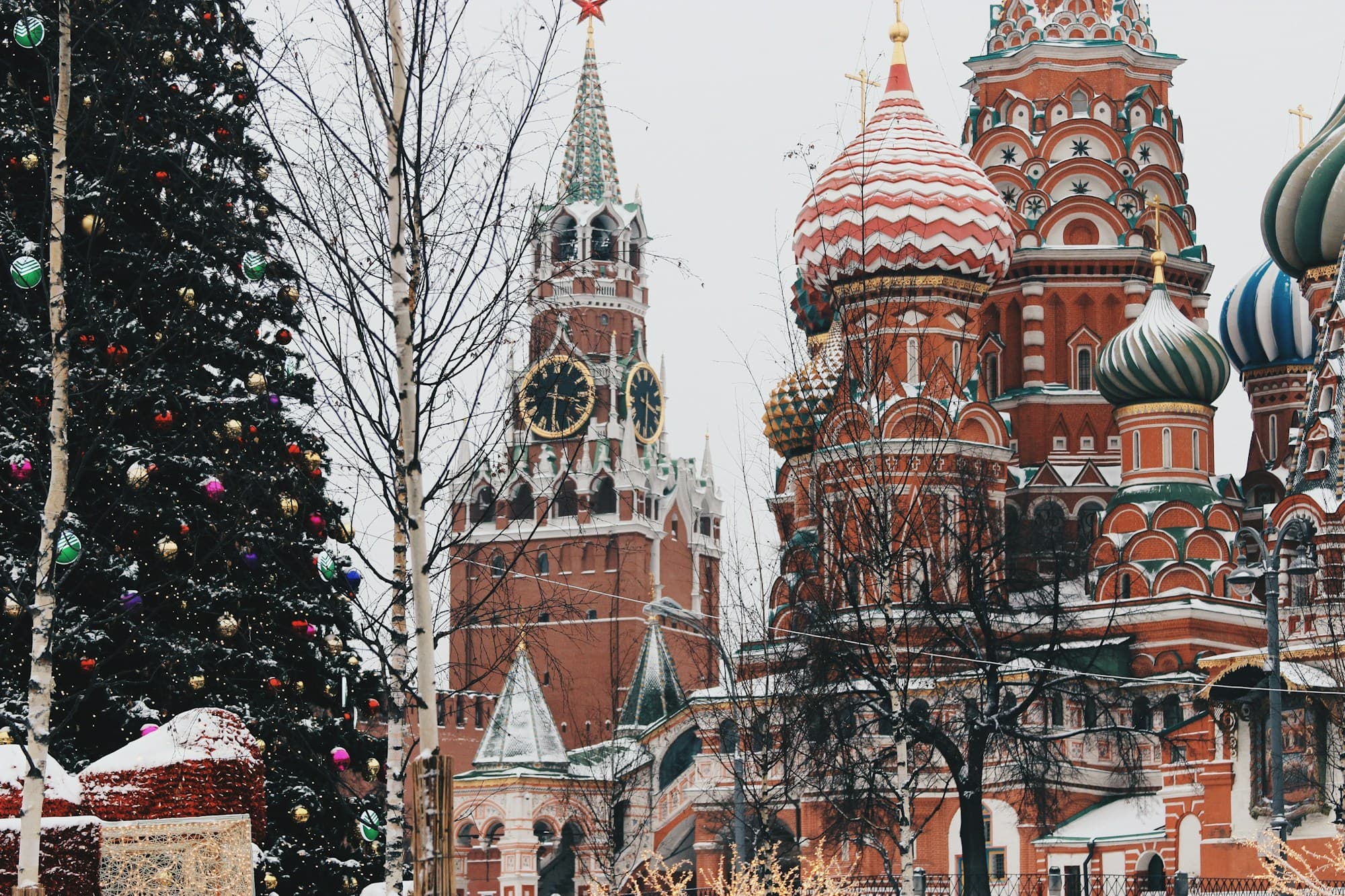
Soviet-era restrictions pushed Christmas traditions to New Year's, so the decorated tree is a 'New Year tree' (yolka), put up in late December and kept until mid-January.
How gifts are given
Ded Moroz brings gifts on New Year's Eve (December 31 going into January 1), not Christmas. Christmas itself is more religious and family-focused.
But who delivers yours?
Russia's gift-giver is Ded Moroz. But there are eight cultural Christmas gift-givers worldwide — Santa, La Befana, the Yule Lads, Ded Moroz, Sinterklaas, the Three Kings, Christkind, and Joulupukki. Take the 6-question quiz to find your match.
Take the gift-giver quizDid you know?
Ded Moroz is taller and more wizard-like than Santa Claus, wears a long blue or red coat, carries a magical staff, and travels in a troika (three-horse sled). His granddaughter Snegurochka, the Snow Maiden, accompanies him, there's no Mrs. Claus equivalent.
The shape of the season
Russian Christmas is a study in calendrical complexity. The Russian Orthodox Church still follows the Julian calendar for fixed feasts, which means Russian Orthodox Christmas falls on January 7, not December 25. But this date sits inside a much larger Russian winter holiday rhythm whose true emotional center is New Year's Eve (December 31), Novy God, followed by what's still casually called Old New Year on January 14 (January 1 on the Julian calendar). The whole season runs from late December through mid-January.
This calendrical layering has Soviet-era roots. After the 1917 Revolution, the Soviet government effectively suppressed religious Christmas, closing churches, banning the Yolka (Christmas tree), and prohibiting public religious observance. Rather than disappear, the tradition migrated: the tree, the gift-giving, the festive table, and the visit from a magical winter figure all transferred to the secular New Year's holiday in the 1930s, where they were considered safely non-religious. By the time the Soviet Union collapsed and Orthodox Christmas was rehabilitated in 1991, generations of Russians had grown up with New Year's as the main winter event. Christmas was added back on January 7, but New Year's never gave up its position as the cultural peak.
So in 2026, Russians celebrate Christmas in two distinct ways. The religious observance on January 7 is real, churchgoing, and quiet. The festive holiday, with its tree, gifts, feast, fireworks, and Ded Moroz visiting children, happens on New Year's Eve, a week earlier. Most Russian families participate fully in both.
Ded Moroz and Snegurochka
The Russian gift-giving figure isn't Santa. It's Ded Moroz, "Grandfather Frost," a tall, dignified figure in a long blue (or sometimes red) fur-trimmed robe, white beard down to his chest, carrying a tall staff and a sack of gifts. He's accompanied by his granddaughter Snegurochka, "the Snow Maiden," a young woman in pale blue or silver, with long blonde braids and a snowflake-trimmed kokoshnik headdress.
Both figures originate in Slavic folklore predating Christianity. Ded Moroz was a winter spirit in pre-Christian Russia, sometimes benevolent and sometimes cruel (in the older tales he froze people to death). The Snow Maiden has her own folk story: a childless old couple sculpts a daughter from snow who comes alive in winter and melts each spring. The two were paired together in the 19th-century Russian cultural revival and became fixed companions in Soviet-era New Year's storytelling.
Ded Moroz visits Russian homes on December 31, traditionally arriving in person at children's parties (a costumed actor, often hired through the same agency that hosts the entire event) and bringing gifts in his sack. He asks the children to perform, whether that means reciting a poem, singing a song, or doing a small dance, in exchange for their gift. Snegurochka coordinates the games and the gift-distribution and is generally the more interactive of the two figures. Together they preside over school New Year's parties (yolki), corporate New Year's events, and home visits.
Ded Moroz has an official residence in Veliky Ustyug, a town in northern Russia, where the Russian Post Office handles his letters from children. The residence is a real tourist attraction with a year-round Ded Moroz theme park, where the costumed figure greets visitors. Letters from children across Russia (and from Russian diaspora children worldwide) arrive there throughout December.
The Yolka
The Russian Christmas tree, the Yolka, sits at the center of the New Year's celebration. The word yolka means "fir tree" but extends to mean the entire New Year's party itself. Children attend "yolki," New Year's parties hosted around the tree, at schools, theaters, community centers, and the famous Kremlin Yolka (the Russian President's official children's New Year's party in Moscow).
A traditional Russian Yolka is decorated with hand-blown glass ornaments (Russia has its own tradition of glass-blown ornament craft, particularly in the town of Klin near Moscow), strings of tinsel, paper chains, walnuts wrapped in gold foil, and a five-pointed star at the top, sometimes a Soviet-era red star, sometimes the Star of Bethlehem in post-Soviet households. Real wax candles were the historic light source; LED candle lights and electric strings have replaced them in modern households.
Underneath the tree, on the evening of December 31, the gifts appear, placed by Ded Moroz overnight or distributed by a costumed Ded Moroz in person at the family party. Children open them either at midnight on December 31 or the morning of January 1.
The New Year's table
The Russian New Year's Eve dinner is the meal of the year. Families gather around 9:00 PM on December 31, eat a substantial multi-course meal that extends past midnight, then watch the Russian President's traditional New Year's address, toast with champagne, and continue eating and drinking into the early morning hours. The next two days (January 1 and 2) are spent recovering, visiting family, and grazing on leftovers.
The canonical Russian New Year's table includes:
- Olivier salad: the iconic Russian potato-and-mayo salad with chopped pickles, peas, carrots, hard-boiled egg, and bologna or chicken or beef. The Russian name comes from the 19th-century French chef Lucien Olivier who invented it in Moscow. Every Russian household has a recipe; the salad is so universal that early-January news segments in Russia often joke about how much Olivier the country collectively consumed.
- Selyodka pod shuboy ("herring under a fur coat"): a layered salad of pickled herring covered with grated boiled potato, beets, carrots, eggs, and mayonnaise. The vivid magenta color (from the beets) makes it the visual centerpiece of the table.
- Studen or kholodets: meat jelly, a savory aspic of slow-cooked pork or beef in its own gelatin, served cold with horseradish or mustard. Old-school but still common.
- Pelmeni: small meat-filled dumplings, served boiled with sour cream, butter, or vinegar. The Siberian Russian comfort dish, scaled up for parties.
- Kotlety: meat patties (closer to American meatballs than burger patties), often with mashed potatoes.
- Caviar: red salmon caviar (ikra) on small toasts with butter is a typical Russian New Year's appetizer; black sturgeon caviar is rarer/more expensive but appears in upscale gatherings.
- Cold cuts and pickles: Russian-style cured sausages, smoked fish, pickled cucumbers, pickled tomatoes, and marinated mushrooms, assembled on a zakuski (appetizer) board that grazers pick at throughout the night.
For dessert: chocolates (Russian Krasny Oktyabr and other chocolate brands have famous New Year's edition assortments), tangerines (the iconic Soviet-era New Year's fruit, a luxury during winter that became permanently associated with the holiday), and Napoleon cake (mille-feuille, a layered pastry with cream filling).
The drink: Sovetskoye Shampanskoye ("Soviet Champagne," Russian sparkling wine in the traditional method, ubiquitous on New Year's tables) is the standard New Year's drink, opened at midnight after the President's address. Vodka follows for the rest of the night.
Christmas Eve and Christmas Day (January 6-7)
The Orthodox Christmas observance, Rozhdestvo, is much quieter than New Year's. The night of January 6 is Sochelnik, or Christmas Eve, the day when many Russian Orthodox families fast until the first star appears in the evening sky, then break the fast with sochivo (a sweet wheat-berry-and-honey porridge similar to Ukrainian kutya). The Holy Supper traditionally consists of twelve meatless dishes representing the twelve apostles, though in practice modern Russian families simplify dramatically.
Christmas Day (January 7) is a public holiday. Religious families attend a Christmas liturgy at the local Orthodox church on the night of January 6-7 (some services run from 11:00 PM through 2:00-3:00 AM). The day itself is family-quiet: leftovers from New Year's, visiting friends, perhaps a small additional gift exchange. There are no Christmas trees specifically for January 7. The New Year's Yolka stays up through Old New Year (January 14), serving as the visual anchor for the whole season.
Old New Year
January 14, Stary Novy God (Old New Year), is a small additional celebration marking what would be January 1 on the Julian calendar. It's a quieter, more reflective version of the December 31 party, often with the same family in a smaller gathering, eating Olivier salad once more, drinking another round of champagne. Many Russian households put up special Old New Year decorations that come down with the tree at the end of the day.
The persistence of Old New Year as a holiday, even though it has no religious basis and the calendar shift happened over a century ago, is a small example of Russian cultural memory: the country has trouble letting go of the festive season, and Old New Year provides one more excuse to extend it by another two weeks.
Inside the home
Russian winter holiday decoration leans towards the maximalist end of the spectrum, with the Yolka as the dominant element. A traditional decorated Russian Yolka can include hundreds of glass ornaments, strings of tinsel, paper-folded snowflakes (children make these in school and bring them home throughout December), and electric or LED lights.
The most distinctive Russian decorative tradition is the window paper snowflake: children cut intricate snowflake patterns from white paper and tape them to windows throughout December, building up dozens or hundreds across the season. The visual effect of a Russian apartment building with rows of snowflake-decorated windows is one of the iconic images of urban Russian winter.
Mandariny, fresh tangerines and a Soviet-era winter luxury, are placed in bowls throughout the home for the season. The smell of tangerines is so culturally tied to Russian New Year's that Russian expatriates abroad often associate the scent with childhood holiday memory.
How gifts are given
Ded Moroz brings gifts on the night of December 31, either left under the Yolka overnight or distributed in person by a costumed Ded Moroz at the family party. Children open them at midnight or on the morning of January 1.
In Orthodox-observing households, a small additional gift exchange may happen on January 7 (Christmas Day), often a religious item (a small icon, a wooden cross) or a meaningful book. The cultural weight remains heavily on the New Year's gift moment, however.
Adults exchange smaller gifts at the New Year's table, things like bottles of champagne, chocolates, and small luxuries, rather than the larger structured gift exchange of American Christmas mornings.
If you wanted to borrow this tradition
The Olivier salad deserves a place in an American Christmas spread. It's hearty, easy to make in large batches days in advance, and travels well, the kind of make-ahead dish that frees the cook for the rest of the meal. The Russian version is mayo-based and dense; American adapters often lighten it with Greek yogurt. Either works.
The tangerines-everywhere convention is the simplest cosmetic adoption. A bowl of mandarin tangerines on the coffee table from mid-December through mid-January, plus a small bowl of tangerine slices on the dessert table on Christmas Eve, gives the season a specifically Russian olfactory and visual marker that's almost free.
The Ded Moroz interactive gift-giving is the most charming kid-facing tradition. Hiring (or recruiting a family member as) a Ded Moroz figure who arrives at the front door on Christmas Eve or New Year's Eve, asks each child to perform a short song or poem in exchange for their gift, then leaves the rest of the gifts under the tree. That's a far more memorable experience than the American "gifts appear overnight" model. The performance trade is what makes it specific.
Did you know
- The Russian Christmas market in Moscow's Red Square runs from late November through mid-January each year, with traditional wooden stalls selling matryoshka dolls, hand-painted ornaments, traditional foods, and mulled wine. The Kremlin's New Year's Tree (the central state Yolka) is erected in Cathedral Square inside the Kremlin walls.
- Ded Moroz wears a blue robe in older Russian iconography (representing winter sky and ice), but a red robe in modern depictions. The latter is widely understood as Western Santa Claus influence absorbed during the late Soviet period. Purists insist on blue; younger generations accept either.
- "Soviet Champagne", Sovetskoye Shampanskoye, was the Soviet government's deliberate engineering of a mass-market sparkling wine in the 1930s, designed to be affordable for working-class families. The traditional méthode champenoise was simplified into a faster industrial process; the result became the Russian people's New Year's drink and remains so today, more than three decades after the Soviet Union ended.
More from Europe



Bring a little of it home
Borrowing one tradition from somewhere else is how most of the traditions on this page started.
Free AI tool
See your own home decorated
Upload one photo and watch your room or house transform, before you buy anything.
Interactive map
All 41 countries
Gift-givers, feast tables, and the surprising customs most articles skip.
City guides
Lights worth the drive
The best displays in 40 US cities, including the free neighborhoods.
More Christmas traditions across Europe
Christmas ideas for your own home.
Seasonal decorating tips and the occasional new tool, straight to your inbox. One list, no spam.