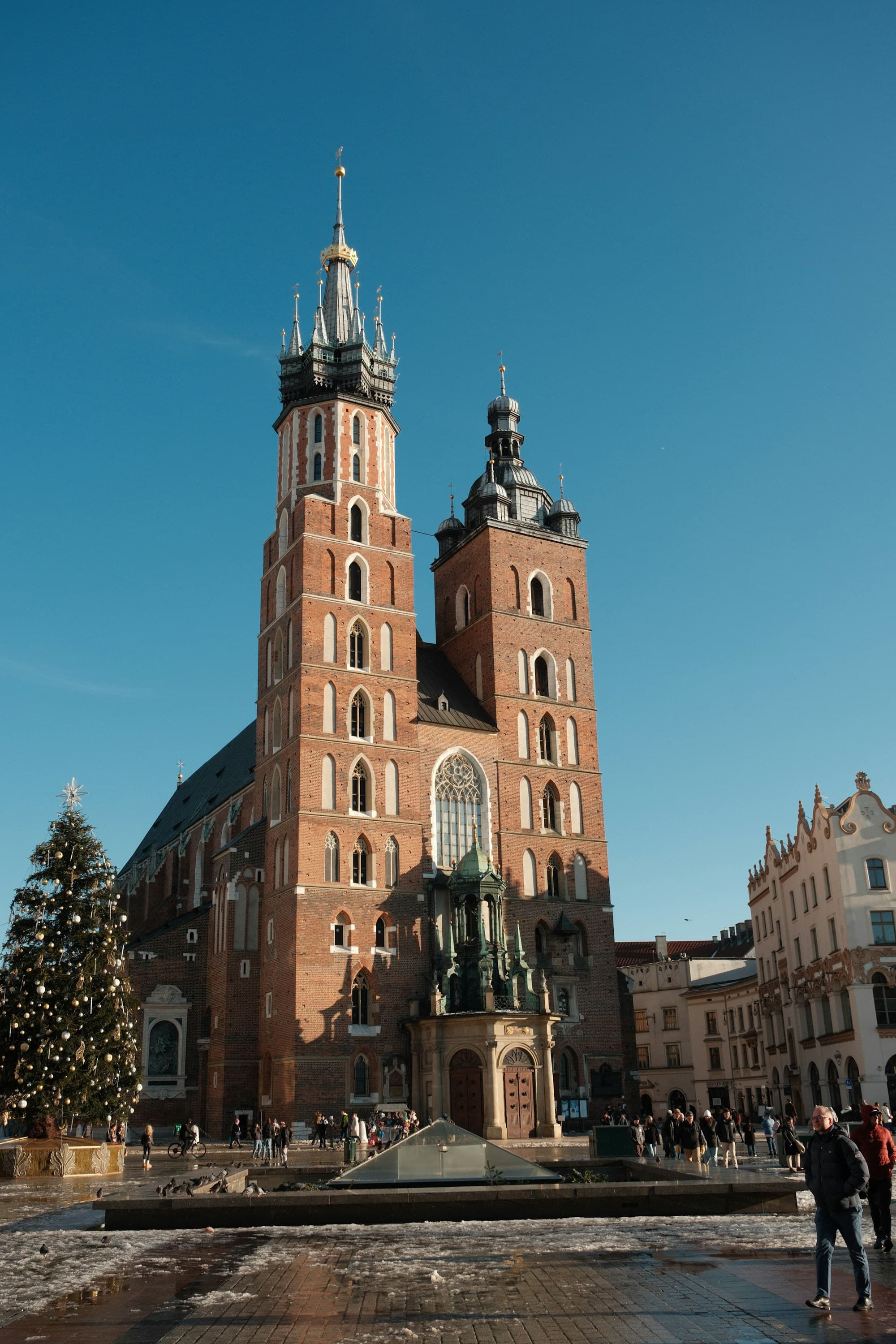
Christmas in
Poland
Celebrated: December 24 (Wigilia) through December 26
Signature traditions
- 1.Wigilia, the Christmas Eve dinner, beginning when the first star appears in the sky
- 2.Sharing the opłatek (a thin Christmas wafer), each family member breaks off a piece and exchanges wishes
- 3.Setting an extra place at the table for an unexpected guest
- 4.Twelve meatless dishes representing the 12 apostles
- 5.Pasterka, the midnight Mass that packs churches across the country
What's on the table
Wigilia 12 dishes, pierogi, barszcz, and karp
The 12-dish Christmas Eve dinner is meatless. Standout dishes: red barszcz (beet soup) with mushroom-stuffed dumplings, pierogi with sauerkraut and mushrooms, fried carp (the centerpiece), and makowiec (poppy seed cake).
The iconic decoration
Hay under the tablecloth
A wisp of hay is placed under the white tablecloth at Wigilia, a reminder of the manger. After dinner, family members pull straws from under the cloth: a green one means good fortune, a yellow one means a single year ahead.
How gifts are given
Święty Mikołaj (St. Nicholas) brings gifts on Christmas Eve after the Wigilia meal.
But who delivers yours?
There are eight cultural Christmas gift-givers around the world — Santa Claus, La Befana, the Yule Lads, Ded Moroz, Sinterklaas, the Three Kings, Christkind, and Joulupukki. Take the 6-question quiz to find out which one matches you.
Take the gift-giver quizDid you know?
Many Polish families keep a live carp swimming in the bathtub for several days before Christmas. Tradition says it cleans the fish and keeps the meal fresh, though the practice is increasingly debated, with some families now buying ready-prepared.
The shape of the season
Polish Christmas, Boże Narodzenie, turns almost entirely on a single evening: Wigilia, the Christmas Eve supper on December 24. Everything in the Polish Christmas season builds toward this one meal, which is among the most ritualized and emotionally resonant family gatherings in any European Christmas tradition. The decorations, the fasting, the cooking, the carol-singing all point to the moment when the first star appears in the December sky and the family sits down together.
The season formally runs from Advent through February 2 (Candlemas, Matka Boża Gromniczna), and Poland keeps it long: carols (kolędy) are sung well into late January, and the Christmas tree often stays up until early February. But the cultural peak is unambiguous: the night of December 24, from the first star through Midnight Mass.
Poland is one of the most observantly Catholic countries in Europe, and Christmas here retains a depth of religious and folk ritual that has thinned elsewhere. Many secular and lapsed-Catholic Polish families still keep Wigilia in close to its full traditional form. It's less a religious obligation than a national one.
Wigilia: the Christmas Eve supper
Wigilia is the heart of Polish Christmas, and it follows a sequence of rituals that are widely observed across the country.
The first star. The supper cannot begin until the first star (pierwsza gwiazdka) appears in the evening sky, a commemoration of the Star of Bethlehem. Traditionally the youngest child is sent to watch the window for it. In practice, families watch the dusk and begin around 4:00–5:00 PM in the short Polish December daylight. No one eats beforehand; the whole day of December 24 is traditionally a day of fasting (post) until the star.
Hay under the tablecloth. Before the meal, a few wisps of hay or straw are placed under the white tablecloth, recalling the manger where Christ was laid. In some households a sheaf of grain stands in the corner of the room. The hay is both a religious symbol and an older agrarian one, a remnant of pre-Christian Slavic harvest ritual absorbed into the Christian feast.
The empty place setting. The Polish Wigilia table is traditionally set with one extra place, an empty seat with a full setting, left for an unexpected guest, a wandering traveler, a soul of the departed, or simply "whoever may come." The custom embodies Polish hospitality (the proverb Gość w dom, Bóg w dom, "a guest in the home is God in the home") and a tenderness toward absent or lost family. No traveler should be turned away from a Polish home on Christmas Eve.
The opłatek. The supper opens with the sharing of the opłatek, a thin, unleavened wafer, embossed with nativity scenes, similar to the Communion host. Each person at the table holds their own wafer, and one by one approaches every other person, breaks off a piece of the other's wafer, and exchanges personal good wishes for the coming year: for health, for happiness, for whatever that relationship needs. With a large family this can take twenty minutes and often brings tears. It's the emotional center of the entire Polish Christmas, a moment of reconciliation and blessing before anyone eats. Poles abroad mail opłatek wafers to family in other countries so the ritual can be shared across distance.
Only after the opłatek does the meal begin.
The twelve dishes
The Wigilia supper consists of twelve dishes, one for each of the twelve apostles (or, in an older reading, one for each month of the coming year). All twelve are traditionally meatless, since December 24 is a fast day; fish is the permitted centerpiece. The exact dishes vary by region and family (some regions historically set an odd number of dishes instead of twelve), but the canonical Wigilia table includes:
- Barszcz czerwony z uszkami: clear ruby beetroot soup served with uszka ("little ears"), tiny dumplings stuffed with wild mushroom. The classic opening course.
- Zupa grzybowa: wild mushroom soup, an alternative or addition to the barszcz, made from dried foraged forest mushrooms.
- Karp: carp, the traditional Christmas fish, most often served fried (smażony karp) in breadcrumbs, or in the Jewish-Polish style karp po żydowsku (in a sweet gelatin). Many Polish families still buy the carp live a few days before Christmas and keep it in the bathtub until Christmas Eve, a practice both beloved and increasingly debated.
- Śledzie: herring, prepared multiple ways: in oil with onion, in sour cream, or pickled.
- Pierogi: dumplings, in the Wigilia version filled with sauerkraut and mushroom (pierogi z kapustą i grzybami).
- Kapusta z grzybami: braised sauerkraut with wild mushrooms.
- Kutia: in eastern Poland especially, a sweet dish of wheat berries, poppy seeds, honey, and nuts (shared with Ukrainian and Lithuanian tradition).
- Kompot z suszu: a drink of stewed dried fruits (prunes, apples, pears), smoky and sweet, the traditional Wigilia beverage.
- Makowiec: poppy-seed roll, a dense swirled yeast cake, the signature Polish Christmas dessert.
- Piernik: Polish gingerbread, spiced and dark, sometimes aged for weeks.
Twelve is the rule; the specific composition is the family's. You are traditionally meant to taste every one of the twelve dishes for good luck in the coming year: skipping a dish invites missing out on its month's fortune.
After the supper: gifts, carols, and Pasterka
Once the twelve dishes are finished, the evening unfolds:
Gifts. Polish children open their gifts on Christmas Eve, after Wigilia, not Christmas morning. Who brings the gifts depends on the region, and Poland has one of Europe's most fragmented gift-giver maps:
- Święty Mikołaj (St. Nicholas): across much of Poland, increasingly the default.
- Gwiazdor ("the Star Man"): in Wielkopolska (the Poznań region) and parts of the west, a sometimes-stern figure in furs who quizzes children on their prayers.
- Aniołek ("the little Angel"): in parts of the south, around Kraków.
- Dzieciątko (the Christ Child / baby Jesus): in Silesia and the south.
- Dziadek Mróz (Grandfather Frost): a remnant of the communist era, now largely faded.
A Polish person can usually tell which region another is from simply by asking who brought their childhood Christmas gifts.
Carols. Poland has one of the richest Christmas-carol traditions in Europe. The kolędy number in the hundreds, many centuries old (Wśród nocnej ciszy, Bóg się rodzi, Lulajże Jezuniu, which Chopin wove into one of his scherzos). The family sings around the table and the tree after supper. Carol-singing continues through the season; in villages, groups of carolers (kolędnicy), sometimes with a star on a pole or in costume, still travel house to house.
Pasterka. The night ends with Pasterka, the "Shepherds' Mass," Midnight Mass, at the local church, traditionally beginning at midnight on Christmas Eve. Many Poles who rarely attend Mass still go to Pasterka; churches across the country fill up. The name recalls the shepherds who were first to visit the newborn Christ.
The szopki of Kraków
A distinctly Polish Christmas art form: the szopka (nativity crib). While nativity scenes exist across Catholic Europe, the Kraków szopka is unique: not a realistic stable but a fantastical, brilliantly colored, multi-tiered architectural structure, built to resemble the towers, domes, and spires of Kraków's own landmarks (especially St. Mary's Basilica and Wawel Castle), with the nativity scene set inside.
Built from cardboard, wood, and shimmering metallic foil (staniol), the szopki glow with color and light. The tradition began in the 19th century among Kraków's craftsmen and builders, who made them in the off-season. Since 1937, Kraków has held an annual szopka competition on the first Thursday of December: builders process to the main market square (Rynek Główny) and display their creations at the foot of the Adam Mickiewicz monument, where they're judged and then exhibited. In 2018, the Kraków szopka tradition was inscribed on UNESCO's list of Intangible Cultural Heritage, Poland's first entry on the Representative List.
Inside the home
The Polish Christmas tree (choinka) is set up (traditionally on December 24 itself, though increasingly earlier) and decorated with glass ornaments (Poland has its own long tradition of hand-blown glass ornament craft), straw stars and pająki (geometric straw "spider" mobiles hung from the ceiling), wrapped chocolate ornaments, candles or lights, and an angel or star on top. Apples, nuts, and gingerbread hang among the decorations, recalling older fruit-and-grain tree customs.
The home fills with the smells of the season: dried forest mushrooms simmering, poppy-seed cake, gingerbread spice, fried carp, and the smoky sweetness of kompot z suszu on the stove. The white tablecloth (with its hay beneath), the extra place setting, and the lit szopka or nativity complete the room.
If you wanted to borrow this tradition
The opłatek is the single most moving Polish Christmas tradition, and it travels easily. The wafers can be ordered online from Polish import shops (or substituted with any thin wafer). The ritual is simple: before the Christmas meal, each person takes a wafer, then goes around to every other person, breaks a piece of theirs, and shares a specific, personal wish. It transforms the start of a meal into a round of one-on-one blessings and reconciliations, and it lands with a depth that a group toast never reaches. Of everything on this list, this is the one worth importing first.
The empty place setting is a beautiful adoption that costs nothing but a chair: one extra seat, fully set, for "whoever may come," whether an unexpected guest, a traveler, or the memory of someone absent. It quietly reorients the table toward hospitality and remembrance.
The twelve meatless dishes are a heavier lift, but the principle (a fish-and-vegetable Christmas Eve supper, saving the meat for Christmas Day) carries over intact, and a simplified version (beet soup with mushroom dumplings, a fish course, sauerkraut-and-mushroom pierogi, poppy-seed cake, and dried-fruit compote) gives an American Christmas Eve a distinctly Polish character.
And the "taste every dish for luck" rule is a charming, easy custom to bring to any holiday table: everyone takes at least a bite of everything, and no dish goes untouched.
Did you know
- The sharing of the opłatek wafer is so central to Polish identity that Poles in the diaspora mail the wafers internationally each December so that families separated across borders can still perform the ritual "together." Pope John Paul II, himself Polish, helped make the custom known worldwide.
- The Kraków szopka competition has run almost every year since 1937, pausing only during World War II. The winning szopki enter the collection of the Historical Museum of Kraków, which holds hundreds spanning nearly a century.
- The Polish Christmas carp-in-the-bathtub custom, buying the fish live and keeping it in the family tub until Christmas Eve, is shared with neighboring Czech tradition and remains common, though a growing number of Poles now buy the carp already prepared, and animal-welfare campaigns have pushed back on the live-carp trade.
- Polish tradition holds that animals can speak in human voices at midnight on Christmas Eve, as a reward for the ox and donkey who warmed the newborn Christ, though it's said to be bad luck to try to listen.
More from Europe



Bring a little of it home
Borrowing one tradition from somewhere else is how most of the traditions on this page started.
Free AI tool
See your own home decorated
Upload one photo and watch your room or house transform, before you buy anything.
Interactive map
All 41 countries
Gift-givers, feast tables, and the surprising customs most articles skip.
City guides
Lights worth the drive
The best displays in 40 US cities, including the free neighborhoods.
More Christmas traditions across Europe
Christmas ideas for your own home.
Seasonal decorating tips and the occasional new tool, straight to your inbox. One list, no spam.