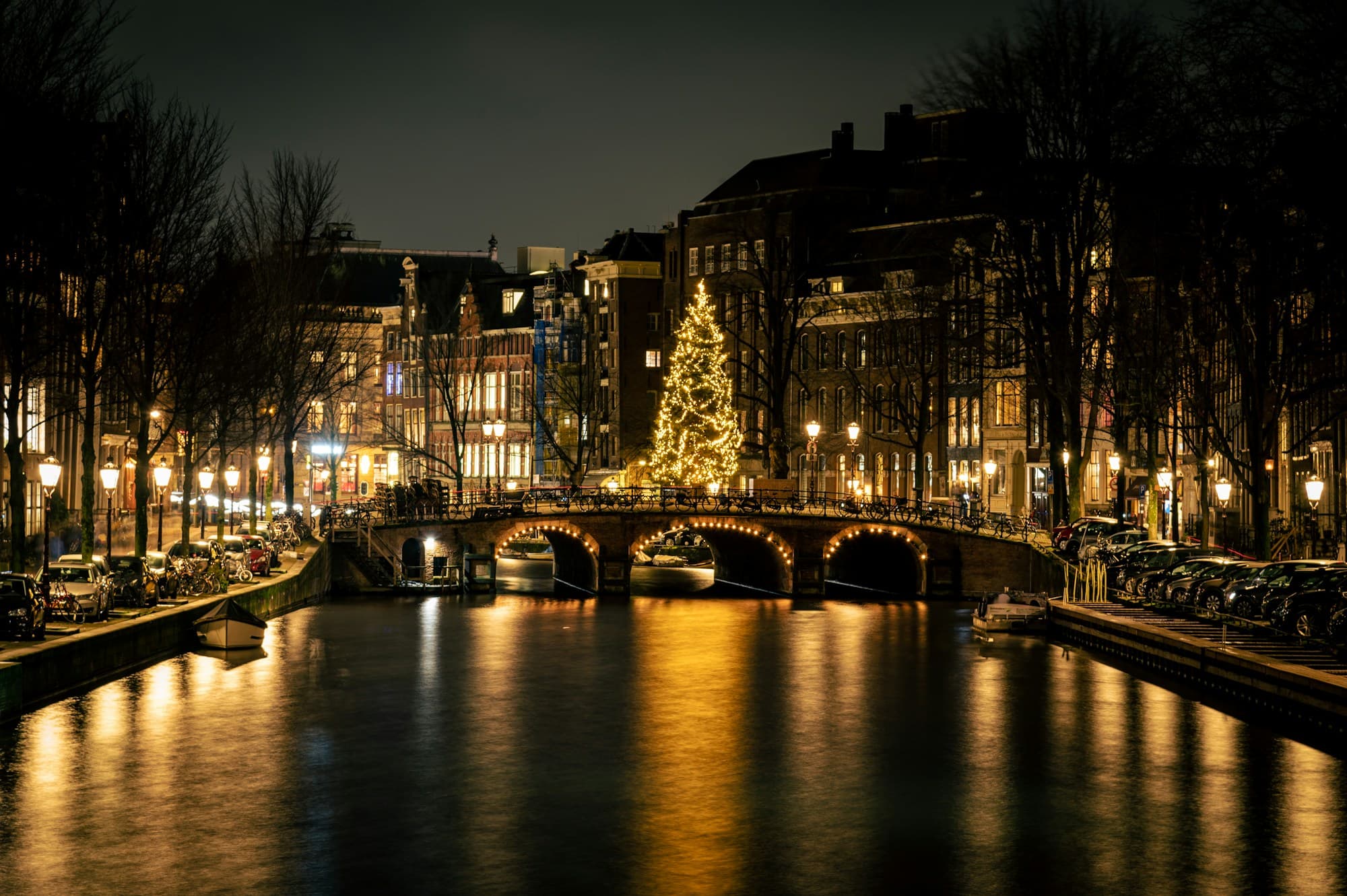
Christmas in
Netherlands
Celebrated: December 5-6 (Sinterklaas) and December 25-26 (Kerstdagen)
Signature traditions
- 1.Sinterklaas (December 5 evening) the original Saint Nicholas tradition that became Santa Claus
- 2.Pakjesavond ('Gift Evening') on December 5, the major family gift exchange happens BEFORE Christmas Day
- 3.Children leave shoes by the chimney with carrots for Sinterklaas's horse, finding them filled with small gifts in the morning
- 4.Christmas itself (December 25-26) is quieter, focused on long family meals over two days (First and Second Christmas Day)
- 5.Gourmetten, a small tabletop grill where the family slowly cooks bite-sized portions over 2-3 hours
What's on the table
Gourmetten and pepernoten
Gourmetten is uniquely Dutch: a small electric grill in the middle of the table where everyone slowly cooks their own meats, fish, and vegetables for hours. Pepernoten (small spiced cookies) are eaten constantly through the Sinterklaas season.
The iconic decoration
Sinterklaas window displays
Through November and early December, Sinterklaas (the saint, not Santa) and his horse Ozosnel (Amerigo's successor) dominate window displays. Lights and trees appear later, after Sinterklaas wraps up on December 6, leaving room for the Kerstdagen aesthetic.
How gifts are given
Most gifts are exchanged on Sinterklaasavond (December 5). The Dutch tradition includes writing personalized rhyming poems for each gift, often paired with elaborate handmade 'surprise' wrapping that hides the gift creatively or comically.
But who delivers yours?
Netherlands's gift-giver is Sinterklaas. But there are eight cultural Christmas gift-givers worldwide — Santa, La Befana, the Yule Lads, Ded Moroz, Sinterklaas, the Three Kings, Christkind, and Joulupukki. Take the 6-question quiz to find your match.
Take the gift-giver quizDid you know?
Sinterklaas (Saint Nicholas in his original Dutch form) is the direct historical ancestor of Santa Claus. Dutch settlers brought the tradition to New Amsterdam (now New York) in the 1600s, where 'Sinterklaas' gradually anglicized into 'Santa Claus.' The modern American Santa is essentially a Dutch saint after centuries of cultural drift.
The shape of the season
The Dutch winter holiday season is structurally different from almost every other Western Christmas culture. The big gift-giving night isn't Christmas Eve. It's December 5, the night of Pakjesavond ("gifts evening"), the eve of Sinterklaas on December 6. The cultural and emotional peak of the Dutch winter season is in early December, not late. By the time December 25 arrives, most Dutch households are essentially done with the gift-giving and ready for a quieter, more church-and-family-centered Christmas: Kerstmis.
The season runs from mid-November (when Sinterklaas arrives by steamboat from Spain in the Intocht van Sinterklaas national event) through December 26, the Tweede Kerstdag (Second Christmas Day, a Dutch public holiday). It bridges into New Year's Eve a week later, which has its own distinctive Dutch traditions: oliebollen, fireworks, and the Nieuwjaarsduik New Year's Day cold-water swim.
What makes Dutch winter holidays distinctive: two separate gift-giving events (Sinterklaas on Dec 5, Kerstmis on Dec 25), with Sinterklaas as the bigger one, plus a deeply community-oriented set of small rituals (poem-writing, gourmetten dinner, neighborhood Sinterklaas processions) that give the season a folkloric, family-game quality unlike most modern Western Christmas.
Sinterklaas
Sinterklaas (Saint Nicholas) is the dominant winter gift-giving figure in Dutch culture, and his cultural footprint dwarfs the Western Santa Claus, which is fitting given that Santa's own history traces directly back to this same Saint Nicholas. Sinterklaas is depicted as a tall, dignified elderly bishop in red robes with a tall mitre, white beard, gold staff (kruisstaf), and a large book in which good and bad children's deeds are recorded.
The Sinterklaas season opens in mid-November with the Intocht van Sinterklaas, the official national arrival of Sinterklaas by steamboat from his "home" in Spain (a deliberately fanciful detail dating to the 19th century). The steamboat docks at a different Dutch host city each year, chosen together with the national broadcaster NTR. Sinterklaas disembarks, mounts his white horse Ozosnel (Amerigo until his retirement in 2019, Ozosnel ever since), and rides through the host town in a grand procession with his helpers throwing handfuls of pepernoten (small spiced cookies) to crowds of children. The event is broadcast live on national television each year and watched by millions, with tens of thousands more turning out in person.
After his arrival, Sinterklaas is "in town" for the three weeks leading to December 5. Children leave a shoe by the fireplace (or the front door, or the radiator) on multiple nights during these weeks. They put a carrot or apple in the shoe for Ozosnel the horse, sometimes a drawing for Sinterklaas. In exchange, by morning a small gift appears: a chocolate letter, a few pepernoten, a small toy. Not every night, only when "Sinterklaas comes" (parents' discretion), typically two or three times across the three-week window.
The climax is Pakjesavond, December 5. After dinner, families gather, and the gift-distribution begins. There's a knock at the door (often staged by an older sibling or neighbor in costume); when the family opens it, no one is there, but a sack of wrapped gifts sits on the doorstep. The gifts get opened one at a time, with everyone watching, and each one is paired with a hand-written rhyming poem (Sinterklaasgedicht) that affectionately roasts the recipient.
Sinterklaasgedichten
A distinctively Dutch tradition: every gift on Pakjesavond comes with a rhyming poem, een Sinterklaasgedicht, written by the giver in the voice of Sinterklaas. The poems describe the recipient, gently roast them for some quirk or running joke from the past year, and then build toward a punchline that explains the gift.
Writing the gedichten is half the work of Pakjesavond. Family members spend weeks beforehand drafting poems, getting the right balance of affectionate teasing and warmth. Children's poems are simpler ("Sinterklaas zag dat je lief bent geweest / dus krijg je dit cadeau voor het feest," meaning "Sinterklaas saw that you've been sweet, so you get this present for the celebration"). Adult poems can run to several stanzas with elaborate rhyme schemes and inside jokes that have been building for years.
For couples and close friends, the gedicht-writing is its own ritual outside the children's Sinterklaas. Adult Dutch friend groups often do their own Sinterklaas exchange (sometimes called Surprise Sinterklaas or just Pakjesavond) where everyone draws a name, makes an elaborate handcrafted surprise (a wrapped gift disguised in an elaborate handmade container related to the recipient's life, such as a fake birthday cake with a gift hidden inside, or a giant papier-mâché version of the recipient's favorite hobby tool), and writes a multi-page poem.
The poem-and-surprise tradition is one of the most distinctively Dutch winter customs, and it's culturally taken much more seriously than the gifts themselves. The work and care that go into the poems and the disguised packaging are the actual point; the gift inside is often modest.
The Zwarte Piet question
A specifically Dutch cultural controversy that's central to any honest discussion of Sinterklaas: Sinterklaas is historically accompanied by a helper called Zwarte Piet, or "Black Pete," depicted in 19th-century Dutch imagery as a Moorish servant in a colorful Renaissance-style costume, including dark face paint, exaggerated red lips, gold earrings, and a curly black wig. (Originally there was a single Piet; the familiar crowd of many Pieten only multiplied from the 1950s onward.)
The tradition's origins are contested. The most-cited official explanation says Piet's blackface is from the soot of climbing down chimneys to deliver gifts. The historical-critical interpretation says Piet derives from the Dutch colonial slave trade and 19th-century racist iconography. Both readings are present in modern Dutch discourse.
Since around 2013, the Zwarte Piet tradition has been the subject of significant national debate, with anti-Zwarte-Piet activists arguing the blackface presentation is racist and should be retired, and pro-tradition voices arguing it's a beloved children's custom with non-racial origins. The result has been a gradual cultural shift:
- Many Dutch towns and broadcasters now use Roetveegpiet ("soot-smudge Pete"), Sinterklaas helpers in face paint that's clearly just streaks of black soot rather than full blackface, explicitly reframing the soot-from-chimney explanation as visually literal.
- Some communities have switched to Schoorsteenpiet or regenboog-Pieten ("rainbow Petes"), helpers in various face-paint colors, removing the blackface entirely.
- The official national Intocht broadcast has used roetveegpiet exclusively since around 2020.
- Some traditional communities (particularly in the southern Netherlands) still use blackface Piet, though this is increasingly contested.
Foreign visitors to the Netherlands in December may still encounter Zwarte Piet in some contexts. The conversation around it is genuinely live in Dutch society and worth understanding before judging. It's a question Dutch people are actively working through, not a settled or universal practice.
What's on the Sinterklaas table
The food tradition for the Sinterklaas season is its own category, distinct from Christmas food. The signature items:
- Pepernoten / kruidnoten: small spiced cookies, between coin-sized and marble-sized, flavored with cinnamon, ginger, nutmeg, cloves, and white pepper. Kruidnoten are the harder, round, cookie-like version (now dominant in supermarkets); pepernoten historically referred to a softer, more bread-like cookie that's less common today. Supermarket aisles fill with bags of kruidnoten from August onward; the country eats millions of kilograms each year.
- Speculaas: spiced shortbread cookies, often baked in elaborately carved wooden molds depicting Sinterklaas himself, his horse, or scenes from his story. The flavor profile (cinnamon, ginger, nutmeg, clove, cardamom) is similar to American "windmill cookies." Larger speculaas figures (10-30 cm tall) are often given as gifts on December 5.
- Chocoladeletter: a chocolate letter representing each family member's initial, given on Pakjesavond. Major Dutch chocolate brands (Droste, Tony's Chocolonely, Verkade) produce special-edition Sinterklaas letters in milk, dark, and white chocolate. The letters are eaten across the season after December 5.
- Marzipan figurines: molded marzipan in the shapes of animals, foods, or Sinterklaas-themed figures, often individually wrapped and gifted alongside the chocolate letters.
- Banketstaaf: a long pastry log filled with almond paste, wrapped in puff pastry, baked golden brown.
Kerstmis: Christmas
After the Sinterklaas peak has passed, Kerstmis, Christmas itself, is observed more quietly. The Netherlands has two Christmas public holidays: Eerste Kerstdag (December 25) and Tweede Kerstdag (December 26), both family-quiet days centered on the meal and (for Christian families) church attendance.
The Dutch Christmas dinner doesn't have one universal canonical menu. Three popular formats:
- Gourmetten: the most distinctively Dutch Christmas dinner format. An electric tabletop grill (gourmetstel) sits in the middle of the table; everyone cooks their own small portions of meat, fish, vegetables, and prawns on individual mini frying pans (pannetjes) at their station. The meal extends for hours; everyone gets to control their own cooking; everyone snacks continuously rather than eating in courses. It's the Dutch answer to fondue (and similarly social) but with much more variety. The gourmetten box (a pre-assembled platter of raw meats, marinated fish, prepared veg, sauces) is sold at every supermarket in mid-December as a Christmas-dinner shortcut.
- Roast goose, duck, or turkey: for more traditional families, a single bird with stuffing, potatoes, red cabbage, and gravy. Common in older households and in southern Dutch (Catholic) regions.
- Restaurant dinner: restaurant reservations for Eerste Kerstdag fill months in advance; for many urban Dutch families, the Christmas meal is a multi-course tasting menu at a favorite restaurant.
For dessert: Kerststol, a sweet bread loaf with raisins, currants, candied citrus peel, and a thick log of almond paste running through the middle. Always served sliced, with butter. The almond-paste-stuffed version is the upgraded Christmas variant of the year-round Dutch krentenbrood (currant loaf).
Christmas Day is otherwise unhurried. No frenzied gift-opening (those already happened on December 5). No elaborate stocking ritual. Mostly: family, food, walks, and quiet.
Inside the home
Dutch Christmas decoration is restrained and tasteful. The Scandinavian aesthetic carries strongly across the North Sea. Real Christmas trees (small to medium) are common, decorated with white lights, simple ornaments, and an Advent calendar or chocolate letters laid out underneath in the days before Pakjesavond.
The truly distinctive Dutch winter decoration is the window candle arch (kaarsenboog), an arched wooden frame with seven or nine electric candles, placed in front-facing windows so the warm light is visible from the street. Visit a Dutch town on a December evening and you'll spot these glowing in window after window. The design originated in Germany's Erzgebirge region (as the Schwibbogen) and has found a comfortable second home in Dutch windows.
The Advent calendar is universal in households with children, typically the chocolate-filled supermarket version with 24 windows, opened one per day through December.
New Year's Eve and oliebollen
A Dutch winter season note: Oudejaarsavond (New Year's Eve, December 31) has its own central food, oliebollen: fried dough balls, deep-fried fresh on the day, dusted with powdered sugar. Pop-up oliebollenkraams (oliebollen stalls) appear on Dutch streets and outside supermarkets through late December and into New Year's Day, selling them by the bag. The tradition stretches back centuries: the oily, dense oliebollen were said to protect the body from the devil's sword on New Year's Eve.
New Year's Eve in the Netherlands is also notable for being completely chaotic with fireworks. Until recent regulatory restrictions, individual Dutch households set off enormous quantities of consumer fireworks at midnight (and for hours before and after). The combined effect was visually stunning and sonically deafening. Recent laws have tightened firework regulations after years of injury statistics, but private fireworks remain a central Dutch New Year's tradition.
January 1 brings the Nieuwjaarsduik ("New Year's Dive"). At noon, swimsuit-clad crowds sprint into the North Sea, most famously at Scheveningen Beach near The Hague, to start the year off clean. The Unox sausage company has sponsored the main Scheveningen event for decades, handing out hot pea soup to swimmers afterward; everyone wears the orange "Unox hats" and the event runs roughly 10,000 swimmers strong.
How gifts are given
Gifts in Dutch winter culture happen primarily on December 5 (Pakjesavond), the Sinterklaas gift exchange, with poems and surprises, as described above. The volume and emotional weight of this gift-exchange dwarfs the Christmas one.
A smaller secondary gift round happens on December 25 (Kerstmis), usually modest, often a single gift per person, sometimes nothing at all. Dutch families that have done the full Sinterklaas treatment often deliberately keep Christmas gift-light, both to reduce commercialization and because the Sinterklaas exchange already satisfied the gift-giving impulse.
In some bilingual Dutch-international households (expat families, mixed marriages), Sinterklaas and Christmas have been deliberately merged or alternated to navigate both cultural traditions. The Dutch-internal practice still keeps them clearly separate.
If you wanted to borrow this tradition
The Sinterklaasgedicht is the most worthwhile Dutch tradition to import. The format, where every gift comes with a rhyming poem that affectionately teases the recipient, adds enormous emotional and creative depth to a gift exchange. The poems can be silly or sincere; the only rule is that they're hand-written. American family Christmas exchanges that adopt this even partially become much more memorable. The pre-write requirement also forces the giver to think about who they're giving to, rather than just buying.
The gourmetten dinner format is great fun for Christmas Day and easy to stage in an American kitchen. The required equipment (a tabletop electric grill, or raclette grills work) is widely available. The "everyone cooks their own small portions across hours" format is much more social and relaxed than a single big served dinner. Especially good with families of mixed eating preferences (vegetarians, picky eaters, dietary restrictions) since everyone makes their own.
The chocoladeletter is the easiest single-item adoption. Order a few from a Dutch import shop or any decent American chocolatier who can make custom letter shapes; give each family member their initial as a stocking-stuffer-style addition to the gift exchange. The visual is gorgeous and the symbolic touch (this letter is yours) hits differently than a generic chocolate.
The window candle arches are widely available now in American import shops and on Amazon (search "wooden window candle pyramid" or "German window arch lights"). Placing one in a prominent front-facing window from Thanksgiving through New Year's gives the home an instantly recognizable warm-glow signature that the typical American Christmas exterior lights don't match.
Did you know
- The Dutch national Intocht van Sinterklaas (Sinterklaas's official arrival from Spain) is one of the most-watched annual television broadcasts in the Netherlands, with viewership routinely exceeding 4 million in a country of roughly 17 million people.
- The "Spain" home of Sinterklaas is entirely fictional and dates only to the 19th century, when a Dutch children's book author named Jan Schenkman invented the steamboat-from-Spain backstory. Earlier Dutch tradition had Sinterklaas living in heaven; the Spanish backstory was an innovation that stuck. The Spanish themselves have no equivalent tradition.
- Dutch supermarkets sell millions of kilograms of pepernoten and kruidnoten each season, with peak consumption from late November through December 5. Van Delft, one of the biggest producers, runs special production shifts from August onward to meet seasonal demand.
More from Europe



Bring a little of it home
Borrowing one tradition from somewhere else is how most of the traditions on this page started.
Free AI tool
See your own home decorated
Upload one photo and watch your room or house transform, before you buy anything.
Interactive map
All 41 countries
Gift-givers, feast tables, and the surprising customs most articles skip.
City guides
Lights worth the drive
The best displays in 40 US cities, including the free neighborhoods.
More Christmas traditions across Europe
Christmas ideas for your own home.
Seasonal decorating tips and the occasional new tool, straight to your inbox. One list, no spam.