Christmas in
Greece
Celebrated: December 25 through January 6 (Theophany)
Signature traditions
- 1.Decorating wooden boats (karavakia) instead of (or alongside) trees, a tradition from the country's seafaring heritage
- 2.Children singing kalanda (carols) door-to-door on Christmas Eve, accompanied by metal triangles
- 3.St. Basil (not Santa) delivers gifts on January 1
- 4.Sprinkling holy water from blessed basil branches around the house to ward off Kallikantzaroi (mischievous goblins) during the 12 days of Christmas
- 5.Cutting the vasilopita on January 1, a sweet bread with a hidden coin; finder gets good luck for the year
What's on the table
Christopsomo and melomakarona
Christopsomo ('Christ's bread') is a sweet round loaf decorated with a cross. Melomakarona (honey-soaked cookies with walnuts) and kourabiedes (powdered-sugar shortbread) are the season's iconic treats.
The iconic decoration
The Christmas boat (karavaki)
Greeks traditionally decorated small wooden boats with lights to honor returning sailors. The custom is making a comeback, towns now display large lit boats in central squares alongside trees.
How gifts are given
Saint Basil delivers gifts on New Year's Day (January 1), not Christmas. Children open presents on January 1.
But who delivers yours?
There are eight cultural Christmas gift-givers around the world — Santa Claus, La Befana, the Yule Lads, Ded Moroz, Sinterklaas, the Three Kings, Christkind, and Joulupukki. Take the 6-question quiz to find out which one matches you.
Take the gift-giver quizDid you know?
Greek folklore warns of Kallikantzaroi, mischievous goblins that emerge from the underworld during the 12 days from Christmas to Epiphany. Families burn old shoes, keep fires going, and sprinkle blessed water to keep them away.
The shape of the season
Greek Christmas runs as a true twelve-day season, from Christougenna on December 25 through Theophania (Epiphany) on January 6, bookended by two of the most distinctive religious celebrations in the Eastern Orthodox calendar. In between sits Protochronia, New Year's Day, which in Greece is the main gift-giving day (not December 25), and which is associated with Agios Vasilis (St. Basil) rather than with Santa Claus.
Greek Orthodox Christmas falls on December 25 like Western Christmas (the Church of Greece adopted the Revised Julian calendar in 1924, which aligns fixed feasts with the Gregorian dates), but the rhythm and weight of the season is meaningfully different. Christmas Day is family-quiet and church-centered. New Year's Day is the festive, gift-exchange, lottery-and-cake moment. Epiphany is the wild swim into freezing harbor water to retrieve a wooden cross, one of the most photographed Greek religious traditions of the year.
What makes Greek Christmas distinctive isn't the day itself but everything around it: the carol-singing children with triangles, the mischievous goblins who emerge for the twelve days, the cookie spread, and the blessing of the waters.
The Kalanta
The most charming Greek Christmas tradition is the kalanta, children's carols sung house to house in the days before Christmas, New Year's, and Epiphany. Groups of children (traditionally boys; modern groups are mixed) walk the neighborhood carrying triangles (trigono) and small drums, knocking on doors and asking Na ta poume? ("Shall we sing them?"). The household replies Na ta peite! ("Yes, sing them!"), and the children launch into the traditional Christmas, New Year's, or Epiphany kalanta verses.
In exchange, households give the children small coins, candy, dried fruits, or pieces of christopsomo bread. Three separate sets of kalanta exist: one for Christmas Eve, a different one for New Year's Eve, and a third for the eve of Epiphany, each with its own melody and lyrics. The Christmas Eve verses begin Kalin esperan archontes... ("Good evening, noble lords...") and run through references to the Nativity story; the New Year's verses praise Agios Vasilis and ask his blessing on the home; the Epiphany kalanta describe John the Baptist and the baptism of Christ.
The tradition is one of the oldest continuously-observed Greek folk practices, and the verses have changed little since the Byzantine period. In modern Greece, the urban version is brief (children sing one verse, accept the coin, move on), but in villages, particularly in the islands and northern Greece, the kalanta visit can stretch much longer, with households inviting the children inside for cookies and warm drinks.
The kallikantzaroi
A specifically Greek Christmas-season superstition: the kallikantzaroi, mischievous goblins who emerge from underground for the twelve days between Christmas and Epiphany to wreak havoc on Greek homes. Folkloric explanations describe them as soot-black, hairy, half-human creatures with twisted limbs, who spend the rest of the year underground sawing at the cosmic tree that holds up the earth; they get to come up only during these twelve days, after which they return below and the cycle resumes.
The kallikantzaroi are minor nuisances rather than serious threats. They sour the milk, scatter ashes from the hearth, put out fires, hide household objects, and generally cause mild chaos. Greek folk traditions developed several countermeasures, all of which are still practiced in some form:
- Keep the hearth fire burning continuously through the twelve days. The smoke is said to keep the kallikantzaroi at bay; a dead fire invites them in.
- Burn old shoes in the fireplace on Christmas Eve. The smell deters the goblins.
- Hang a cross wrapped in basil on a small bowl at the doorway, sometimes with a sprig of rosemary or holy water from the church, to bless the entryway.
- Mark a cross on each doorframe with white chalk or olive oil on Epiphany morning, after the priest blesses the home.
The kallikantzaroi disappear at Epiphany when the priests bless the waters and re-sanctify the earth. The folklore is no longer believed literally by most modern Greeks, but the rituals persist. The fire is still kept warm, the cross is still hung, and grandmothers still tease children about the goblins.
The cookie spread
Every Greek home, regardless of religious observance level, produces an enormous spread of Christmas cookies during December. The two iconic Greek Christmas cookies are paired and balanced, one dusted white and one drizzled dark, and appear together on every Christmas table:
-
Kourabiedes: almond shortbread cookies, often shaped as crescents, generously dusted with powdered sugar so they appear snow-white. Buttery, crumbly, almost crystalline. The grandmother's recipe is considered family heritage in many Greek households; some include a clove pushed into the center as a small spice surprise.
-
Melomakarona: honey-cinnamon-clove cookies soaked in honey-orange syrup, dense and dark with chopped walnuts on top. Greek bakers traditionally argue that melomakarona must be made first (before the kourabiedes), because making the powdered-sugar kourabiedes first contaminates the kitchen with sugar dust and ruins the honey-soaking step.
The two cookies appear together on plates throughout the season, never one without the other. The visual contrast (white snow vs golden honey) is part of the canonical Greek Christmas table aesthetic.
Other distinctly Greek Christmas-season sweets include diples (thin sheets of dough fried until crisp and drizzled with honey and walnuts, particularly common in the Peloponnese), finikia (the name melomakarona go by in some regions), and christopsomo (Christ's Bread, a round sweet loaf decorated with a cross of dough on top, baked Christmas Eve and broken at dinner). Most families also display a large bowl of walnuts in the shell and dried figs throughout the season as a traditional Christmas offering.
Christmas Day and the festive table
Greek Christmas Day dinner is a substantial midday meal, eaten after the morning church service. The traditional centerpiece is roasted pork. Pigs were historically slaughtered specifically for Christmas in rural Greece, and roast pork with lemon-potatoes remains the canonical Christmas main. In wealthier urban households, stuffed turkey has become common, prepared Greek-style with a chestnut-and-ground-meat stuffing.
The starters and sides:
- Avgolemono soup: chicken broth thickened with egg yolks and lemon, often served as the warming starter.
- Yemista: vegetables (tomatoes, peppers, zucchini) stuffed with rice, herbs, and sometimes ground meat.
- Spanakopita or tyropita: spinach-and-feta or cheese phyllo pies.
- Salata horiatiki: the classic Greek salad with feta block on top.
- Lemon potatoes: wedges roasted in lemon juice, olive oil, and oregano.
For dessert, the cookie spread (above) is the main act, accompanied by Greek coffee or café Vienna (Vienna-style coffee with whipped cream) and a glass of Mavrodaphne sweet red wine or Metaxa brandy.
New Year's and the Vasilopita
In Greece, Agios Vasilis (St. Basil the Great) is the gift-giving figure, and January 1, St. Basil's Day, is the main gift-exchange moment, not Christmas. St. Basil was a fourth-century Greek bishop from Caesarea who was famously charitable to the poor; the connection between him and gift-giving comes from this association rather than from any Santa-like myth.
The central New Year's tradition is the Vasilopita, St. Basil's cake, a large round sweet cake (or sometimes a sweet bread) baked with a coin (flouri) hidden inside. At midnight on New Year's Eve, or sometimes on New Year's Day at lunch, the head of the household cuts the cake ceremonially: first slice for Christ, second for the Virgin Mary, third for the home itself, then a slice for each family member in order of age (oldest to youngest), then a slice for the family business, then one for the poor. Whoever finds the coin in their slice is considered blessed with good luck for the year.
The Vasilopita-cutting ceremony is taken seriously even in secular Greek households. Workplaces, schools, civic organizations, and clubs all hold their own Vasilopita-cuttings throughout early January, and being the coin-finder at the office party is genuine bragging rights.
The cake itself varies regionally. The most common version is a round sponge cake with mahlepi spice and orange zest, glazed white and decorated with the year's date in candied fruit. Cretan and northern Greek versions are denser, more like a sweet bread.
Theophania (Epiphany)
January 6, the Feast of Theophania ("the appearance of God"), commemorates the baptism of Christ in the Jordan River. The Greek Orthodox Church observes it with the Blessing of the Waters (Agiasmos), a ceremony where priests bless harbors, rivers, lakes, and reservoirs across the country.
The most photographed Greek Theophania tradition is the diving for the cross. A priest leads a procession to the local harbor or river, blesses the water, and then throws a wooden cross into it. Young men (traditionally, though modern celebrations include young women) immediately dive in after it, swimming through the freezing winter water to retrieve the cross. Whoever surfaces with it earns a special blessing for the year.
Famous diving locations include Piraeus harbor (Athens), the Saronic Gulf at Aegina, and the old harbor of Chania in Crete. In northern Greece, where rivers freeze, ice may be broken specifically for the dive. The early-January Aegean sits somewhere around 55-59°F (13-15°C), bracing rather than brutal, and divers are usually fortified by ouzo or tsipouro before plunging in.
After the diving ceremony, the priest visits homes throughout the village, using a small wooden cross dipped in holy water to sprinkle each room (the agiasmos of the household), chasing the kallikantzaroi back underground for another year. The twelve days of Christmas close at the moment the priest sprinkles the last home; Greek Christmas is officially over.
Inside the home
The Greek Christmas tree (Christougenniatiko dentro) is a relatively recent addition. The Bavarian-born King Otto introduced it (his court put up Greece's first tree in 1833), but it only became widespread in Greek homes after World War II. Until the mid-20th century, the traditional Greek Christmas decoration was a small wooden boat (karavaki) strung with lights and ribbons, recognizing Greece's deep maritime heritage and the journeys of sailors and merchants. The boat decoration is still common in coastal areas and in some traditional households as a parallel to (or replacement for) the tree.
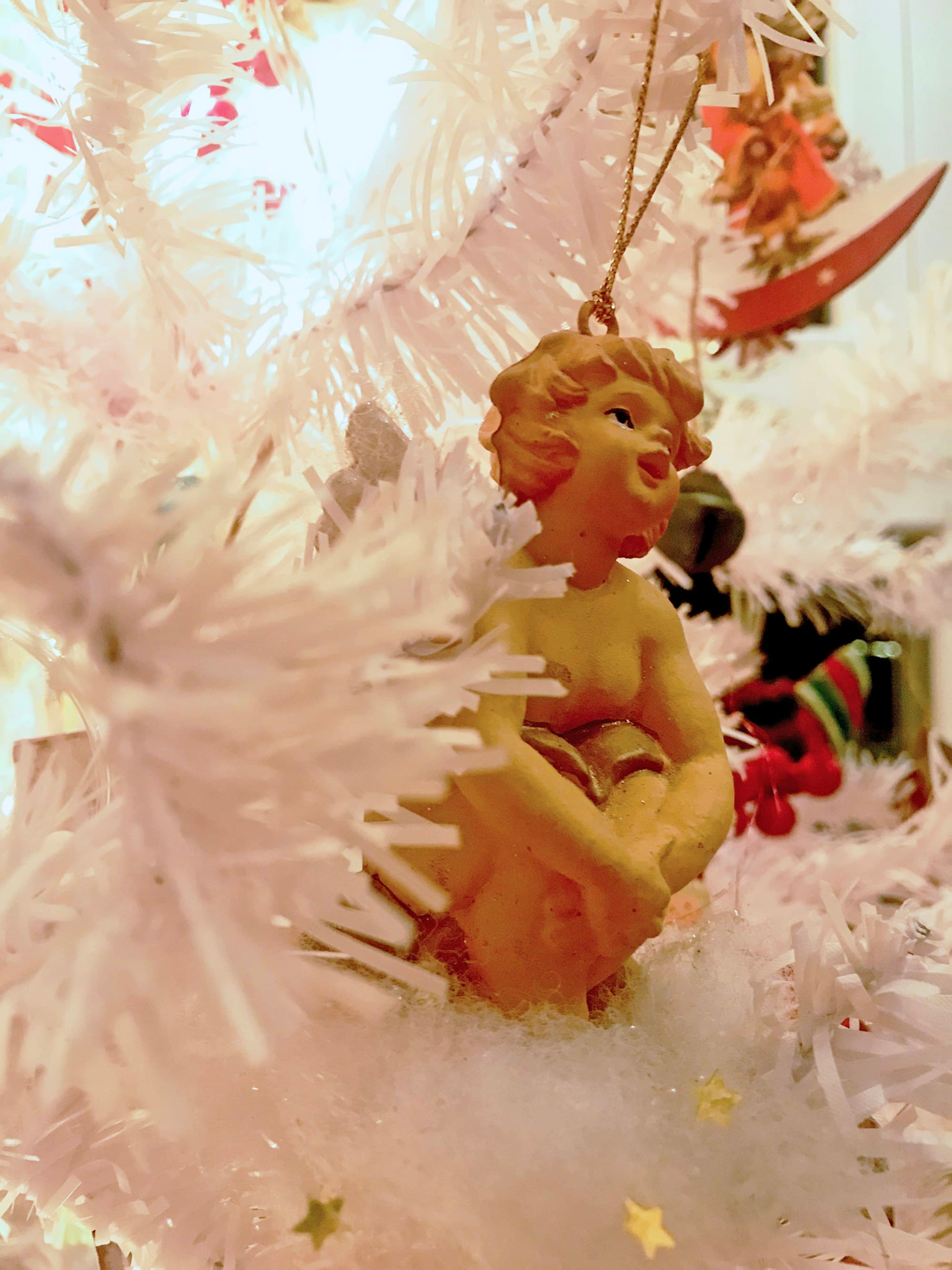
The tree itself, when present, is decorated with traditional ornaments: small pomegranate-shaped baubles (pomegranates are a Greek symbol of abundance and good fortune), evil-eye charms (mati), painted glass balls, and a star or angel at the top.
The nativity scene (fatni) is common in religious households, especially in Catholic Greek-Italian families on the Ionian Islands. The Orthodox decorating language emphasizes icons, candles, and red-and-gold textiles more than figurines.
How gifts are given
Agios Vasilis (St. Basil) brings gifts to children on the night of December 31 to January 1, New Year's Eve, not Christmas Eve. Children open their gifts on New Year's morning. The gifts are typically modest; the Vasilopita cake (above) is often the centerpiece event of the morning, not the gift exchange.
Modern Greek households increasingly do small gifts on Christmas Day as well (Western cultural influence), but the cultural weight remains on New Year's. Workplaces, friends, and extended family exchange small gifts at the Vasilopita-cutting events through the first week of January.
For Epiphany (January 6), a small final gift may be exchanged in some families, often a religious object (a small icon, a wooden cross, holy water from the church).
If you wanted to borrow this tradition
The easiest Greek adoption is the kourabiedes-and-melomakarona pairing. Both cookies are within reach of any home baker (Greek-American bakeries sell them by the box throughout December, or the recipes are widely available online). Putting a plate of both on the Christmas table, never one without the other, adds a specifically Greek touch that's visually striking (the snow-white contrast against the honey-dark) and, not incidentally, delicious.
The Vasilopita is a charming alternative to the standard New Year's Eve champagne-toast moment. Bake a small Vasilopita with a coin (or a foil-wrapped nut) hidden inside; cut it ceremonially at midnight or on New Year's Day at lunch; let whoever finds the coin celebrate. It works whether or not you observe the religious dimension, and it's a memorable family game with low effort.
The kalanta as a neighborhood tradition is harder to import, since it requires participation from a whole community, but the spirit of children going door to door singing seasonal songs and receiving small treats is something American families could resurrect (it's similar to caroling, which has mostly died out in the US but used to be common). The Greek format, with short visits, a small coin or candy, and a specific song, is more sustainable than the longer hymn-based caroling that lapsed.
Did you know
- The Greek word kalanta comes from the Latin calendae (the first day of the month) and originally referred to any song sung at the start of a month or season. The narrowing to specifically Christmas/New Year's/Epiphany carols happened over centuries.
- Greek Orthodox Easter and Christmas are calculated differently. Greek Orthodox Christmas is on December 25 (same as Western, since the Church of Greece adopted the Revised Julian calendar for fixed feasts in 1924), but Greek Orthodox Easter is calculated using the older Julian calendar and is typically a week or more after Western Easter.
- The Vasilopita coin tradition is paralleled by similar coin-in-the-cake customs across the Eastern Orthodox world (Bulgaria, Cyprus, Romania, parts of Serbia and Russia), but the Greek version is the most elaborately ritualized.
More from Europe



Bring a little of it home
Borrowing one tradition from somewhere else is how most of the traditions on this page started.
Free AI tool
See your own home decorated
Upload one photo and watch your room or house transform, before you buy anything.
Interactive map
All 41 countries
Gift-givers, feast tables, and the surprising customs most articles skip.
City guides
Lights worth the drive
The best displays in 40 US cities, including the free neighborhoods.
More Christmas traditions across Europe
Christmas ideas for your own home.
Seasonal decorating tips and the occasional new tool, straight to your inbox. One list, no spam.