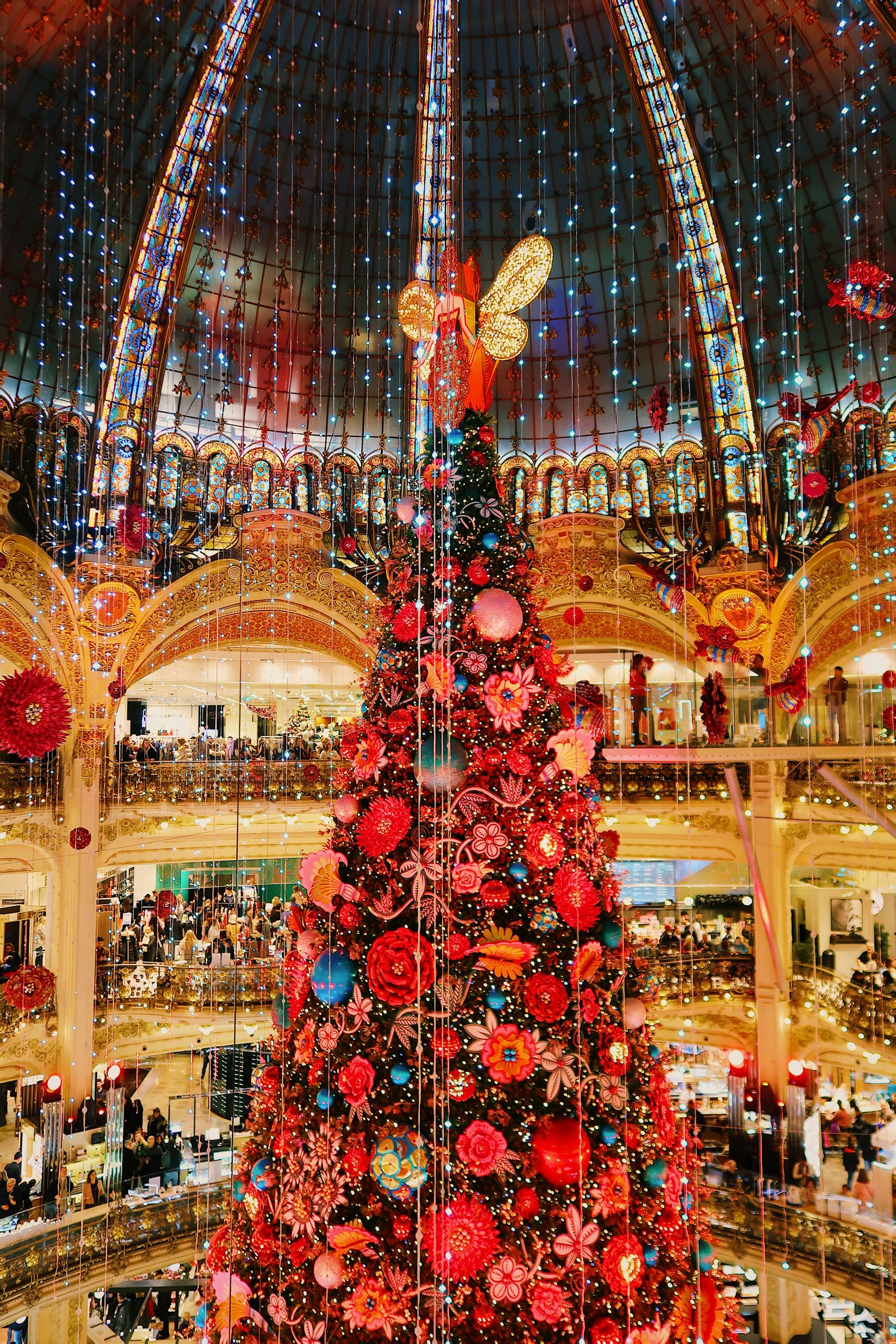
Christmas in
France
Celebrated: December 24 (Réveillon) through December 25
Signature traditions
- 1.Le Réveillon, a long, late-night feast on Christmas Eve, often lasting past midnight
- 2.Building an elaborate Provençal nativity scene with santons (small painted clay figures of villagers)
- 3.Attending midnight Mass (Messe de Minuit) on Christmas Eve
- 4.Children leaving shoes by the fireplace for Père Noël on Christmas Eve
- 5.Burning a Yule log in the fireplace and serving a Yule log cake (bûche de Noël)
What's on the table
Réveillon feast and bûche de Noël
The Christmas Eve feast features oysters, foie gras, smoked salmon, capon or turkey, and a procession of cheeses. Dessert is the bûche de Noël, a sponge cake rolled and frosted to look like a log.
The iconic decoration
The crèche provençale
In Provence especially, families build elaborate nativity scenes with santons, small clay figurines representing not just the holy family but the whole village (the baker, the fishmonger, the gendarme).
How gifts are given
Père Noël leaves gifts in children's shoes by the fireplace on Christmas Eve. Père Fouettard, his darker companion, leaves coal or a switch for misbehaving children.
But who delivers yours?
There are eight cultural Christmas gift-givers around the world — Santa Claus, La Befana, the Yule Lads, Ded Moroz, Sinterklaas, the Three Kings, Christkind, and Joulupukki. Take the 6-question quiz to find out which one matches you.
Take the gift-giver quizDid you know?
The bûche de Noël (Yule log cake) emerged when fireplaces shrank in 19th-century Paris and families could no longer burn an actual log, pâtissiers turned the tradition into pastry instead.
The shape of the season
French Christmas, Noël, is built around a single ceremonial meal: le Réveillon de Noël, the Christmas Eve feast. The rest of the season (Advent calendars, the tree, the lights on the Champs-Élysées and in every village square, the marchés de Noël) all builds toward this one dinner, which begins late on December 24 (often 9:00 or 10:00 PM) and runs past midnight, often closing with a return from Midnight Mass at 1:00 or 2:00 AM.
The season's structure is more compressed than the German or British versions. December 24 is the high point. December 25 is a quieter family day with a long lunch. December 31 is le Réveillon de Saint-Sylvestre, a separate New Year's Eve feast. January 6 is the Epiphany, observed with la galette des rois (Three Kings cake) but not a major gift-giving day.
What distinguishes the French season is the seriousness with which the food is treated. Christmas Eve in France is one of the most elaborate meals of the year, a multi-course production that French households start planning in November and shop for over the final two weeks.
Le Réveillon de Noël
The Christmas Eve dinner is the moment all of French Christmas turns on. Structurally, it's the same as a French wedding banquet in miniature: an apéritif with champagne and small bites, an opening course of luxurious starters, a main course, a cheese course, a dessert, coffee, and post-dinner digestifs. It runs four to six hours.
The canonical opening:
- Foie gras: slabs of goose or duck liver pâté on toasted baguette or pain d'épices (spice bread), with a sweet onion confit or fig jam. This is the most iconic Réveillon starter and a near-universal presence on French Christmas tables.
- Oysters: usually a large platter of half-shells from Brittany or Normandy, served with lemon, mignonette sauce, and rye bread. France imports a huge volume of oysters specifically for Christmas; the four days before December 24 are the busiest of the entire oyster trade year.
- Smoked salmon, typically Scottish or Norwegian, served sliced thin on blini with crème fraîche.
- Lobster, langoustines, or scallops: shellfish at this meal is luxurious; the prices double in supermarkets during Christmas week and people pay anyway.
Then the main course, which varies by region but consistently leans extravagant:
- Capon or stuffed turkey: chapon is a castrated, fattened rooster, the original French Christmas bird and still the most traditional. The version filled with chestnut stuffing (aux marrons) is the classic preparation.
- Roast goose, an older tradition, less common today but still seen.
- Game: venison, boar, or duck, often in elaborate sauces.
- Roast beef tenderloin, where modern households increasingly pivot.
Sides lean simple: chestnuts, mushrooms, roasted root vegetables, potato gratin.
A long cheese course follows, with five to eight different cheeses from across France: Brie de Meaux, Comté, Roquefort, a goat cheese, sometimes a regional specialty from the host's home region.
Then dessert, which in France means the bûche de Noël.
La bûche de Noël
The French Christmas dessert is the Yule log, a rolled sponge cake filled with buttercream or ganache, frosted to resemble a log of wood, often decorated with meringue mushrooms, marzipan holly, and a dusting of cocoa powder for "bark." Every French pâtisserie, from the most modest village bakery to Pierre Hermé in Paris, sells bûches in December.
The flavor has evolved. The classic version is chocolate-and-coffee buttercream rolled in a chocolate sponge. Modern pâtissiers compete each year on increasingly elaborate flavor combinations: pistachio-raspberry, salted-caramel-pear, vanilla-chestnut, exotic-fruit, even savory-influenced versions with elements like saffron or olive oil. Top Paris pastry chefs publish their year's bûche design in November and take pre-orders that frequently sell out.
For home cooks, supermarket bûches in the freezer aisle are common, but a household that takes Christmas seriously orders from a pâtissier a week in advance. The bûche is presented at the table whole and sliced ceremonially, with great attention paid to the cleanness of the cut and the visible cross-section.
The crèche and the santons
French Christmas decoration centers on the crèche, the nativity scene, much more than the tree. The crèche tradition is particularly Provençal: in southern France, especially in Provence, Christmas crèches feature santons (Provençal for "little saints"), small painted clay figurines depicting not just the holy family and the three magi, but the entire population of a Provençal village.
A traditional Provence crèche includes the boulanger (baker), the meunier (miller), the lavandière (washerwoman), the pêcheur (fisherman), the tambourinaire (drummer), the curé (priest), the chasseur (hunter), the ravi (the "amazed one," a figurine of a man standing with arms raised in wonder), and la bohémienne, the wandering Romani woman. Some elaborate Provence crèches contain 50 or more figurines, arranged in a built landscape with mountains, fields, a stream, and the village of Bethlehem all visible.
Santons are still hand-made by family workshops in Provence, most famously in Aubagne and Marseille, and have been since the late 1700s, when the tradition emerged during the French Revolution when public Christmas displays in churches were banned and families brought the nativity into their homes instead.
Outside of Provence, French Christmas decoration is somewhat more restrained than American (a tree, lights, candles, perhaps a wreath on the door) but the crèche remains the symbolic center.
At the table beyond Réveillon
The 24-hour gap between Réveillon on Christmas Eve and Christmas Day lunch on December 25 is not as elaborate. Christmas Day lunch is often a more relaxed meal: leftovers from the night before, perhaps a second simpler roast, the cheese course continued. Many families spend Christmas Day quietly, reading, walking, or watching films.
A distinctively French ritual: le pain d'épices (spice bread) appears throughout December, a dense, dark, honey-and-spice loaf served sliced with butter, sometimes with foie gras at the apéritif, sometimes as a tea-time snack. It's especially associated with Alsace, where the German and French Christmas traditions overlap.
The drink throughout: champagne for the apéritif and toasts, Bordeaux or Burgundy red with the main course, Sauternes or Champagne again with the cheese and dessert, Cognac or Armagnac afterward.
The Provençal 13 desserts
A particularly Provençal tradition: after the Réveillon dinner, southern French households put out les treize desserts, a spread of thirteen sweet items representing Christ and the twelve apostles. The exact composition varies but commonly includes:
- Two nougats (white and dark, representing good and evil)
- Dried figs, dates, almonds, and raisins (the "four beggars," representing the four mendicant religious orders)
- Fresh fruit: clementines, apples, pears
- Calissons d'Aix (a Provençal almond-and-candied-fruit confection)
- Quince paste
- Honey-and-olive oil sweet bread (pompe à l'huile, also known as fougasse d'Arles)
- Chocolat noir
- Candied fruit or grape jam tartlets, depending on the family
The 13 desserts remain on the table for three days after Christmas Eve. Guests pick at them through the holiday. The custom is authentically Provençal (northern French households rarely observe it) but the tradition has spread enough that some southern French restaurants outside Provence now offer a 13 desserts plate during the season.
How gifts are given
Père Noël delivers gifts overnight on December 24. Children leave their shoes by the fireplace (the traditional French version) or under the tree (the modernized version) and find gifts there on Christmas morning. The French Père Noël is dressed largely like the American Santa Claus now that the imagery has converged, but historically he was depicted in a longer red robe, more like a bishop than a sleigh-driver.
In Alsace and other eastern French regions where German influence is strong, le Christkindel (the Christ child, a winged angelic figure) delivers gifts on Christmas Eve evening, before the family heads to Midnight Mass, paralleling the German Christkind tradition.
Gift volume is modest. Adult-to-adult French gift exchange is often a single thoughtful item rather than a pile; children's gift piles are smaller than American but increasing.
The Epiphany on January 6 is observed with la galette des rois (Three Kings cake: flat, round, made with frangipane), but it's a cake-and-coffee gathering rather than a major gift-giving moment as it is in Spain or Mexico. A small ceramic figurine (la fève) is baked into the galette; whoever finds it in their slice wears a paper crown for the rest of the day.
If you wanted to borrow this tradition
Import the late-night Christmas Eve dinner before anything else. The American convention of a quick Christmas Eve dinner before bed (because Christmas Day is the "real" meal) wastes the night. The French model, a multi-hour elaborate dinner starting at 9:00 PM, running past midnight, returning home from Midnight Mass to the cheese course and bûche, produces one of the most memorable meals of the year and shifts Christmas's center of gravity to the evening, which is when the season actually looks best.
A simplified American version: champagne and oysters at 8:30, foie gras and toast at 9:00, a roast at 10:30, cheese at 11:30, bûche at midnight. Then bed; Christmas Day is unhurried by design.
The bûche de Noël is widely available now in American patisseries and even higher-end supermarket bakeries. Ordering one as the Christmas dessert (instead of the typical American pie or sheet cake) instantly upgrades the dessert moment and gives the table a clear visual centerpiece.
The Provençal crèche is harder to source in American shops but a single hand-painted Provençal santon, ordered from one of the Aubagne workshops or via Etsy, becomes a treasured object that you add to year over year. Building a santon collection over five or ten years produces a family Christmas heirloom.
Did you know
- France is one of the world's largest consumers of oysters per capita, and roughly half of the country's annual oyster consumption happens across the year-end holiday season, from the run-up to Christmas through New Year's. The Brittany oyster trade essentially keeps its books based on those few weeks.
- The Pierre Hermé Christmas bûche, his annual signature design, typically retails for €60-90 in his Paris shops and sells out within hours of release each November. The same goes for the bûches at Ladurée, Hugo & Victor, and other top patisseries.
- French Christmas markets, the marchés de Noël, were originally an Alsatian tradition imported from neighboring Germany. The Strasbourg market, the oldest in France, has been running since 1570, making it one of the oldest continuous Christmas markets in Europe.
More from Europe



Bring a little of it home
Borrowing one tradition from somewhere else is how most of the traditions on this page started.
Free AI tool
See your own home decorated
Upload one photo and watch your room or house transform, before you buy anything.
Interactive map
All 41 countries
Gift-givers, feast tables, and the surprising customs most articles skip.
City guides
Lights worth the drive
The best displays in 40 US cities, including the free neighborhoods.
More Christmas traditions across Europe
Christmas ideas for your own home.
Seasonal decorating tips and the occasional new tool, straight to your inbox. One list, no spam.